


Ari was born in a community of survivalists living on an island somewhere off the coast of Canada. When the community’s founders are killed, the narrator-protagonist is on the cusp of puberty and forced to make do with two other survivors, Heiko and CeCe. Filling their days by doing what is needed to survive in the wild, all three navigate how to live as a new family unit. In Peter Rock’s new post-apocalyptic novel, Makeshift, they are made sisters by this shared experience.
Whatever end-of-times catastrophes gave birth to the novel’s initial status quo don’t really matter, the reader quickly discovers. The titular community is gone and the three sisters have to find shelter from a storm, an ethos that animates similar post-apocalyptic narratives. This setup might feel familiar, given the subgenre’s popularity in novels, television, and podcasts alike. However, Makeshift still manages to shine in a crowded field thanks to a few canny decisions.
The post-apocalyptic subgenre is, perhaps, popular these days because it reveals anxieties shared by people across the political spectrum. If people on both the left and the right see collapse on the horizon, imagining survival scenarios through novels like Makeshift makes sense. The subgenre also allows authors to approach the world with fresh eyes. The more practiced of fiction writers can skirt cliché by approaching trite subjects with a hue of abstraction or alienation, refreshing the narrative function of objects, places, and relationships. Rock—previously known for the novel My Abandonment (2009), which was adapted into the film Leave No Trace in 2018—achieves just this through a beautifully sensitive narrator. Makeshift is at its best when narrating how food (and its scarcity) have to be constantly considered, and when imbuing a map or a compass with the sparkle of portent needed to make a dangerous, desolate world feel lived in.
Genre trappings are also applied with a light touch; Makeshift deftly intertwines the challenges of survival with the emotional extremes of adolescence. The reader first accompanies the sisters while they maintain shelters, collect water, forage food, and set traps. But the novel then quickly moves on to unearthing a variety of human preoccupations with curiosity: the psychologies of protagonists who are beginning to understand themselves in relation to gender, their bodies, lives lived in kinship with animals, and relationships beyond the nuclear family.
Furthermore, all three named characters are clearly defined. Each one has their own competing or overlapping preoccupations. For example, while Ari wonders how to rebuild what has been lost, Heiko and CeCe are convinced of the futility of returning to anything that might have existed before or outside the island, since they were both born before their community’s founding. The latter two are anyways too busy focusing on the solar powered machines working away at mysterious ends in the forests or hiding from the boats of foreigners that keep circling the island. CeCe, the eldest and de facto leader, is also spending time away from the group, having sporadic meetings with some unknown party. And there is also that one other kid who might still be out there somewhere.

On the novel’s horizon, beyond the few details shared above, lies a more complicated story, one with a handful of sneaky-but-satisfying twists. These give the reader’s feelings room to change, grow, or evolve. While caught in the morass of vividly painted teenage feelings and an efficient survivalist plot, larger questions emerge. What makes Makeshift’s characters sisters? How much should they take from the land? Can one ever truly give something back to the land?
FICTION
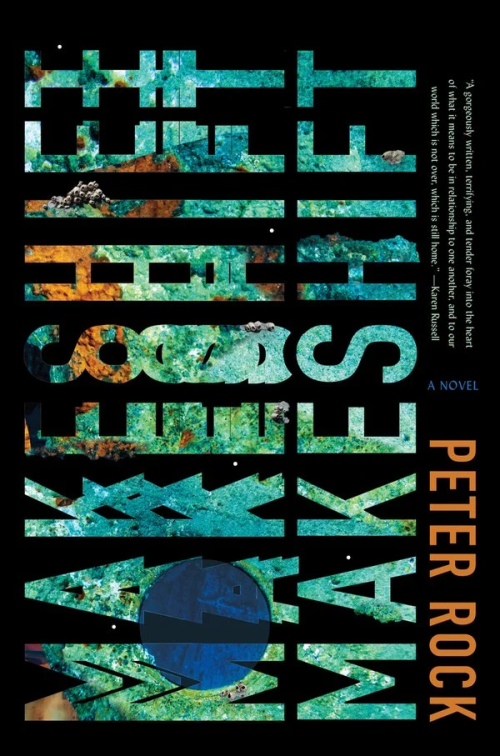
Makeshift
By Peter Rock
Soft Skull
Published August 25, 2026


