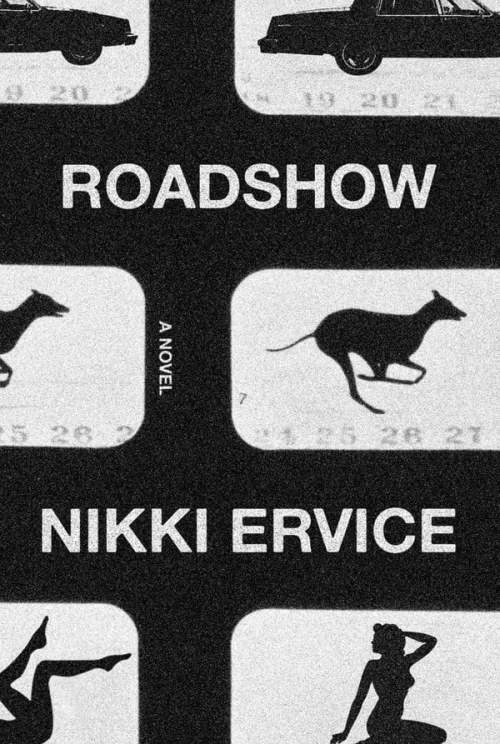
There are too few novels by New York-based MFA graduates that explore the anxieties of working people. Roadshow by Nikki Ervice is one of them. In this debut novel, Ervice delivers an affecting family tale and entertaining road-trip story that in spite of its flaws engages honestly with life at the economic margins. More than this, it captures a drive for human connection that is often most pronounced in society’s fringes: motels, strip clubs, and far-flung villages in Alaska.
Annie Juric is an exotic dancer and waitress living in New York City. At Club X, a raucous burlesque club, she performs as The Dog-Faced Girl, a routine involving a papier-mâché mask modeled after her childhood mutt. A struggling artist, Annie has no outside support: she works long hours and returns each evening to a stuffy, cockroach-infested apartment.
One day, a letter arrives. Vera, Annie’s mother, is dying and wants to reconnect. She has returned to Annie’s childhood community on the Alaskan coast and seems remorseful over having abandoned her as a child. Egged on by her not-boyfriend, Annie agrees to embark on a transcontinental road trip to Alaska, sleeping in parking lots and keeping herself afloat by dancing in small-town strip clubs.
Roadshow is weakest at its opening. Narrating in close third person, Annie is a sharp observer, but as a character she is frequently tepid and disaffected. She is a little too “cool,” and in several crucial, plot-defining moments, other people make decisions for her. The worst example is in Chapter Six: as Annie is conflicted about whether to make the trip, Serge—the not-boyfriend—intervenes and convinces her to go. But because the reader knows almost nothing about Serge, his motivations are illegible and Annie comes off as diffident.
Ervice’s prose is also strained at times, particularly in Annie’s chapters. Sentences like “his preoccupation with himself and his stagnancy in the market of prestige superseded much interest in her outside of her body” are overwritten and awkward for a reader to navigate.
Things improve once Annie hits the road. Ervice splits the narrative into two alternating threads: Annie’s exploits on the road and a series of emails in which Vera recounts her life, by way of an explanation for why she abandoned her daughter. Vera’s voice is well-executed and appropriately scattered for a remorseful woman living out her last days. And Ervice has a talent for allowing Vera’s ramblings to naturally cohere into a compelling and funny first-person narrative.
But the novel’s brightest moments come when Annie is fully engaged as a performer. Here, Ervice’s insights into exhibitionism are illuminating: “for all the girls showed, revealed, there was more withheld.” The reverse is also true. Instead of merely separating her from her audience, Annie’s dog mask allows for an intimacy that would not otherwise be possible. Performance implies artifice, being who we are not; however, artifice paradoxically forms new horizons of honesty.
In one of the book’s strongest scenes, Annie gives a lap dance to the patron of an Edmonton gentleman’s club. Confined to a private booth, Ervice captures the mixture of lust, shame, and self-justification that bind Annie and her patron together in an economy of desire. It’s not sexy, but it is intense, haunted by the possibility that the boundary between producer and consumer—the dog mask—might slip.
And slip it does. Roadshow is populated with hair-raising moments of exposure, embarrassment, and the indignities that come with being an entertainer. But it also understands the infinite hope that unites all dedicated artists, or even all working people: “she couldn’t help but suspect that she might be the exception, that she might outwit time, and that bit of willful foolishness, of magical thinking, had kept her going well enough.”
It’s this “magical thinking” that propels Annie and Vera (in their respective timelines) into the punishing industries of the performing arts. In this respect, Roadshow succeeds most as a meditation on work: what we bring to our jobs and what we leave at home. The mythology of personal exceptionalism defines not only their ambitions, but also what they will tolerate to achieve them. It soothes and romanticizes the psychic strain of exploitative labor.
Roadshow stumbles in its execution, but it ultimately finds value in the stubborn, self-defeating hope that makes a working life livable. This is a powerful insight. It makes the novel well worth its deflated opening. More debut literary novels should reckon as seriously as Roadshow does with the triumph and tragedy that come between paychecks.
FICTION
by Nikki Ervice
Astra House

Published on November 10, 2026