


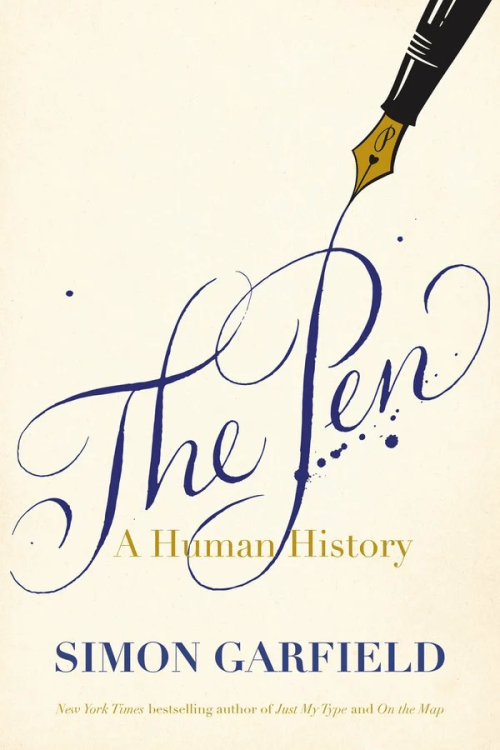
Ordinary objects often blend into the background of our lives. Both humble and mighty, the pen is one of these objects, so common and routine we think nothing of walking off with someone else’s or giving one away. We notice the pen’s absence only when we need it most, perhaps to jot down a thought we want to hold onto, or a phone number we want to pass on. Still, even these uses have become less critical in recent years as we’re just as likely to have digital solutions. This evolution of the pen, from rare and expensive, to cheap and ordinary, to nearly obsolete is the subject of a new history from Simon Garfield, aptly titled, The Pen.
Garfield takes us on a journey through time dating back hundreds of years, though the majority of the book focuses on the more recent centuries. Fountain pens dominate the book, but Garfield structures the narrative in three broad periods. The earliest iteration of the pen includes a look at dipped instruments, such as a quill. This section sets up the next by highlighting the flaws and shortcomings of writing instruments before the invention of the fountain pen.
The fountain pen follows, dominating and upending the industry because of its relative cleanliness and ease of use, and making the pen and writing generally more accessible. Finally, with the invention of the ballpoint pen, the modern era arrives. Garfield carries the narrative to the present too with digital styluses threatening to replace ink entirely. He presents this dichotomy while inquiring about purchasing an expensive, customizable fountain pen. As he and the salesperson run through the options on this pen valued at several thousand dollars, the clerk checks off the choices with a digital stylus on a tablet rather than with ink and paper.
The Pen is a social history, not a technical one. Overall, this story is about changing social norms, new traditions, and the slow reduction in the cost of pens—in terms of actual cost, but also cost of access. And most of this narrative is about the evolution of the fountain pen, or the many fountain pens. The fountain pen has had many inventors in different locations of the world throughout the 19th century. Everyone wanted a better solution to the quill. There are also other early examples of singular one-offs such as one from Egypt dating to AD 970. Primarily, the narrative focuses on the impact of the fountain pen through the 19th and early 20th century.
To understand the mechanics of a fountain pen I ended up watching YouTube videos. The precise methods of how these devices work are less relevant to Garfield’s narrative given his broader interest in the effects of the pen on society, but there are moments where offering a better explanation may have helped. Many of the vignettes in the book follow a formula where a new pen is introduced and then fails for some reason related to the design. This cycle is particularly true as manufacturers attempt to develop ballpoint pens. Overall, we should all be grateful we no longer must have ink-stained hands just to write a letter.
Even casual pen enthusiasts will recognize the brands Garfield digs into like Parker and Montblanc, but there are plenty of other manufacturers better known among true aficionados. The price on some of these pens is shockingly high, but reading The Pen inspires a desire to possess them. There is care given to the specific model numbers in what will surely delight the pen collectors, but is less important to casual pen users. He does make this level of detail more accessible by exploring the depiction of pens through film. Far more people will have seen Kingsman or Indiana Jones than can recall the model numbers of pens, even the more famous ones. For instance, in an examination of both the film and recent television adaptations of The Talented Mr. Ripley, Garfield looks into the prop department’s usage of specific pen models and the appropriateness for the time and place. Forging signatures drives much of the plot, and getting the right pen for the period drama was important.
In later sections of the book, shorter narratives about pens diverge from the broader story. As an example, one tangent explores the tradition of the President of the United States signing legislation with many pens and then passing them out to supporters. Pens that sign a single letter of a signature are imbued with the significant historic moment. There’s no definitive origin, though Garfield hypothesizes that the celebrity of John F. Kennedy helped make the practice more common. The more amusing anecdote is of Lyndon Johnson signing the Civil Rights Act and passing out an unaccounted for number of pens. Many of these have gone on to have significant value beyond simple sentimentality.

Nevertheless, the story of the pen is the story of cheapening it. While plenty of fountain pens cost thousands, the revolution is the low cost and accessible ballpoint. The earliest of these instruments were messy, failed experiments, but once perfected, changed our relationship with pens more generally. As Garfield explains, the “ballpoint has long ago become an unloved item, and an impersonal one, its smudgy paste incapable of individual expression.” And yet, even as pen writing has become more accessible, more common, we’re finding new ways of eliminating it. Handwriting is a fading art. Even keyboards have yielded to touch screens. Garfield concludes The Pen with a breakdown of how much of the manuscript he wrote by hand versus using his computer. Spoiler: he estimates less than a third of the manuscript was written with pen.
The Pen offers keen insight into how the evolution of this essential tool has changed our relationship to writing, particularly emphasizing the previous two centuries. The book is amusing, framing the narrative through accessible vignettes and anecdotes, but also concerned with specifics more obsessive readers will find of value. Garfield makes clear too that he has a deep affection for the pens he writes about, and that joy comes through his text. Pen collectors will find a tribute to their passion, and for regular consumers, a deeper reflection on an object we mostly take for granted.
NONFICTION
The Pen: A Human History
By Simon Garfield
Crown
Published November 3, 2026


