


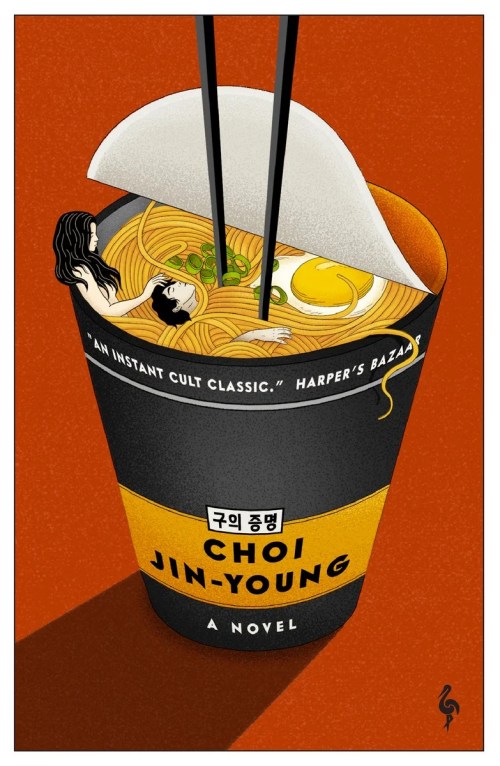
The fundamental brokenness of our world takes center stage in Choi Jin-Young’s daring novel Hunger, translated from Korean by Soje. In this novel, which became a cult classic in the mid-2010s in South Korea, a woman named Dam sees her partner dead in the road and decides that instead of turning his body over to authorities or cremation, she will eat him.
The novel flashes backwards from there. Dam and Gu grew up neighbors, students in the same school, and loved each other from before they hit puberty. Their connection was so intimate that they didn’t need communication to understand each other. Which is important, because communication in their society feels impossible. The weight of responsibility, of the pressure to not worry or trouble others, means that Gu and Dam are constantly swallowing their feelings in front of family members and coworkers, forcing themselves not to cry unless they’re with each other. Dam holds in sobs one night as her aunt sleeps, in order to not wake up the woman who works so hard to provide for her. Gu avoids going into his apartment one night, seeing that the light is on, because he doesn’t want his parents to feel they can confide in him.
Which brings us to the other theme of the novel: the heavy responsibility of debt, of burden, and of the need to provide. Dam’s parents are saddled with tremendous debt, and he knows this from early in his childhood, knowing his job is to someday grind himself to nothing in order to help pay an endless debt that seemingly never runs dry. Gu struggles to feel as though she deserves the hard work her aunt puts into their survival. From their youth, neither is able to fully relax, or connect with others, because they know their body is expected to be productive. Their bodies are reduced, as they grow up, to how much they can generate. The investments into their childhoods are themselves debt; they are expected, by society and by their own selves, to earn that investment out, to support the adults in turn.
But death and loneliness lurk behind every turn. The weights of debt and responsibility seem to zap Gu and Dam of their humanity. As readers soak up their story, they feel a similar weight sink into their stomachs. Choi has written what feels like a tragic elegy for a generation in a world that grew up in a grimly capitalist society and no longer feels like they amount to anything outside of their productivity. Dam feels that consuming Gu is the only way to keep them together, because the body, not the soul, is where our humanity is sized up and weighed. In this oppressive world, their bodies were constantly offered up for others to consume. People they love die before they have any chance to retire, to live for themselves rather than for others, to take their body out of the endless system of productivity and consumption. So what, then, are they working so hard for? Why does our value as bodies continue to be reduced to how hard we work, and how much we owe?
This is why Dam’s rebellion is to consume Gu herself, to not allow anyone else to benefit from his body, to allow no exploitation to occur. Even burial, cremation, costs money; she refuses those costs. She wants Gu’s body to remain pure, and her consumption will keep it that way. Is that human? She isn’t sure. She doesn’t know whether any other person or law would allow her to consume her love. But she knows that this is better than being human, if being human would mean offering up his body to be burnt away. In this way, Choi’s novel is a blistering, emotional condemnation of where we are today, and what we are raising our youth to become. These young teens grow up under the weight of responsibility and guilt, told to grind themselves into the dust; but many of the adults in their lives admit that they, too, are still grinding, in what may be a never-ending cycle of work. There’s no promised reprieve for this generation, only a promise to produce labor and gather money in order to survive.

The novel’s popularity stands as a sign that many of our young people identify with this devastating verdict, even as they yearn for the one genuine connection of the novel: the deeply romantic solidarity between two people who refuse to accept the world around them. Dam’s aunt dedicated herself to hard work to provide for Dam, and was destined to never get the chance to rest; Gu’s parents saddled him with incredible debt; their only other relationship that means more than the two of them is cut tragically short. Only in each other do they not need to work to communicate. In a society where being human seems to mean grinding yourself to the bone, Dam thinks to herself that it’s ok if eating Gu makes her inhuman in the eyes of others. She doesn’t want me to be human anymore, something to be consumed, and she doesn’t want Gu to be consumed: she’s going to consume instead, and keep him closer than anyone else could. A powerful, if often painful, novel.
FICTION
Hunger
By Choi-Jin-Young
Translated from Korean by Soje
Europa Editions
Published May 12, 2026


I’m excited to explore this book further