


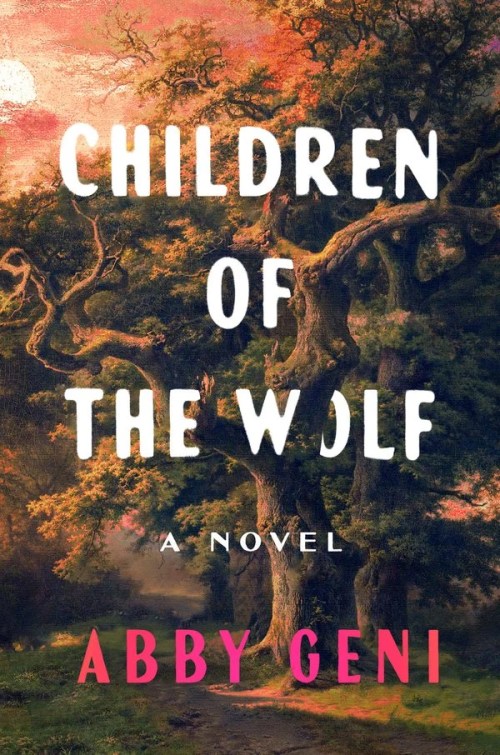
In Children of the Wolf, the new novel by Chicago-based author Abby Geni, the ominous prologue teases a story of murder, secrets, and chaos. The novel jumps immediately to the narrator’s past to reveal the disturbing childhood of Liv and Finn, the children of the wolf. Young Liv recounts horrific memories of violence and a life dominated by her abusive father, a modern-day Viking, Ulf (translation: wolf) Thorvaldsson. Told with a backdrop of untamed nature and Norse tradition, the story feels mythic or fablelike at times as Liv tries to make sense of her obsessive father, a mysterious dead mother, and a locked basement door.
The novel opens with Liv’s earliest memory. When she’s four, she helps her seven-year-old brother Finn mop suspicious red “paint” from the living room floor, douse it with lye, then burn their clothes. Raised in isolation in rural Iowa, the children roam freely on a vast forest-filled land enclosed by razor-sharp barbed wire and peppered with unmarked graves. Ulf teaches the children the traditions of their Viking ancestors and trains them in the battle tactics of warriors. But Ulf is mercurial, prone to rage and regularly knocks Finn unconscious or cuts him during sword play. Liv learns to stitch her brother’s wounds, to wield a knife and keep house in the tradition of their Swedish ancestors. Sudden phone calls take Ulf away from home for indeterminate lengths of time during which the children have to fend for themselves. When Ulf returns, he locks himself in the basement where high-pitched squeals and guttural moans can be heard. Liv may be too young to understand what is going on and admits her memories are fuzzy but the reader, and Finn, know Ulf is up to no good and the children of the wolf are not okay.
The story really gets moving when Finn turns his father into the authorities. The FBI raids their home, the children are taken away, and their serial killer father is imprisoned for life. Twenty years pass and the siblings have created a quiet, rural life of beekeeping in Haven, Michigan. But when several local men go missing, fear disrupts Liv’s attempt to heal. She compulsively checks and rechecks the prison database to make sure her father has not escaped. Her paranoia grows when she takes a lover with a mysterious past, a woman who lives alone in the woods, and has a locked room Liv is forbidden to enter. As secrets are revealed, Liv’s memories bleed into an inescapable legacy of violence and an obsessive love that brings her face-to-face with her father once again.
Stories of child abuse are always a tough read, but throughout the novel Geni juxtaposes the horrors of Liv’s childhood with the beauty of the natural world and the epic fantasy of Norse myth. Liv simultaneously recalls splinting her brother’s broken arm, the sweet smell of lingonberry jam and the honey-scent of beehives. The bee metaphor swarms in and out of the story, as beekeeping is the family livelihood. Like Vikings, bees are violent and loyal to their hive. Like humanity bees are fragile, interdependent, inexplicably die yet still persevere.
Liv’s memories are intertwined with Swedish tales of soothsayers, Valkyries, and the promise of Valhalla. At times Geni depicts a pastoral idyll where Liv and Finn swim in the pond and spin fantastical stories of trolls and fairies. Stories and storytelling are integral to Liv’s understanding of her world. Liv is telling a story, carefully curating the details for maximum tension. She frequently interrupts her memories with references to stories and how they are told which contributes to a softer, fablelike feel of the story and lends a bit of unreliability to the child narration.
The characters are rich and the familial relationships complex. Ulf is larger than life, strong, dangerous, and wise like the Viking gods of his stories. Yet he also displays gentleness. He reads to his children for hours telling epic sagas of Viking gods and warriors. He weaves flower crowns for Liv and braids stems into his beard to celebrate Midsommar. He rollicks with laughter at his own jokes, caresses Liv’s face with praise and meaningful endearments. Shielded from the worst of Ulf’s violence by Finn, Liv idolizes her father’s physical strength, his bravery and longing for Valhalla. Liv and Finn are resilient and share a sibling bond that fuels their survival. Young Liv’s voice is innocent, and the frequent retrospective insight of adult Liv signals a brighter, albeit unusual, future.

Geni’s novel is both a page-turning thriller and coming-of-age tale of epic proportions. The power of her narrative is more than the salacious plot of Viking lore and childhood trauma. The unique familial relationship, Liv’s loss of innocence and Geni’s lush description of the natural world are immersive and heartbreaking. Thematically, “Children of the Wolf” depicts violence in all its forms, the unredeemable violence of abuse, the necessary violence of survival, the animal violence of the natural world and the inevitable violence of revenge and justice. Geni creates a fated sense of nurture’s imprint on nature where Liv cannot escape her legacy. The novel poses major thematic questions. What are the limitations of love, loyalty, and forgiveness? Is violence ever justified? Can you heal from an abusive childhood? And finally, how does normalized violence shape our values and the choices we make? The novel is gripping, not for the faint of heart and will leave you wondering if these children will ever be okay.
FICTION
Children of the Wolf
By Abby Geni
Ballantine Books
Published September 15, 2026


