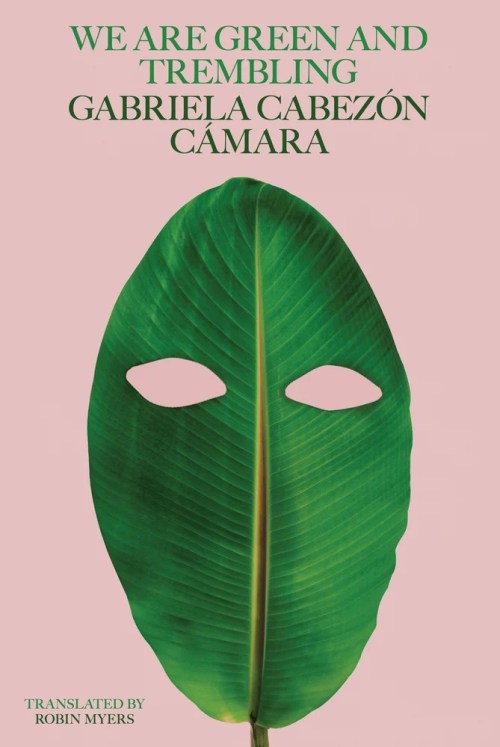
Representation matters. How we see ourselves reflected in media—especially in so-called highbrow cultural forms—shapes our understanding of the world we inhabit, the communities we belong to, and the symbols we use to construct meaning. It also reveals how others see us: how art and media can reinforce stereotypes, or, at worst, convey cultural ignorance and bigotry under the guise of appreciation or critique. If representation feels more urgent now than in past eras, it is because the channels through which it circulates have multiplied. Each generation experiences its own turbulence, but today’s volatility feels both uniquely modern and painfully familiar. That’s what makes Gabriela Cabezón Cámara’s We Are Green and Trembling (translated from the Spanish by Robin Myers), a novel set in the seventeenth century, so profoundly resonant with our current moment.
At times a swashbuckling tale of conquest laced with magical realism and surrealism, We Are Green and Trembling is historical fiction in name only. History, in Cabezón Cámara’s hands, becomes a Trojan horse: a device for interrogating the present by revisiting the past. The novel centers on a real historical figure, Antonio de Erauso, who, like his fictional counterpart, was born Catalina de Erauso. The question of trans representation—particularly urgent in an era witnessing a resurgence of regressive politics—forms a central concern. Legislation aimed at restricting gender identity expression, such as limitations on pronouns and chosen names, represents an attempted erasure of queer existence under the banner of tradition and biblical fundamentalism.
As Catalina, Antonio was confined to a convent under the supervision of her aunt, the prioress. The convent soon became a prison, both literally and symbolically. Antonio escapes and begins a process of transformation, drawing on lessons learned in religious life. His journey—from convent escapee to muleteer, cabin boy, soldier, and secretary to a grotesque conquistador—mirrors a continual act of becoming. Antonio’s shape-shifting identity challenges not only the gender norms of the seventeenth century, but also those of our own time. Through his character, the novel interrogates fixed notions of masculinity and the often rigid expectations imposed on trans identities.
In The Lieutenant Nun: Transgenderism, Lesbian Desire, and Catalina de Erauso, scholar Sherry Velasco notes that when the historical Erauso petitioned the Spanish Crown for a soldier’s pension, the request also included permission to continue living as a man. The petition was approved, justified by Erauso’s noble lineage, distinguished service, and celebrity status. Yet, even as the Crown confirmed the pension, the final line of the decree read: “It is advisable she returns to wearing women’s clothing.” This contradiction underscores the tensions between public valorization and private policing of gender.
A queer picaresque, We Are Green and Trembling is both lyrical and linguistically inventive. Its alternating narrative structure and vibrant prose serve to subvert traditional historical storytelling. In one strand of the novel, Antonio writes letters to the prioress—aunt and former jailor—while caring for two young Indigenous girls he has rescued from enslavement and medical experimentation at the hands of a cruel prelate with a “piranha-smile.” Their makeshift camp includes a red dog, two capuchin monkeys, and a horse with her foal. The girls’ curiosity—about God, about oranges—becomes a quiet counterpoint to the violence they’ve endured, as well as a symbol of the resilience of Indigenous knowledge and innocence in the face of colonization. Their survival is a testimony to what endures.
Interspersed with these letters are scenes of horrific violence perpetrated by the Spanish colonizers, often narrated from the perspective of a buzzard circling overhead. One such passage describes Indigenous captives bound and surrounded by sabers and torches, led to a pyre to be burned alive. The flames devour “trees and people” alike, and the bonfire—used to execute “heretics, Indians, and Jews”—becomes a grotesque landscape of destruction: “a pink, waxy lagoon of white skeletons, like stiff trees in a saltpeter bed.” Cabezón Cámara doesn’t merely document historical atrocity; she forces the reader to confront it through visceral imagery and hybrid narration.

Ultimately, We Are Green and Trembling offers a searing critique of modernity’s colonial echoes: a resurgence of far-right ideology, cultural erasure, and gender-based oppression. Through its exploration of identity, history, and resistance, Cabezón Cámara dismantles dominant narratives and power structures. In doing so, she constructs a story that is not only inclusive but also redemptive—anchored in the richness of language, the beauty of the natural world, and the power of storytelling to reclaim what history tries to erase.
FICTION
We Are Green and Trembling
by Gabriela Cabezón Cámara
Translated from the Spanish by Robin Myers
New Directions Publishing Corporation
Published June 3, 2025