


I first met Sarah Wang at the Kenyon Review Writers Workshop. She was fresh from Convent Arts—a residency at a one-time seaside retreat for nuns—and I couldn’t help but try to reconcile her grown up cool girl vibe and witty observations on the limits of cognitive behavioral therapy with the sort of monastic asceticism one tends to associate with nunneries. Kenyon is one of those rare, magical spaces steeped in literary history where writers from all over the world come together to spend a week maniacally generating and sharing new work, talented author-instructors throw prompts at them, and participants are invited to read nightly. When she read from her then-in-progress novel New Skin, the chilling imagery of the opening scene and Sarah’s nimble maneuvers between the realms of horror, humor, cultural observation and family drama, I knew I’d want to read the rest of the novel.
In New Skin, Linli Feng is about to start grad school when she receives a call that pulls her back into her estranged mother Fanny’s orbit. Fanny’s face is collapsing after enduring years of black-market cosmetic procedures in LA’s underground beauty clinics and Linli is still listed as her emergency contact. While Fanny angles to get cast on a reality television series for botched surgery survivors, Linli plans a second escape from her mother’s patterns of dysfunction. Wang’s narrative expands and contracts around the duo, at times creating moments of tight, claustrophobic constriction where the two women are enmeshed then unfurling into an expansive Los Angeles loneliness where mother and daughter are all each other has. Sarah and I tossed questions back and forth in the Spring as she prepared for her debut novel’s unveiling, touching on our writing community, her favorite body horror, and her glamorous beauty routines. This interview has been edited for clarity and length.

Stephen Patrick Bell
How did the first kernels of New Skin occur to you?
Sarah Wang
I wanted to write a coming of age story when I was in grad school, like many young writers and people writing their first books. The first attempts were similarly about a twenty-something lost Chinese American woman in LA doing drugs and wearing thrift-store clothes, but what she lacked that Linli doesn’t is purpose. That previous iteration of the character was a party girl bumming around the city with her female friends drifting from parties to diners, which was my own experience at that age. Subsequent attempts at writing fiction kept this protagonist but her character began to shift slowly, growing perhaps as I grew, but with the same existential longing and displacement. The story shifted from friendship to a relationship hovering in the background—that of her and her mother. When I brought that into the forefront and wrote the mother as having had a facelift, it gave way to a ton of other ideas and possibilities. The writing of this book has been long, mutative, and palimpsestic as I began again and again anew from a blank page over many years.
Stephen Patrick Bell
Did your various workshop and residency experiences shape the novel?
Sarah Wang
I love doing residencies. They did for me what they’re intended to do, I suppose, allowing me to write in intense and furious stretches, though that’s how I usually write anyway. I like using the temporal structure of a residency to give myself deadlines. At MacDowell, I revised my novel and blew through a draft in a month. Workshops can be hugely influential when you’re working on a novel. At Sewanee, I took a workshop with Maurice Carlos Ruffin and he commented on some dialogue I’d written on the reality show that probably read like a caricature (though that’s not how he said it). I rewrote it easily, having been given such clarity by Maurice in a casual way. The time when you’re working hard on a story and thinking about it all the time can be a magical fertile time when people unwittingly drop seeds into the soil of the text and some take root. But timing is also important. Who knows which year you’re going to get into a workshop and be able to go and which writer you’ll work with who’s teaching that year, and what stage of which project you’re going to be working on.
Stephen Patrick Bell
Linli doesn’t reminisce much, doesn’t care to dwell on the past, eager as she is to move forward, so frantic to put space between herself and Fanny. I found there wasn’t a lot of space in the text for my curiosity about Fanny and her past. I love those sorts of frustrating gaps, especially when they complicate the plot – our inability to know Fanny takes on a sharper tone once she’s interested in being cast in a reality TV show. Fanny feels so deeply and naturally deceptive that I wonder how much you, as the author, actually trust her.
Sarah Wang
Unstable stories, ones that shift what readers believe and plots that upend everything you thought you knew, are wildly fun to write. Fanny is in all honesty a mystery to me. There’s something thrilling about hanging out with someone who may take you places you’ve never been and never even knew existed. Maybe you don’t trust this person but you go anyway because it’s more fun to say yes and the unknown is more interesting than what you already know. There’s a dark side to this kind of possibility too. Maybe after you’ve gone, you’ll realize it’s a place you don’t like and never wanted to go in the first place, and maybe even that you’ll never be the same again after having gone. That’s Fanny. Do I trust her? Maybe. Maybe not. But is she like no one else you’ve ever encountered? Absolutely.
Stephen Patrick Bell
Once the plastic surgery angle came to you, what kind of research went into portraying this addiction in New Skin?
Sarah Wang
I always straddle the work of research with doing a lot of it and also avoiding it for fear of being too influenced. I watched a lot of plastic-surgery-gone-wrong shows before I was working intensely on the novel’s reality TV plot. I’ve always been fascinated by body horror and the ways that the body can be pushed to the extreme. I did, however, avoid watching reality TV plastic surgery competition shows like The Swan. Plastic surgery discourse has changed a lot since I started writing New Skin. Previously, people associated it with Hollywood and the facelift scene in Terry Gilliam’s Brazil. Now, there’s so much discourse that it’s hard to keep up with everything in the news, from Mar-a-Lago face to cadaver fat injections and bone-smashing looksmaxxers. I try to keep up with it all for fun. In terms of research for the novel, I also read a lot about illicit plastic surgery clinics and the horrors of what can go wrong in the black-market cottage industries of beauty. Death, certainly, is one risk. A story I’d seen in the news that I kept going back to was about a Korean woman who was a former pageant queen turned plastic surgery addict. When doctors refused to perform more surgery, she began injecting cooking oil into her own face. This left her severely disfigured. What was at stake for her and what did she want so badly that she could never attain? She currently lives alone and rarely goes out, effectively hiding in her home where no one can see her.
Stephen Patrick Bell
What are some of your favorite body horror influences?
Sarah Wang
I’ve always loved Cronenberg. Every film up until Existenz (1999) and also the Crimes of the Future (2022) is incredible. I’ve seen Dead Ringers so many times. The gynecological tools for operating on mutated uteri still haunt me to this day. They’re very Rick Owens, actually. And the amphibian bone gun that shoots a tooth in Existenz—genius. No one does body horror like Cronenberg. I have no idea what compelled him to make all those movies for two decades that didn’t have body horror. It was a great tragedy. But Crimes of the Future has this boy who eats plastic as food and surgery is conducted in front of live audiences as spectacle, as art performance. In fact, that reminds me of a previous iteration of my novel, which had this whole hair transplant subplot. I did a ton of research for that and read about a government program where plastic surgery was offered to incarcerated and recently paroled people as part of a program to study whether or not criminality was determined by certain physical features: a big knobby nose made you a burglar, a scarred lumpy face made you a murderer… low eyebrows, small eyes, a recessed chin. An early procedure on an incarcerated woman took place in a theater in New York City with an orchestra in front of a live audience. The surgeon performed a facelift while people watched, like an opera! Body horror in real life as art. Cronenberg wasn’t making anything up. I also loved the recent Ryan Murphy series The Beauty for more recent body horror. People were reborn from these wonderful flesh sacs after getting a sexually transmitted virus that made them young and hot.
Stephen Patrick Bell
Were westernizing cosmetic procedures a particular interest of yours while you were working on the novel? The racialized contestants end up being grouped in ways that feel inevitable despite, or perhaps because of, the production’s best efforts. What aspects of reality TV does that reflect for you?
Sarah Wang
The history of plastic surgery has been to pathologize nonwhite features and remake a face into one that is “better”—a high-bridged, thin nose; high cheekbones; light skin; big eyes. In other words, features associated with Eurocentric heritage. Fanny says in the first chapter that she started getting cosmetic procedures when she moved to America, where she suddenly felt a sense of difference after immigrating from Taiwan. To write about plastic surgery is to write about whiteness and colonialism. It’s shifting a bit now, though, as beauty standards in the west like having full, plump lips and a BBL are becoming desirable. But that’s only lately. And the recent discourse in Asia rejects the narrative of aspiring to whiteness through plastic surgery, instead arguing that wanting white skin has nothing to do with race but with class—a marker of not having to toil in the fields. Getting double eyelid surgery also doesn’t mean you want to look white. Half of Asians are born with double eyelids. While both these things are true and I welcome a discourse that doesn’t kowtow to whiteness, it doesn’t mean that it’s not without its own problems or that other racialized people getting plastic surgery in other parts of the world aren’t aspiring to the aesthetics of whiteness.
On America’s Beauty Extreme, the competition reality show that Fanny is cast in, I wanted her to find community with people who were like her—both in terms of the botched and the racialized. Her allies on the show are not only people of color but they’re also allies of the heart and mind. Jimmy is a poet. Mercedes is an intellectual. Their antagonists, the other faction on the show, are white right-wing, anti-immigrant MAGA people who hate Fanny for who she is and what she stands for. These dynamics were absolutely influenced by the scapegoating of Asians during covid. In my research for reality TV dynamics, I saw people who were similarly gravitating towards each other. On Survivor, nerds often hung out with nerds, jocks with jocks… not always, but often.
Stephen Patrick Bell
Linli and Fanny constantly trigger each other but they also fall into a pattern that, while it’s often uncomfortable, is very familiar. How have readers responded to their dynamic so far?
Sarah Wang
People can be triggered by their dynamic, and one even said that the freeway scene reminded him of a similar incident involving his grandmother. I think some readers are drawn into their dynamic, hoping that Linli will escape Fanny’s clutches. But by the end, they might have a different understanding of what it means to be beholden to another person and all the complications inherent in that dyad. People have asked if they are codependent. I’m not really a fan of labels or diagnoses in that way. I also want to avoid pathologizing. There’s a danger in using generalized language to determine who someone is or what they’re dealing with. If there are two people at the end of the world who stick together for survival in a landscape where their lives are threatened, would that be codependence? In a lot of ways, for people like Fanny and Linli, who don’t have money or power and who are marginalized in the ways they are, sticking together is about survival and protection. Once, someone asked me what Fanny’s diagnosis is. Imagine reading literature this way, wondering what each character’s diagnosis is. We’re not residents in medical school.
Stephen Patrick Bell
Funny enough, I could see my mother assigning your work to her nursing students, prompting them to profile Fanny and Linli. There’s an obsession with diagnosis in media these days. Competitive therapy is a prominent aspect of the show Fanny is cast in. The other contestants on the reality TV show each come with their own plastic surgery trauma plot. How did you go about shaping these narratives that portray obsessions and needs so different from Fanny’s?

Sarah Wang
I’m interested in the reasons why people want to modify their bodies, and to the extents that they do. We’re all conditioned to desire certain beauty standards, whatever the algorithm is serving us that week, but what makes people buy a new shade of lipstick versus someone who gets leg-lengthening surgery or shaves their skull to slim down their jawline? What makes Clavicular take meth to be skinny and hit himself in the face with hammers to attain a more chiseled bone structure commonly associated in the incel world with Alpha males? The reasons, I suspect, are deeply personal. I know a woman who started getting cosmetic procedures and enhancements after her mother died. A journalist’s brother, who grew up with an abusive father, got red-pilled into the incel community and died after a botched leg-lengthening surgery. I’m not against plastic surgery. In fact, what I portray in New Skin are characters who are both expressing themselves through their bodies and also using plastic surgery as meritocratic labor to ascend their class and attain a better life. Ami is an undocumented immigrant who thinks that if she gets a ‘high-class’ nose, she will attract a high-class husband. Plastic surgery for these characters has to do with wanting a new life, to be changed, to leave suffering behind. It is also what many immigrants want when they leave their homes in search of opportunity. That’s why plastic surgery and immigration are inextricable in New Skin.
Stephen Patrick Bell
Linli is very much a caretaker in this novel and often lacks the support she needs. She’s very focused on Fanny and she’s relatively isolated so we really only see what she’s seeing. The moments that gave some of the most interesting insight into Linli’s mental state are when she is interacting with characters outside of the Fanny/Linli vacuum. How did you think about those moments and where you placed them in the novel?
Sarah Wang
There were editors who wanted me to revise the story and keep Fanny and Linli together throughout the novel—which I didn’t do for very specific reasons. I wrote the beginning to suffocate the reader and then made the decision to rip them apart. Fanny goes on the reality show and Linli is left behind with the wreckage of what her mother has done. If you think that it’s unbearable when they’re trapped together, you’ll be surprised at how much you miss their enmeshment when they’re apart. The novel constantly goes from one extreme to another. Linli has to figure out who she is when she is not in direct relation to Fanny, though of course all of her desires still orbit around her mother.
Stephen Patrick Bell
I remember you reading the opening of this novel at the Kenyon Review Writers Workshop. The room was so charged as you read about the unveiling of Fanny’s collapsing face – it felt like everyone was holding their breath. You broke the tension with a joke, reminded us that this is fiction, gave us permission to laugh, and swept us back into the scene. That’s a feeling that carries through the book, a sense that there’s humor just under the grotesque. Colm Tólbín calls New Skin hilarious. Was levity something you actively thought about throughout the writing process?
Sarah Wang
Humor is something that’s natural to me in both my life and in my writing. If I’m hanging out with you and joking around, that means I really like you and I’m comfortable around you. I like dressing funny on purpose. I have this old Helmut Lang shirt with four sleeves, and a shirt I found at a thrift store with three neckholes. Sometimes I wear a necklace that’s cast from a nose or a necklace I made by threading a handmade clay leg that I got for a dollar on a string. There’s nothing I love more than funniness, especially when it’s absurd, grotesque, excessive, or transgressive. Humor in the novel functions not just as entertainment and comedy but also intelligence and taste. It’s not easy to be funny in writing, and especially literature. To make someone laugh or cry, to be moved through writing—it’s rare. Some readers have said that they were laughing and crying at the same time or laughing one sentence and crying the next. It makes me so happy to hear that because writing New Skin involved the same emotional acts. I was crying and laughing while I wrote it. That’s what’s incredible about writing, when you can transmit what you think and feel into a reader. It’s a haunting, an occupation, a body-snatching.
Stephen Patrick Bell
I know you just came back from the authors guild gala. Did you have a gala-specific skincare routine?
Sarah Wang
I was on a zoom for four and a half hours right up until I had to throw on a dress for the gala and leave my apartment. My beauty routine was something I often do—put on makeup in the car parked around the corner from the venue and then run to the event. That night my dress and jewelry took up the majority of the spotlight. I was wearing this crinkled cotton dress by an incredible designer in LA, Nancy Stella Soto, and a pink chicken-foot Egyptian pearl necklace with matching earrings, which are very Existenz, actually. Chicken foot pearls are made when the implanted nucleus of a pearl sac is ruptured and forms two different pearl sacs. It’s a botched pearl, and it’s gorgeous.
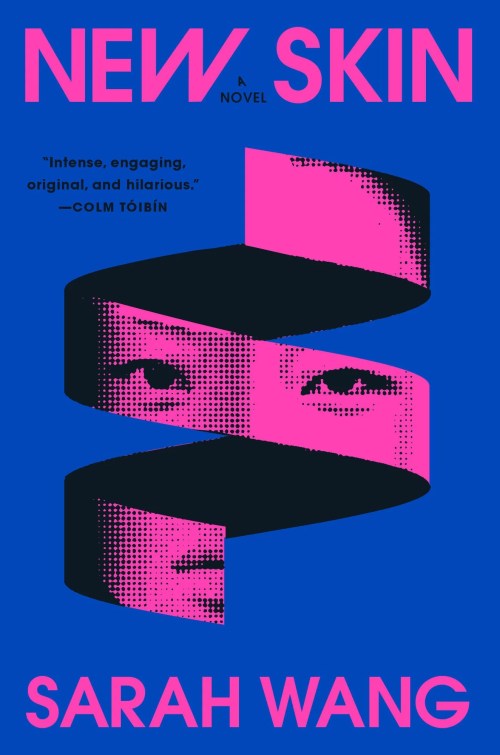
FICTION
New Skin
By Sarah Wang
Little Brown and Company
Published May 12, 2026


