


It’s spring 2007. Alicia Canales Forten feels trapped—in a long-distance relationship, living at home with her mother, and saving up for a future marriage to a doctor.
But a chance encounter with La Garza, an up-and-coming fashion designer, whose epic house parties are the stuff of legend, sweeps her into the bustling creative scene of Brooklyn’s Fort Greene neighborhood. La Garza’s life seems glamorous, capturing a boldness that Alicia has never imagined for herself. When La Garza wants to reconnect with Alicia’s wealthy banker cousin Devon, who is also her first love, their lives become even more intertwined.
Alicia is the first-person narrator in Last Night in Brooklyn, Xochitl Gonzalez’s gender-swapped reinterpretation of The Great Gatsby, set before the 2008 stock market crash. Compared to her previous novel, Olga Dies Dreaming, this book adopts a singular first-person narrator, a distilled version of the epistolary and breadth of perspectives in Olga. But her narrator is different than Nick Carraway. Both narrators are engaged to their evaporating fiancés, which becomes an inciting incident for Alicia, but the depth of their narrative varies, with Alicia inhabiting a weaving of familial history. Gonzalez got fixated on what the character would be like as a Puerto Rican woman telling the story.
“When I got set on doing this gender-swapped notion of Gatsby, I realized that it hinges on two very male things: telling the story without ever implicating any wrongdoing, which so male, and then a man thinking that he can lure a woman back with his material gains. Like, I’m gonna wow her with my success,” she said. “It was two things that never would happen if the narrator was a Puerto Rican woman from Brooklyn. We’re gonna get so much side story, and we’re gonna get it from the beginning.”
The allusion to Gatsby in this novel bears the name of La Garza, Garza, or Gigi to a chosen few. Much like Nick’s encounter with Gatsby, Alicia sees Garza in the wild, rolling down with a shopping cart and being the life of the party. Later, she finds an invitation taped to her door—something only 2007 would elicit a response in. Compared to Alicia’s precarious economic situation, Garza owns her own clothing design business with an eye on menswear and the ability to fill a room when throwing a party.
The foils of Alicia and Garza, who both know Devon, the former’s cousin and the latter’s flame, show themselves in rooms of wealth. Alicia inhabits both worlds—able to code-switch while living in her working-class neighborhood and seeing her wealthy father for two weeks a year at Martha’s Vineyard, said Gonzalez, but Garza can’t, despite her legendary status.
“Alicia benefits from knowing how to speak when in rooms with Ivy League graduates. She went to Yale, and she fit in perfectly because she already knew how these people hung out…that is a kind of capital that most people [who] grow up working class in Brooklyn do not have,” she said. “Garza is much more the person [who] doesn’t have that path and rarely gets into those rooms.”
Where Garza is the glamour of putting on a show, Alicia possesses the rich first-person narration, but with a curated caution to not share much about her family out loud—her summer fling Matteo, the moral compass of the novel, becomes the first man to visit her grandmother’s house.
Much like Alicia, author Xochitl Gonzalez once spent her last night in Brooklyn before departing for the Iowa Writers’ Workshop to earn an MFA in Creative Writing, leaving with the uncertainty of whether she could afford to live in New York again. From the artist’s loft to Garza’s, the apartments of this novel possess their own life, inspired by the earlier coming of artistic age Gonzalez experienced in Brooklyn with her own circle and opening a business in DUMBO.
The evening filled with Puerto Rican food and friends served as a last night in Brooklyn, even though Gonzalez moved back with a New York Times bestselling novel and new release, Last Night in Brooklyn, an ode to the Brooklyn before.
What makes the Brooklyn of Alicia and Gonzalez’s 20’s different than now? This stems from Gonzalez’s inspiration for the novel, after reading a New York Magazine piece that posited DeKalb Avenue as the new spot to hang out.
“[There was a] New York Magazine piece about when everyone started hanging out and on DeKalb Avenue. And I was like, in 1995, guys, like, No, it’s not a new thing. This is just another version of it…. that piece kind of made me start ruminating on the importance of that era and and this notion of like another time when America felt super hopeful and opportunity felt boundless, and so it felt like a good parallel to that kind of pre–Great Depression, like crash time.”

Even though Gonzalez moved back to New York, she’ll never have a last night in Brooklyn like Alicia’s, for the landscape of that Brooklyn has changed, but the pressure the narrator feels knowing the turn history will take with the 2008 market crash adds prescience to the clock.
“The villain of this book is meant to be the invisible hand of the present,” said Gonzalez.
This invisible hand moves Alicia’s narration along at top speed as the entanglement of Devon, married to Marla, and Garza, his first love, unfolds before the eyes of their circle, while Alicia experiences that solidifying summer of the frontal lobe on the streets of Fort Greene.
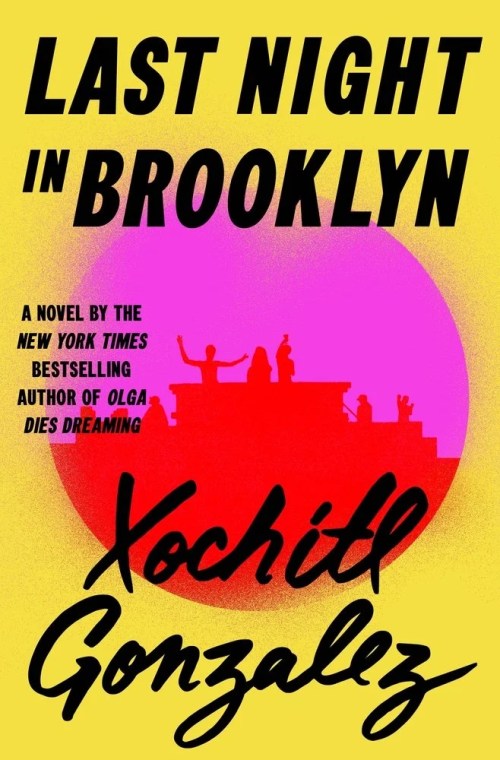
FICTION
Last Night in Brooklyn
By Xochitl Gonzalez
Flatiron Books
Published April 21, 2026


