


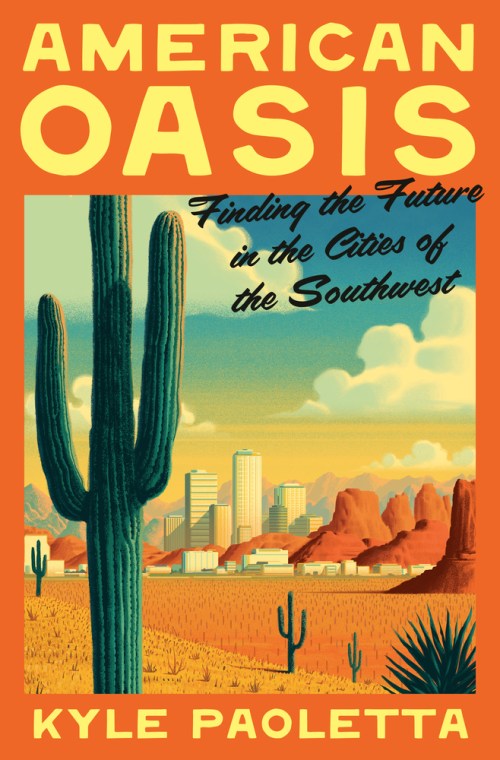
There are few places in the United States seemingly less hospitable to human life than the southwest. Short on water, lacking the verdant greenery of the east, and with few resources or natural geographic advantages, the southwest of the United States nevertheless has blossomed with sprawling metropolises and a steady flow of migration from all directions. In American Oasis: Finding the Future in the Cities of the Southwest, Kyle Paoletta explores how this region, despite the disadvantages, sprouted major cities and sprawling suburbs, becoming a destination for a wide range of people.
The southwest, according to Paoletta, includes a broad area spanning lands from Las Vegas in the north to Albuquerque and Phoenix, right up to the border with Mexico. Though not entirely monolithic in climate or geography or demographics, the arid region is tied together today through the politics of dividing the limited water in the Colorado River and allocated in a complex set of agreements. There’s more to the southwest though than water scarcity. The southwest seemingly provides each arrival a blank canvas allowing anyone the opportunity to build a world they can envision. It’s this aspiration that ties the region together most of all. Paoletta is interested in the history of this place, and various individuals imagined and grew their own utopia. His journey begins before the arrival of Europeans, follows the evolution through the 20th century and up to the present, while also examining each of the major metropolitan regions and how they expanded.
Paoletta helps tie the narrative together too by traveling around the region and adding his own experiences as a way of connecting to the place itself. These interjections offer segues between chapters, as well as into otherwise disparate topics, such as when he is driving past White Sands National Park. “I didn’t realize I was nearing a Border Patrol checkpoint until I saw the red brake lights of a handful of cars that had been diverted… when you’re Anglo and spending a lot of time in the borderlands, these micro-interactions become routine.” Immigration plays a big role in the development of the region, and the ever changing laws about who and how people can come.
It’s impossible to ignore that the southwest borders Mexico and that proximity has long shaped the growth. At one time, Mexican immigrants were encouraged to fill vacant jobs, while treaties like NAFTA shaped industry, and even U.S. Policy on drug smuggling, and the power that gave cartels all impacted the area. Paoletta spends a significant amount of the book looking at the arrival of different groups in the region, including from before Europeans’ arrival to more modern migration. He also points out too how his own ancestors arrived in the east coast, Jewish and Italian migrants, before relocating to the southwest.
The heart of this book, and where the strength of the narrative comes from, is in how Paoletta tells the stories of the individuals responsible for shaping the cities. He identifies essential people responsible for charting the course of each city. The book relates for instance, the rise of Steve Wynne and the growth of the Las Vegas strip, named in honor of the Sunset Strip in Los Angeles. Paoletta hits the major points in Wynn’s rise to power, and what that meant for turning Las Vegas into a destination. But it’s not just the business leaders, but people like Jimmy Santiaago Baca, a Chicano poet involved in civil rights in New Mexico. Like most of America, racial identity and the politics behind it are a major influence over the region’s development. But Paoletta manages to tell these through the personal narratives of individuals, helping to humanize those stories rather than merely looking at them as abstract history.
If there is something lacking, it is in explaining why people choose to live here. There is quite a lot of defending the desert generally, and of pointing out that there is plenty of life and beauty in this part of the world. But along with that, much of the area is inhospitable to large populations and rarely is there a reason, a resource, a river, to tie the population to the specific location. So why did people come? It was the question I most hoped to have answered. I wondered if there was some kind scam, like outlined in Cheap Land Colorado, or whether there had been some logical reason that simply no longer exists. But there isn’t, or if there is, Paoletta doesn’t explain it.
There are hints as to why people might have come, the suggestion they sought opportunity, like in the case of Las Vegas attracting migrants from the Deep South. The city’s Black population grew rapidly, attracting a Black population from the southern states where segregation remained, while Las Vegas was integrated earlier, in part because of the celebrity talent that performed there. But Paoletta doesn’t explore any explicit connection. He’s more interested in what happened rather than the motivations of the people involved.

Perhaps, if there is one reason, Paoletta is putting forth the idea of the southwest as the blank slate. Like a lump of clay, it can be molded however you wish. Paoletta describes Phoenix as having “offered itself to the rest of the nation as an empty page, a place with no history where new arrivals could compose their own story.” But while he hints that the idea of endless possibility motivates people to come to this place, there’s nothing conclusive. There’s a deep accounting of who and what settled in the southwest, but no parallel explaining why.
American Oasis is an extensively researched history of the southwest’s growth and evolution into a major population center. Paoletta wrangles the complex history into a digestible and engaging look at these changes, all while examining the ongoing challenges, including racism, immigration, and water crisis, facing the area today. American Oasis contextualizes a unique region of the world through a personal and economic lens.
NONFICTION
American Oasis: Finding the Future in the Cities of the Southwest
By Kyle Paoletta
Pantheon Books
Published January 14, 2025


