


Lately I’m hearing more complaints about rising gas prices and continued grumbles of how expensive food is, but fewer people talking about healthcare. How expensive it is, how everything isn’t covered. (Who among us doesn’t have a pending medical bill that needs to be paid?) It’s almost like we’ve come to accept crappy coverage as part of life. Dreams of universal healthcare for all are still alive, but muted by the outrage over other issues. We sigh as we collect our bills for tests our doctors decided to run “just to be on the safe side,” wondering when on earth we’ll meet our deductible this year—worrying if we’re one medical emergency away from bankruptcy.
We know the American healthcare system is broken, but I’ve wondered how healthcare professionals see it. What stories they have, how that brokenness might lead to their own burnout. Which is why I was eager to check out Adam Axler’s forthcoming medical memoir, American Triage (Whisk(e)y Tit Books, May 2026). Axler is a former Ground Zero paramedic and physician assistant who quit to become a bookseller, and he chronicles the decline of modern medicine in his memoir. It’s a slim book, but it packs quite a punch. The book is narrated with humor, as well as a healthy dose of the jaded skepticism that comes from working in a broken system.
I had the pleasure of chatting with Axler about his forthcoming memoir and the state of American healthcare via Google Docs.

Rachel León
I knew our healthcare system was broken before reading your memoir, but I still found your stories pretty eye opening. Can you talk about why you decided to write the book and what you hoped readers would get from it? I’m curious if you had a specific goal for the work, or if it was more a chance to turn your experiences into art?
Adam Axler
The book grew out of my field notes, a frustration diary of sorts, over more than 20 years in emergency medicine. But this moment in time feels like the perfect entry point for American Triage. We are commemorating the twenty-fifth anniversary of 9/11 and the return of measles at the same time. Working and surviving 9/11 only made me want to help people more. But over those twenty-five years, our disastrous shift towards pseudoscience has led to diminished respect and increased burnout for healthcare professionals. I would like readers to see our healthcare system through the eyes of someone who dedicated their life to hard medicine. To realize American medicine is broken on multiple levels.
Rachel León
I’d love to hear more about keeping field notes or a frustration diary. Were you capturing the stories to get those frustrations out, almost like an act of self-care, or was the goal to document everything? I’m curious to hear the original reason you began chronicling your work in emergency medicine and when you began to turn that into a book?
Adam Axler
A little of both actually. I learned early on when recording my 9/11 timeline very shortly after that day to keep track of anecdotes and cases that affected me. Stories that even among emergency medicine workers would be shocking. I also wanted a living record for my family, for my girls. The old man drove an ambulance in New York City, pretty cool.
But as you know from your work in foster care, there is also a disbelief element to outsiders. The “did that really happen,” or “how can it be that bad,” if you’re doing such important work? Writing about my experiences ensured my emotional reactions over a twelve-hour shift were real in a way that talking to my wife or friends outside of medicine couldn’t.
I had published a few articles in professional journals, which even led to my PA school (Nova Southeastern University) offering me a professor position. But I wasn’t ready to leave clinical practice at that time. As the burnout meter ticked higher, I shifted to an exit strategy of creating a bookstore, something I could do for the rest of my life.
This second life, as the owner of Collectible Science Fiction, has connected me with so many amazing people. One of those people was author David Scott Hay. We bonded over a love of dystopian writers like J. G. Ballard and Philip K. Dick, then as parents of teens during Covid. DSH sent me his books and introduced me to some other great indie authors as well. I had nothing to lose, so I asked him if I could send him some crazy ER stories and my 9/11 timeline.
Two years later he still says, “DAMN YOU, AXLER!” He was already working on his next project, but knew these stories would make a great book and he introduced me to his publisher, Miette.
Rachel León
Did he help with the editing process then? I’d love to hear about how these stories became a book.
Adam Axler
Yes! I read recently that non-celebrity memoirs are the toughest sell with good reason. There’s a big difference between telling a great story and writing a great story, and David had to knock some bad habits out of me. We decided on a much more active pace like Kitchen Confidential or Post Office, [rather] than something that read as clinical and stiff. Even the hard science chapters are couched in real-life anecdotes.
David also pushed me to personalize my story, whether it was reuniting with my wife, Lori, in our tiny NYC apartment after 9/11, or the panic of delivering a baby in the ER on my first day.
Rachel León
I really loved the balance you struck with the science, personal anecdotes—and the glimpses of your family. Because with such intense, draining work, sometimes it’s the people we come home to who actually allow us to keep doing the work … and in your case, to also escape it.
Adam Axler
I appreciate that. People may not know the sacrifice we make. My PA career began with two months in a cadaver lab and ended with twelve- to thirteen-hour days. Missing holidays and weekends with your family, missing tuck-ins, is hard. And there are some things in emergency medicine you can’t unsee. They change you in bad ways. I’m very fortunate that Lori supported me finding a way out, and I hope that my girls appreciate the extra time we’ve had together these last few years.
Rachel León
What was the experience like of putting those things you can’t unsee onto the page?
Adam Axler
I don’t want to say cathartic, more like an emotional ride. Looking back at some of my notes, I couldn’t believe how upset I was when I had written them. And I didn’t try to recreate that frustration, but let some of it stand. I was also nostalgic for the irrational overconfidence that permeated my twenties, a feeling of invincibility. I talk about that in chapters like Times Square. The reactions from my daughters, my true beta listeners, were at times overwhelming. Knowing both of their parents could have separately died on September 11th.
Rachel León
While I’m hesitant to steer away from the personal, this interview is part of our Reading Your Resistance series so I did want to dive into talking about our healthcare system. You mention how the current Health and Human Services Secretary doesn’t believe in vaccines (which I agree is totally maddening). Are there frustrations about the current state of healthcare that didn’t make it into the book?
Adam Axler
So many. But it was impossible to keep up with the horrible decisions RFK Jr. and his henchmen make on a daily basis. I live in a state where the polio vaccine is now optional. Ask your parents or grandparents what the fear of polio was like in the fifties. You were a pariah if you kept your children from receiving what is widely considered the most or second most important advancement in medical history.
And some were left out intentionally. I was asked to “find a solution” to our crisis in a concluding chapter. But we have the answers, answers that are already in place across the world.
- Women have autonomy over their own bodies. No caveats ever.
- Healthcare is free for everyone.
- Healthcare professionals need a minimum of three weeks of vacation / PTO / mental health days every year.
Rachel León

Amen to all that. But wait, healthcare professionals don’t get at least three weeks of vacation / PTO / mental health days a year?!?
Adam Axler
I talk about this in Triage. When I was a paramedic in NYC, I had so much PTO they actually called me before a shift to stay at home and burn a few days so I didn’t lose them. In order to take any sort of vacation as a PA, I had to essentially work two weeks straight, lump my few vacation days together, and then get slammed with another two weeks upon my return. It almost wasn’t worth it.
Sick days? Despite being exposed daily to every cough and fever imaginable, you were expected to never call out sick. And I didn’t.
Rachel León
Can we dig into those solutions a bit? Let’s start with the first one you mentioned: reproductive rights. We’re in an era where access to abortion—and even just birth control—is largely determined by where you live.
Adam Axler
The same backwards logic has women dying in emergency room parking lots and children dying of measles and Hib (H. flu [i.e., Haemophilus influenzae], a serious bacterial infection that we vaccinate for, not a viral flu) again. You make a great point about this being regional. These decisions affect where people want to raise a family, where doctors pursue a residency, even where doctors continue to practice. We’ve seen states like California simply say, “I’m out.” Don’t take guidance from the CDC or HHS, we’re joining WHO, and women still have access to reproductive care here.
Rachel León
Access is exactly what the second solution is about: accessibility to all people, regardless of income. (I seriously can’t believe this is up for debate.)
Adam Axler
It isn’t in other countries. It’s a basic human right. I’ll use Lenox Hill Hospital as an example again. When I was a medic there in the early 2000s, my medical insurance was free. Adding Lori cost me $14 a paycheck. My last few years as a PA were spent in an urgent care that was eventually bought out by a UnitedHealthcare division. They not only didn’t offer us discounted insurance, they didn’t even offer us a UH plan! The cuts to the ACA and Medicaid at the beginning of this year were meant to be punitive. The joke, unfortunately, is on those who voted to do this. These cuts are effectively wiping out access to healthcare in some areas of our country over the next few years.
Rachel León
So what can we do? I don’t mean to ask you to “find a solution,” but this interview is part of a series with an eye towards reading and resistance. People should obviously read your memoir. Anything else?
Adam Axler
Yes, definitely start by reading American Triage haha! Push back. I thanked doctors and scientists who have had the courage to speak out, to testify before congress, about the dangers of destroying our scientific communities. The least I can do is the same. These attacks against evidence-based medicine, women’s health, and banning books (as my subtitle hints at) are all connected. The people who are taking away important healthcare access and interventions are the same people who have taken away the professional status from PAs, nurses, MSWs, PTs … while simultaneously limiting access to student loans. Don’t think you or someone you love won’t be affected when the bill comes due.
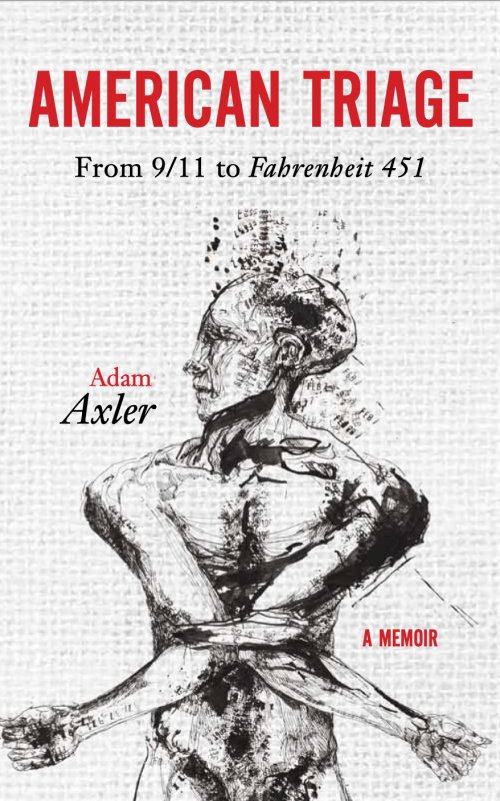
NONFICTION
American Triage
By Adam Axler
Whisk(e)y Tit
Forthcoming in May 2026


