


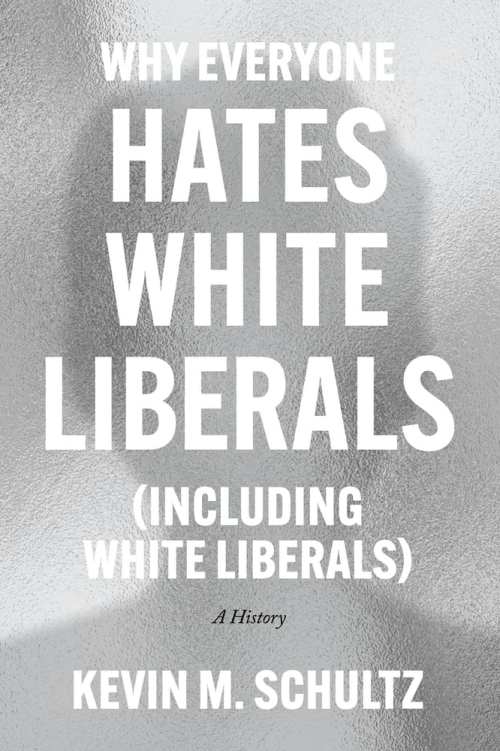
There may be no more urgent time to reflect on what it means to be a “liberal” than right now. The Democratic Party is on its back foot. Younger Democrats are primarying older incumbents. The New York Times ran an opinion piece suggesting Democrats play dead. Meanwhile, the President of the United States is disappearing people without due process and initiating a global trade war. Chicago-based historian Kevin M. Schultz’s provocatively titled Why Everyone Hates White Liberals (Including White Liberals) is a timely reminder of what happens to those who don’t know history.
Schultz takes the reader from Franklin Delano Roosevelt, who began to refer to his New Deal as “liberalism” in 1932, all the way up to former Vice President and 2024 presidential candidate Kamala Harris. Schultz is not here to critique and analyze the substance of the policy debates among liberals or between liberals and conservatives. That’s not the main reason everyone hates white liberals. Rather, this is a book about how white liberals have served as the avatar for a wide range of political concerns. In the introduction, Schultz remarks that “how you define a white liberal says as much about you as it does about them, and maybe more.”
Though our current moment of political polarization and constitutional crises is often thought of as an unprecedented phenomenon, Schultz highlights the people and ideas that our political ecosystem lives downstream of. Before the pejorative usage of “woke” and “DEI” there was “political correctness” and before that there was Nixon’s presidential campaign successfully tying his 1972 opponent George McGovern to a supposed platform of “acid, amnesty, and abortion,” though McGovern was factually not particularly extreme on any of these topics. Today’s Republican Party and conservative movement stand firmly on the shoulders of figures including William F. Buckley, Spiro Agnew, Phyllis Schlafly, Ronald Reagan, Pat Buchanan, Rush Limbaugh, and others who recognized what could be won by uniting their constituencies against the threat of liberals. Meanwhile, today’s Democratic Party faces the same questions about liberalism that its predecessors have been grappling with since the end of World War II: the tension between the centrist establishment and the leftist part of the big tent coalition, the word “neoliberal” being thrown around without clear definition, and debates about whether winning back the favor of the white working class requires halting progress on or even ceding the rights of marginalized groups. Nothing comes out of nowhere, but America as a country does love and sometimes rely on its capacity to forget its history.
Why Everyone Hates White Liberals (Including White Liberals) is a persistent reminder of how much of politics is driven not by economics or morality, but by psychology. The traditional imaginings of the two sides of the American political spectrum seem apocryphal when you evaluate the real behavior of our politicians.
Politics is often about making up a guy and convincing your potential voters to get mad at him. A question that has especially haunted the past three general elections is why people often vote against their own material interests. “A vote for me is a vote for a better America” is evidently not as invigorating or perhaps believable as, “A vote for me is a vote against my opponent.” There is certainly more certainty in the latter.
To conservatives, the white liberal is elitist, godless, bureaucratic, condescending, out of touch, a supporter of “government handouts,” out to destroy family and tradition and scheming to transform America into a communist hellhole. To the left and to many Black Americans, the white liberal lacks urgency, is overly sympathetic to conservatives, accepting of piecemeal reform and compromise, is uninterested in material change that might personally alter their way of life, and embraces consumerist individualism to a detrimental point. Both of these portraits are obviously on the exaggerated and uncharitable side, but they are also both vivid and motivating to their bases—who would want either of those scary made-up guys running their country?
Schultz devotes a solid chapter to the left and another to Black civil-rights era leaders who were frustrated by white liberals for generally more grounded reasons than conservatives, like liberals backing down from big fights including the campaign for a nationalized healthcare system and addressing de facto racial segregation. Much of this book is about how the conservative movement built itself up less through unified ideology and more through unified grievance and opposition. The contrast in the number of evocative, one-word insults that fit in the last paragraph for the conservative portrayal of white liberals compared to the more nuanced leftist one is an excellent illustration of what conservatives have accomplished when it comes to branding.
The “white” in “white liberals” is mostly there to acknowledge the caricature most people are imagining when hearing the word “liberals.” The problem is “white liberals” and also perhaps especially “white male liberals” when diversity or the fight for equality are framed as “special interests.” One has to laugh when a group as massive as “women” can sometimes be counted as a “special-interest group.” Schultz muses that the replacement for the word “liberal” needs to be “vague enough to encompass commitments to the preservation of regulated capitalism and the challenges diversity brings to those commitments,” concisely articulating a key wedge between the left and liberals.

Liberals repeatedly underestimate the power of setting the narrative and so the story of liberalism for more than half a century has mostly been told by their enemies and critics. Operating from a defensive crouch by dodging the word “liberal” altogether, or trying to attack liberalism to establish oneself as moderate, was occasionally successful, but ultimately uninspiring. Schultz astutely observes in his conclusion that, “rather than ground the words in their historic uses, which have changed over time to meet various demands, most of the authors who are invested in rehabilitation efforts have tried to make liberalism simply the way things are supposed to be.” It is both tautological and underwhelming to attempt political persuasion by arguing that one’s own point of view simply makes the most sense and is how things ought to be. This insistence on the sublimation of liberal politics has begun to sour in the public conscience.
What is the Democratic Party going to do about all of this? Being American today means having the privilege, the stress, and the looming threat of a front-row seat to the outcomes of this question. Some current players in US politics have the potential parts for a cogent and compelling new narrative, but someone has to be able to put it all together and sell it to the public. One thing is for sure: if liberals don’t work quickly to reassert their political identity, conservatives will do it for them.
NON-FICTION
Why Everyone Hates White Liberals (Including White Liberals)
By Kevin M. Schultz
University of Chicago Press
Published May 7, 2025


