


Sophie Mackintosh, beloved and known for her speculative storytelling in novels like Blue Ticket and Cursed Bread, is returning this April with her fourth novel, Permanence. Mackintosh is one of those authors whom I remember vividly reading for the first time and wanting to consume everything else she had ever written. Her 2019 debut novel, The Water Cure, was my launching pad into the world of speculative, female-focused reads, and thus when I saw an opportunity to review this new work, I had to take it.
Permanence, at the surface level, technically speaking isn’t looking at anything new. This made me all the more eager to grab it, because if I believe in anything, it’s Mackintosh’s ability to take the mundane and spin it artfully into an unrecognizable web of ideas. What I mean by not doing anything new is the relationship that the story is exploring: an affair, in which the husband is cheating on his wife and daughter with a lively, free-spirited (and notably, single) young woman who finds herself in the helpless position of “the other woman” (see ex: Carrie Fisher’s character in the beginning of When Harry Met Sally). Tale as old as time, right?
These two characters, though, are not in a world that we recognize as our own. While Francis, the husband, and Clara, the lover, are engaging in what can only be described as the most stereotypical affair in the books, the difference is what happens to them as they engage in this illicit affair. One day, after about eighteen months into their romance, the pair wakes up in a city. Not a city recognizable to the world, because it isn’t in the world, not really. The city is a perfect utopia, built to the whims and needs of the couple and all who reside there…all couples engaging in affairs. The city allows Clara and Francis to do something they never have before—be a couple, and to do so publicly. The couple soon finds, though, that there are unspoken rules to the city, and at any moment they can be thrown back into their real lives, helpless to return to the city unless the city wills it so. The boundaries between the two worlds are malleable, and learning to navigate them will pull at the seams of their tumultuous relationship.
Now here’s the thing. Call me a traditionalist, but I do tend to reside pretty firmly in Camp Don’t Cheat On Your Wife You Toad. I also have a residency at Camp Girl You Deserve So Much Better And He Will Never Leave His Wife Please Move On!!! I’m not saying there is never nuance and gray area, but for the most part, those are my stances. Now that you know where I stand on that matter, you can imagine that I was not rooting for the success of Francis and Clara’s relationship. In fact, the more I read, the more I rooted against it. Francis and Clara’s relationship is not unique, it’s a cliché. And it’s a painful cliché too—their love is hidden away because it hurts others, knowingly and intentionally, and both live in the honeymoon state of delusion those embarking on year long affairs do.
But to the city. The city, referred to occasionally as “the city of impermanence” in the book, is the driving point of this novel. It shows itself initially as this bucolic, meandering paradise that has everything the couples could want: delicious food, beautiful parks and museums, and most importantly, no reason to hide. But when temperaments between Clara and Francis begin to sour, as do their surroundings: fruit begins to rot, clouds cover dusty streets, and the place that once looked so welcoming begins to look like unavoidable cracks in their reality.
This place is accepted by the characters as being dream-like or otherworldly, but that’s not to say that there aren’t little invasions across the boundaries. For example, when it’s time for the couple to return home, each receives a wound of some kind that follows them back into the real world. The city quickly takes on the vibe that Christopher Nolan’s Inception does, meaning that the city begins to challenge Francis and Clara’s idea of which world is home and which one is worthy of their stay, though not in the sense that the characters begin to become confused as to which is which.
Clara, from the beginning, wants to stay in the city forever—and why wouldn’t she, given her lack of other commitments? Francis, on the other hand, is of course frequently wanting to return to the real world as he will suddenly remember that he has a child and already-existing partner as well. Francis turns outright mean to Clara at times, calling her childish and self-obsessed when she suggests things like staying forever. He encourages them to “not do this right now” whenever Clara brings up the subject of their future, shushing her like a petulant child. As I said before, not an unfamiliar picture, right?
But the unique aspect that the city brings in its nature of being shifty and inconsistent is that it forces Clara and Francis, and also any other citygoers, to confront what it actually means to be with someone. Not with them in the sense that you live together or are friends, but in the sense that you are with them, day in and day out. You are forced to be with them at all times. (In the city, when a pair separates more than a few feet they feel physical pain.) You are forced to really, truly see them, and are, crucially, physically unable to warp them into a fantasy which they are not. The real point of the city is that it takes away the essential ingredient to the beginnings of any passionate affair: the imagination. No more dreaming of the person, concocting imaginary scenarios or whittling their personality down to your most ideal, most contrary-to-real-life version you want. Even the environment surrounding you mimics the state of your true feelings toward the person—there is literally no running away from your problems, which, at the end of the day, is all an affair really is.

Of course, Mackintosh writes this predicament for Clara and Francis with the utmost lyricism and thought-provoking prose. Despite my extreme distaste for Francis, there were moments where I even ventured to feel a morsel of pity for the man, a feeling I attribute entirely to Mackintosh’s gorgeous writing and zero percent to any action Francis took throughout the book. And Clara, well…she has things to discover, too. The world in Permanence is gripping, disorienting, potent, and alluring. Mackintosh is a master storyteller of the slightly strange and a devout creator of the most inviting dystopias, and this one was a pleasure to explore.
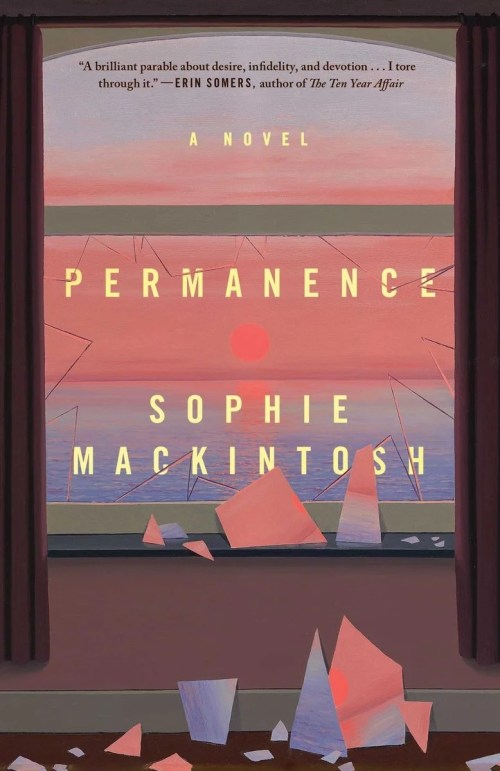
FICTION
Permanence
By Sophie Mackintosh
Avid Reader Press/Simon & Schuster
Published April 21, 2026


