


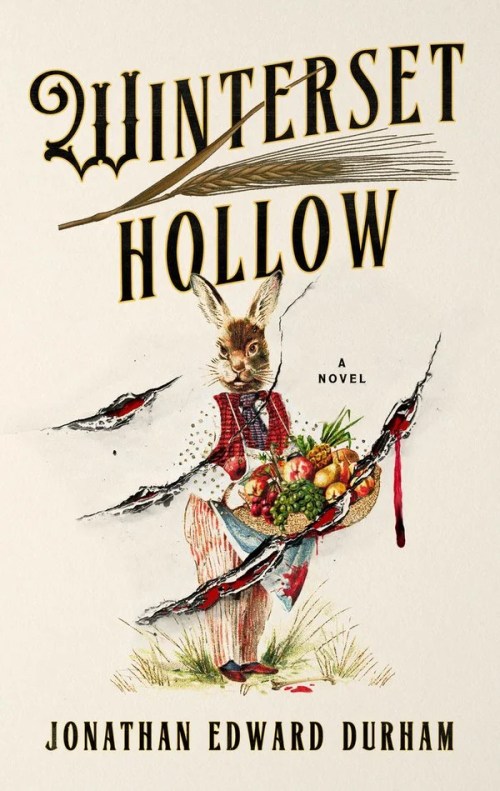
Eamon, a young man in his mid-twenties, is browsing a fan magazine dedicated to his favorite book: a children’s classic titled Winterset Hollow. In the magazine Eamon finds three free ferry passes to Addington Isle, the real world inspiration for the forested location of Winterset Hollow. Winterset Hollow, the fictional children’s book (hereafter referred to as WH to avoid confusion with our actual novel), is a sort of Hundred Acre Woods with its own Winnie the Pooh cast of talking animal characters. It also has dark undertones of war and death as well as a fascination with feasts and food a la Redwall. Eamon, whose father disappeared when he was fourteen, latched onto the book, both fascinated and comforted by it. After finding the ferry passes, Eamon and his friends Mark and Caroline join a crowd of young fans traveling together to Addington Isle.
Alas, as in the tradition of 1980s slasher films, this group of young people are going to find more death than fun on their vacation. This is effectively a slasher film in book format, a thriller that seems to already be asking for the movie deal. It’s a somewhat goofy slasher, no doubt: for the cute animal characters of WH—Runny the Rabbit, Flackwell the Frog, Finn the Fox—are real, anthropomorphic, human-sized menaces that have invited the young people out in order to kill them. This is hardly a spoiler, but rather the conceit of the novel. The animals are fuller characters than, say, those of Five Nights at Freddy’s, with real characterization and some motive behind their decisions.
We can see Winterset Hollow as part of a growing trend of “turning a childish motif scary.” This description is not meant to lampoon; it’s more that we don’t have much of a better term. TV Tropes suggests “Mascot Horror” which feels too limiting, and “Childhood Trauma Core” suggests a more psychoanalytic origin than is necessary. (Wouldn’t childhood trauma suggest that the scariness already started in a childhood event, while the trend this writer is thinking of can involve people of any age discovering that something friendly on the surface has a dark side?) We are seeing this trend, whatever we want to call it, in videogames, film, and now novels. Much of A.A. Milne’s original work is now in the Public Domain, and already we’ve seen two Winnie-the-Pooh: Blood and Honey films released with a third on the way. To face the simple, happy things of childhood turned corrupted, usually in over-the-top, absurd, and to various degrees funny ways, may just be a way of coping with the developments of adulthood. At the same time, the writer of this article believes there is a lot of potential behind these ideas. Are not the Grimm Brothers’ fairy tales already a sublime blend of the childish, the horrific, and the esoterically true? Perhaps the modern works that are making childish things scary are restoring a balance lost in the softened media we are tempted to feed children. The dark side, the shadow, demands acknowledgement.
Winterset Hollow is a fair contributor to this growing genre. We get a good grasp of the characters, protagonists and antagonists alike. Readers may very well resonate with Eamon and even the often sad talking animals. Some of the scenes are quite striking, and the action is usually well executed. Interspersed poems throughout the book are fun too, though the inclusion of an extended, unified version of the poems in the appendix was a questionable choice — more on that later. Also interesting are the childhood traumas of the protagonist (related to his abusive father, not murder-animals), and a commentary on toxic families.
Unfortunately, however, Winterset Hollow is also not quite the great novel it wants to be. Several plot elements clash with a setting that’s meant to be the “real world.” The murder animals have lived on Addington Isle, just a few miles from the United States’s West Coast, possibly Washington, for about the last hundred years. The Isle is famous, with developed property and a full mansion, yet no one has surveyed the land in all this time. Nor has anyone noticed its visitors disappearing. Nor is it made clear how the conspiracy is arranged in which an unaware boat captain ferries prey into the paws of the anthropomorphic antagonists. Additionally, while the talking animals live longer than not just their natural counterparts, but humans as well, they are also not spirits or immortal. This reader was continually distracted by other unanswered questions, logical gaps, and repetitious phrasings throughout the novel.
There has also been the questionable choice, in this re-release of Winterset Hollow (the original version was published in 2021) of including the in-universe children’s book, what we have referred to in this article as WH. This appears in the appendix as a 44-page poem. This is apparently the same work that, in the novel, is described as a timeless classic that has fascinated generations of readers, whose characters are rich enough to be beloved far and wide, and that drives fans to debate which character has the most interesting personality. Referencing a legendary fictional work in your novel is one thing. To attempt to also deliver the actual artifact is a tremendous task, one the appendix struggles to rise to. The poem does not have characters of a timeless nature, the morals are confusing, and rhymes are often repeated in an awkward manner — for instance, “Runny” and “bunny” are rhymed six times.

Despite these issues, Winterset Hollow is a serviceable thriller with a fun conceit fresh enough for the world of novels. It is fairly strong for a genre fiction debut. The action is fun, and if you read horror to see people get killed, Winterset Hollow provides. Talking animals can be a plus, too.
FICTION
Winterset Hollow
by Jonathan Edward Durham
Union Square & Co.
Published October 6th, 2026


