


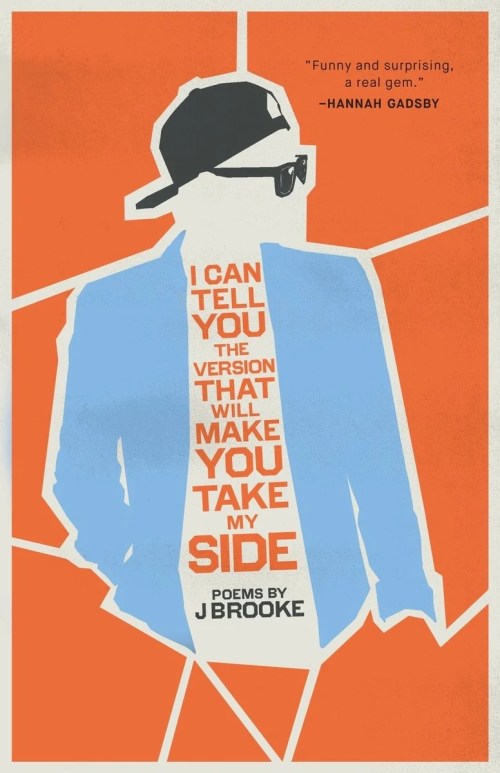
“I am Gender Affirming Care looking to affirm my gender anywhere,” writes self-described “present-tense reactionary writer” J. Brooke. Their debut collection, I Can Tell You The Version That Will Make You Take My Side is out now from Driftwood Press.
While I was previously unfamiliar with Brooke’s work, the collection comes incredibly well-endorsed with blurbs from such heavy-hitters as Rosie O’Donnell, Hannah Gadsby, and Jennifer Finney Boylan, among others, an outlier for debuts. It’s worth noting that while these are queer icons, they are not poets which speaks to the accessibility of J Brooke’s work. A poetry collection in two parts, I Can Tell You The Version That Will Make You Take My Side is one part personal narrative and one part social commentary. Part one leans into the personal, especially focused on the poet’s childhood and family of origin. Parental figures are either overbearing or absent, casting different shadows on the poet’s early life, one in which freedom to choose is so often denied. Autonomy, ownership of the body, and rigidly policed gender roles are recurring themes in this section, which dovetail beautifully with the more powerful voice in part two.
Part two takes a much wider lens, following the poet into adulthood, but focuses more on the ways the outside world conflicts with gender exploration. We see the poet grappling with the political realities of being a queer, trans nonbinary person in Trump’s America, the pain of parts of the LGBTQ community seeking to distance themselves from trans lives, and the whiplash that naturally accompanies watching the next generation of trans people struggle less. Brooke explores parenthood doubly complicated by queerness, mapping the reverberations of one’s life and gender identity and journey from parent to child. The experience of having a trans child as a trans person is one that I have not experienced, but my experience of having been a trans teacher to trans children lent just a fraction of the emotional weight Brooke brings to the page in those passages.
Queer writing that critiques the hetero- and cis-normative systems of power in our society is key, but Brooke takes things a step further by refusing to withdraw their critical gaze from the queer community writ large, holding a mirror to those who would offer milquetoast affirmation instead of real support. The poem “LGB No Longer My 4-Le er Word,” in particular calls out the hypocrisy of abandoning trans folk with all the anger and grief such abandonment demand—that they experience misgendering both ways is a gut punch of isolation.
The title is a motif throughout the book, a subtle nudge for the reader to accept the agency and inherent responsibility required to tell our own stories. The poetry in this collection occasionally experiments with form, but for the most part is fairly straightforward with clear narrative elements. This collection will appeal, of course, to those interested in queer and trans poetry, but it is still accessible to the poetry naive (or poetry skeptical, as the case may be).
The book closes, interestingly, with an interview conducted by the publisher. It’s a fairly wide-ranging conversation, the most interesting parts of which explore J Brooke’s writing and submission practice, and the way these processes differ between poetry and prose. Much of the interview, however, seems to pursue explanations for the content of the poems throughout the collection. While Brooke’s responses are interesting and worthwhile, the questions being asked at all perhaps belie an insecurity at the heart of the project. In my view, this insecurity is unfounded as the poems can and do speak for themselves with or without the benefit of author commentary.

I Can Tell You The Version That Will Make You Take My Side will make a fantastic addition to any Pride month reading list. Brooke’s poetry grounds itself instead in the constructed world we interact with every day, lending an immediacy that the pastoral cannot easily achieve. That its critical gaze is not solely locked on the cis-hetero-normative world that oppresses us all, that Brooke reminds us that queer people are not above reproach on the question of trans liberation, is a salient and integral reminder. In these pages, Brooke asks us to remember our history so as to not lose sight of where we could go together.
POETRY
I Can Tell You the Version That Will Make You Take My Side
By J Brooke
Driftwood Press
Published June 2, 2026


