


1992, the Dominican Republic. The dictatorship of Joaquin Balaguer is slowly waning, but the years of political imprisonment, torture, and deaths under his reign are still felt across the country. This is the reality. Now for the fictional conceit: the demon Asmodeus has inhabited the body of Rudy, a former Dominican rock star, for decades. Asmodeus considers himself responsible for Rudy’s greatest flights of poetic inspiration, but by the time the narrative begins, Rudy is washed up. A steady user of cocaine, Rudy is aging, holed up alone, and ill. Asmodeus decides to find a new host.
In the seven days that follow, Asmodeus will hop from person to person, from cockroaches to knives. He enters the lives of witches and young musicians, black metal enthusiasts and youth benefiting from the political landscape, not to mention fellow demons. His path will take him back through Rudy as well, since while Asmodeus’s movements are erratic if not random, the lives of the people he observes are all connected.
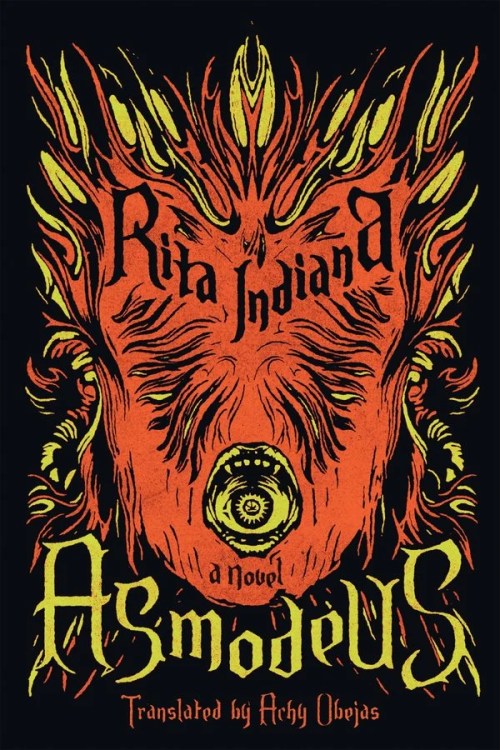
The English edition of Asmodeus this year is translated from the Spanish original by Achy Obejas. The original author, Rita Indiana, is a noteworthy personality. Born in Santo Domingo in 1977 (making her around the age of fifteen when Asmodeus is set, a charged moment of life to reflect on), Indiana has become known as the lead singer of the band Rita Indiana y los Misterios and as a novelist. Her literature explores social issues in the Caribbean as well as nonconforming sexual identities rarely portrayed in earlier works of Dominican literature. We can begin to imagine how Asmodeus draws on this background.
Asmodeus reads stylistically as a postmodern, poetic rollercoaster. The title demon flings from place to place, sometimes bound by magical rules to be stuck inside of a knife, sometimes seemingly free to wander. The narrative also appears to jump to characters far from Asmodeus, exploring subplots such as the planned robbery of a book depot. But “far” here becomes an uncertain term, when Asmodeus may in fact be able to teleport instantly. There is also the suggestion that the entire narrative may just be part of Rudy’s creative imagination as he prepares to rejuvenate himself and compose new songs. Or that Rudy has tapped into a collective consciousness through the journeys of Asmodeus and is able to write songs about nearby events he would otherwise be unaware of. This is hard to clearly interpret, but that’s not the point. We’re dealing with spirits and the mysteries of creative inspiration here.
The language is often appropriately psychedelic, for instance: “Lili la Turbia scraped the edge of the dagger against the concrete floor in a single movement, throwing off sparks, and then placed the tip at the center of Guinea’s forehead. The spell ripped Asmodeus from the knife and shot him toward the sparkling confines of Guinea’s brain. His voice—screaming ‘damn witch’—streaked across the neuronal sky like a meteorite.” But this is one of the more grounded descriptions, ultimately, compared with entire scenes that may only be hallucinations and the various disturbing visions of a developing witch making her first contact with dark powers. Décimas, traditional ten-line poems, also recur through the novel, offering their own cryptic statements.
The early 1990s were an important time for black metal music as it entered its “second wave”. Most infamous were the events surrounding the Norwegian band Mayhem. Between 1990 and 1993, the members of Mayhem were involved with serious attempts at devil worship, committing murders, church arsons, and other crimes. Asmodeus is not about the band Mayhem—the nonfiction work Lords of Chaos is highly recommended for those interested—but the psychic space feels similar, if not quite as realistically grim.
It is also ambiguous how properly “evil” the character Asmodeus is. At times he is suggested to be a creative principle, albeit only accessible through the double-edged use of cocaine. Double-edged in that the use of the drug has contributed to the decay of Rudy’s body, but also potentially stimulated his best work (this point in itself is ambiguous). Asmodeus the novel is deeply immersed in its mythology, but we may take a step back and read a worldview where all thoughts are spirits of sorts, particularly the mysterious sources of creative thoughts. A “new” fictional idea appears and inspires multiple writers, spreading fast like a virus. Calculus was discovered virtually simultaneously by Leibniz and Newton, living hundreds of miles and even countries apart, long before the internet. Do ideas and thoughts move invisibly through the air, if not some other unknown ether? In Asmodeus, certainly.
The novel is recommended, with the caveat that the reader be interested in postmodern literature, psychedelia, and horror themes.
FICTION

Asmodeus
By Rita Indiana
Graywolf Press
Published September 1, 2026


