


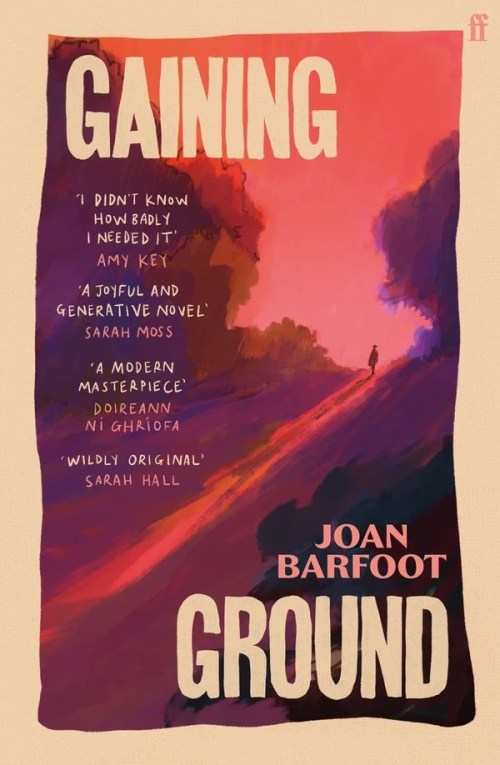
In Joan Barfoot’s Gaining Ground, a young mother devotes herself entirely to the art and labor of homemaking. She puts up cream wallpaper, crafts her own floral curtains, and reupholsters her furniture. She spends most of each day in her garden, and she subsists almost entirely on food she grows herself (plus eggs delivered by a neighboring farmer). She takes her time with this work and does not check or even own a clock. She finds immense “pleasure in doing things slowly.”
With the “tradwife” dominating both our social media feeds and bestseller lists the last few years, it’s tempting to assume that this is a familiar story about a regressive fantasy of “traditional” femininity. But Barfoot’s novel actually has more in common with another emerging figure: the loneliness influencer. Abra revels in her solitude, elated that she has only her own meal to prepare, her own single set of dishes to wash. Her handiwork around the house is imperfect, and this too becomes a source of satisfaction: “some things would be crooked and others wouldn’t fit right, but it was my place and I could have crooked things.”
For Abra, conservative gender roles are not enacted through homesteading but rather define the life she has left behind. Originally published in 1978 as Abra, released by The Women’s Press in 1980 as Gaining Ground, and now reissued again by Faber Books, Barfoot’s novel is a psychological portrait of a privileged housewife who leaves her husband and two young children for a remote cabin in the Ontario woods. When her daughter Katie, now a young woman studying archeology, finds her a decade later, Abra digs through her own past. The novel draws together Walden’s quest for clarifying solitude with ideas drawn from twentieth-century feminist writers as Abra reflects on her decision to privilege the pursuit of her own “truth” over the ties that bind her to others.
Gaining Ground puts into fictional form the critiques of domesticity posed by Betty Friedan in The Feminist Mystique (1963). Abra’s dissatisfaction with her role as an upper middle-class white housewife leaves her feeling profoundly dissociated, eventually becoming suicidal. She describes her old life as a “portrait of happiness,” a scene she can gaze upon from a distance, but which never feels quite “real” to her when she inhabits the “charade.” Her life in the woods, by contrast, is “vivid” enough that she begins an artistic practice, reserving the cabin’s second bedroom for sketching, embroidery, and writing in her journal. Indeed, Abra is lucky to have, via an inheritance from her grandmother, both the “money and a room of her own” that Virginia Woolf, writing in 1929, deemed prerequisite to women’s creative lives.
As Abra recounts her days of solitude, the novel bears similarities to other recently reissued late-twentieth-century fiction about women in isolation: Marlen Haushofer’s The Wall and Jacqueline Harpman’s I Who Have Never Known Men. In each of these speculative novels, a woman is unwittingly separated from human society by an unexplained global event. In Barfoot’s realist novel, the forces drawing Abra to her new home grip her, too, with an almost supernatural quality: her initial attraction to the remote cabin and all that it represents is “like an electric shock, sharp and abrupt, strange and terribly painful.” The house is not incidental to Abra’s quest—it is fundamental to it. Over time, she becomes unable to distinguish herself from her surroundings.
Unsurprisingly, Abra’s profound identification with the house can make her worldview unnervingly solipsistic. In Haushofer’s The Wall and Harpman’s I Have Never Known Men, the protagonists gradually accept that they will die alone. In Gaining Ground, Abra describes her old self—the one who lived among others—as already dead. But someone does come for her, and the possibility of her return has the quality of myth. While she permits and even occasionally enjoys Katie’s company at the house, she cannot follow her back to the world beyond it. What begins as a conflict along gender lines ultimately gives way to a generational divide: the young woman begs her mother to come with her; the older woman insists on remaining in place. Readers, like Katie, might want more from Abra: a more collaborative feminist ethic, for instance, through which she and Katie might forge a world they can both inhabit. But Barfoot’s protagonist insists on being left alone. By the novel’s end, Abra achieves the self-realization she seeks, but hers is a vision of women’s liberation set for one.
FICTION
Gaining Ground

by Joan Barfoot
Faber & Faber
Published on August 25, 2026


