


Moisés is a young boy growing up in a remote Brazilian village that is dominated by a monastery that not only rules the moral world of the town, but also its land, charging regular taxes. His sister, Luzia, has a disability that makes the town condemn her as a witch, claiming she causes misfortunes all around. His father has a drinking problem that leaves him struggling to tend their plot of land. As Moisés grows up, he’s exposed to a trauma that sends him fleeing home, and Luzia is left to try and salvage what she can as their town changes in irrevocable ways.
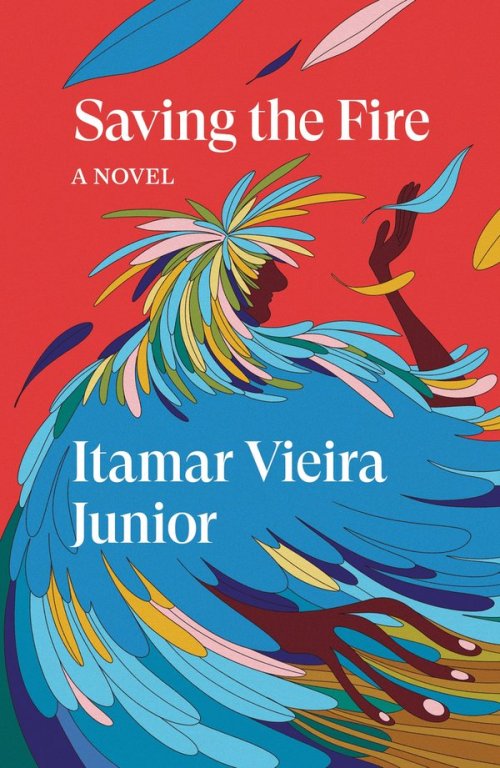
Saving the Fire by Itamar Vieira Junior, translated from the Portuguese by Johnny Lorenz, is the second novel by the author of the Booker Prize–shortlisted Crooked Plow. Here, as in that novel, he brings a clarifying and sharp eye to the impact of colonialism and the dynamics of power on rural Brazilian communities. Whether it’s Luzia, doing the dirty laundry (literally) of the monastery while trying to ignore those mocking her in the village, and remembering her tumultuous teen years, or Moisés, who finds that life in the city isn’t that much better than life in his village back home, the characters of Vieira Junior’s novel must face deadly silences, poisonous secrets, and knowledge gaps, all of which spark deep fires that threaten to boil over.
Memory is already incomplete. We can only recall so much, and in the mire of responsibilities and emotions, our memories often fail to hold onto everything. But we also have a choice about what to keep and what to toss. “I had to bury the melancholy I’d inherited from my ancestors,” Moisés says after escaping to the city. “I turned the past into a book I could open when I wanted to. Most of the time, I left it shut.” But naturally, that book could only stay shut for so long. And some would argue—including, it seems, Vieira Junior—that by closing the book of generational trauma and sorrows, we are also closing ourselves off from the generational wisdom and support that could hold us together.
In a passage particularly charged with meaning, Luzia thinks back to a time when she had a bad tooth as a teenager. Despite them being a church-going people in a town run fully by the church, her mother pulls out the folk ways that she has known and continues to know, folk ways supposedly forbidden. She leads Luzia into the forest, knowing the way by instinct, not speaking. She does a particular set of rituals, and then gives Luzia a couple of rules to follow about the “milk” of the tree. Years later, desperate to lose another tooth, Luzia wanders in herself, determined but lacking the knowledge. Her mother never explained to her the ways, or the rituals. She doesn’t know them. Instead, she guesses at things, desperate for relief but unpracticed. When she pours the milk into her mouth, she ends up losing not one bad tooth, but all of them.
The failure to discuss the past, to pass on stories and knowledge, is a crucial loss to the characters of this novel. At another point Luzia laments that she doesn’t know, and so will never know, the full history of her people. By closing off the past, and refusing to speak about traumatic moments of the past, she hoped to shield Moisés; but all she did was fail to protect and prepare him, leaving him just as isolated as she once was. This isn’t the fault of the community so much as it is of the powers that rule their lives. Luzia’s father takes for granted his right to farm his own land, but those sort of instinctive principles and community-based faiths don’t carry into the colonialist system around them. The haunt of colonialism is deep within the tragedies of this novel, and it’s so threaded in that its characters have no concept of how to pull it out. Not speaking about the hurts only means that the scars heal unevenly, itching and aching.
“Forgetting,” Moisés thinks, near the end of the novel, “wasn’t a form of devotion.” He and Luzia dive back into history, without knowing all the rules, without knowing all the scenes they’ve missed; but their decisions to retell and insist on that retelling, to reserve space for themselves and insist on it, is the spark at the center of this vivid novel about the inner space, the spark, the trouble-making rebellion that kept communities alive, if scarred, through repressive colonialism.

FICTION
Saving the Fire
By Itamar Vieira Junior
Verso
Published September 1, 2026


