


Following the acclaimed arrival of her English translation debut, The Remembered Soldier, a National Book Award finalist, Anjet Daanje’s latest novel, The Song of the Stork and Dromedary, is yet another psychological puzzle, enveloping readers in a mystifying literary haze that persists until the novel’s final pages. Drawing on the lives of the Brontë sisters, Daanje weaves macabre imagery, dubious diaries, scattered letters, and a series of vignettes into a story spanning nearly 300 years. The result is a sprawling meditation on death, sisterhood, and the mysteries that refuse to be buried.
Opening the novel in late 18th-century England, Daanje wastes no time linking the novel to the esteemed Brontë sisters, primarily Emily, whose life is mirrored by the cryptic Eliza May Drayden. The Drayden sisters not only write Victorian Gothic novels but also echo the Brontës in their sisterly bonds, childhood-born imaginary worlds, and encounters with illness, all of which lie at the heart of the narrative. Blankly gazing at the corpse of yet another sister, six-year-old Eliza asks, “Is God hungry?”, initiating the novel’s lengthy exploration of death. Along this ghastly thread, readers follow eleven primary profiles—including biographer Agnes Chambers, Emery Niles, and several pairs of fated sisters—whose lives are all influenced in some manner by Eliza Drayden and her novel Haeger Mass, a heavily criticized Gothic tale in the vein of Wuthering Heights. These episodes are interspersed with diary entries, notes, and poems that gradually fill in the gaps of the enigma that surrounds Eliza far beyond the grave.
Carefully rendered by translator David McKay, Daanje’s silky prose balances delicacy and lyricism with a sense of dread. As characters wrestle with deathly curses, disturbed graves, and unexplained phenomena, the novel sends chills with the turn of a page. However, beyond the overtly Gothic motifs throughout, sisterhood persists as a central theme of the work. Whether it’s the Draydens, the Balthasars, or twins Lena and Penny, the novel is undoubtedly rooted in the unshakable bond of sisterhood. Without explicitly demonizing marriage, Daanje presents this capitulation to social convention or seduction not only as a devastating loss for the unsuspecting sister, but also as a form of abandonment. In each case, sisters are torn from their tender love and intimacy, only to fall victim to suffocating relationships. In an effort to seek refuge, characters frequently turn to fictional worlds or music, each possessing an immortal quality that allows them to transcend their creators and reach future generations.
Ascending in scale with each chapter, the novel’s eponymous symbols of the stork and dromedary become increasingly apparent—though the stork remains the more essential of the two. Drawing from a seventh-century Chinese proverb, the stork serves as an analogy for adopting an elevated, broader perspective on the seemingly ceaseless chaos that wreaks havoc in our lives. When grappling with the distressing uncertainty of his wife’s coma, one of the novel’s later characters explains,“At the quantum level, we live in unimaginable chaos, we’re made of that chaos ourselves, our bodies, our minds, and in that chaos there is no Time, because one chaotic state leads to the next chaotic state, so nothing seems to change. Not until we look from the threshold at our simple, orderly world of big things do we experience change, and therefore Time. Time is the result of our inability to see the world as it truly is.“ This perspective perfectly complements the novel’s grand scale and its meditation on grief.
Yet in her intricate web of interconnected stories, Daanje opens the door for intrigue, but largely fails to furnish the room. Much like her debut novel, this work often presents characters with a verbosity that spills over the page rather than adding depth. From time to time, she dabbles in concepts, such as quantum mechanics, that are too underdeveloped to be effectively integrated into the greater narrative she’s constructing. Despite this limitation, her graceful style and ability to sustain suspense ultimately reward patient readers.

Serving as both its strength and weakness, Daanje’s multilayered composition creates a palpable atmosphere that takes on the quality of recovered history rather than fiction. For all its inconsistent focus, the novel boldly grapples with unsettling questions, challenging our conception of time and the ways it governs our experience of death and grief. Ultimately, The Song of the Stork and Dromedary stands as another example of Daanje’s brilliant storytelling, cementing her status as a writer to watch for years to come.
FICTION
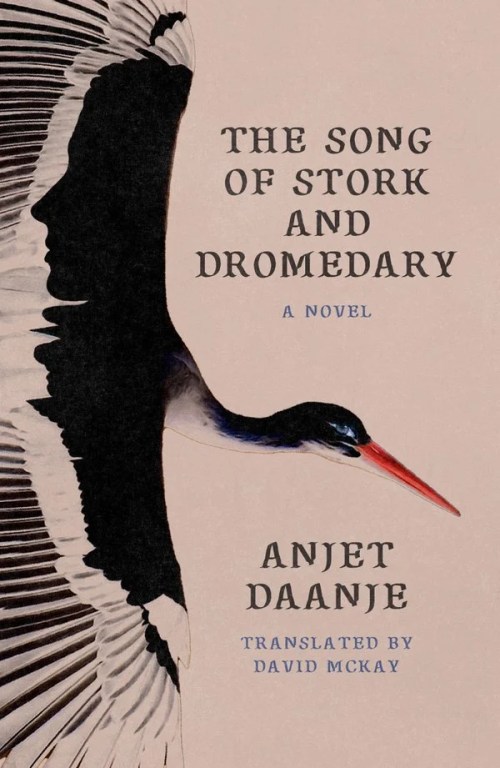
The Song of the Stork and Dromedary
By Anjet Daanje
FSG Originals
Published August 18, 2026


