


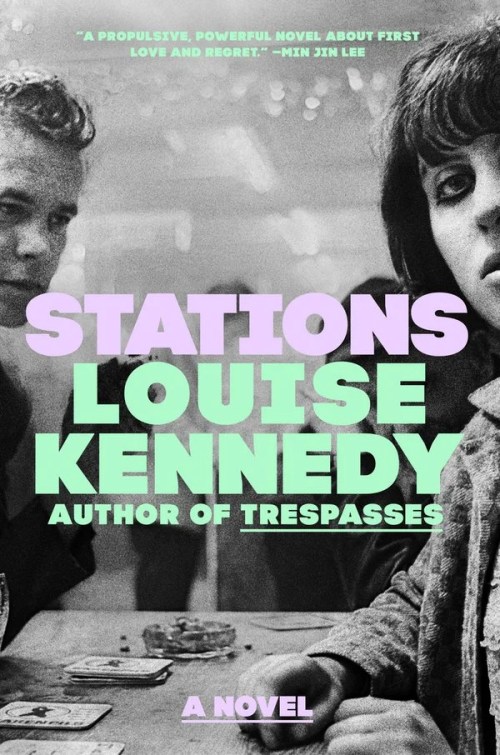
Since its European publication in September, Stations, the new novel by Irish author Louise Kennedy, has received critical acclaim in Ireland and England. Fans of her debut novel Trespasses (series adaptation recently aired on PBS) will not be disappointed. Now available in the U.S., Stations follows the turbulent relationship of Rόisín and Redmond, two outsiders navigating family trauma, addiction, and life as exiles in Ireland and London in the 1980s through the early 2000s.
Rόisín and her mother (Una) have been abandoned by her alcoholic father who left after an unexplained breakdown. Rόisín is angry at her father’s betrayal of Una with a younger woman, and unbeknownst to her, a newborn half sister. Rόisín is befriended by Redmond (Red), another troubled teen and is tormented by an unrequited romantic love for Red throughout the novel.
Red’s troubles remain a carefully guarded secret. After a fraught encounter with his family at Christmas Eve mass, Red’s father offers him money to leave Ireland, banishing him from the family and his home. Rόisín’s loneliness and anger grow in Red’s absence. She faces another abandonment when her mother plans to annul her first marriage (divorce being illegal in Ireland) to remarry, leaving Rόisín illegitimate in the eyes of the church and ostracized by their community.
On another hopeful Christmas Eve, Rόisín travels to London to visit her father (and escape her mother) only to discover her pseudo-step mother and baby sister. Unable to cope with her feelings of betrayal and jealousy, she rejects her father’s new family and her mother, who kept the secret of her half sister with the close-lipped excuse that it was not her story to tell. Furious and hurt, Rόisín drops out of college and moves in with Red who she finds squatting in an abandoned London apartment with no electricity and several Irish exiles. Rόisín’s futile efforts to reconnect with Red leave her rejected and heartbroken and she leaves his squalid, drug-addicted world in search of love and acceptance.
Community college and fledgling career as a writer lead Rόisín to a life she never imagined, married to an upper-class Englishman whose family thinly veils their disdain for the Irish. She loses touch with Red and nearly misses seeing him at a train station where a skeletal and visibly sick Red begs for change as she walks past. A divorce, her aging and increasingly drunk father, a longing for home and regret haunt Rόisín. She returns to Ireland to start her life over and learns Red’s father has died. She makes a promise to Red’s ailing mother to find him and deliver a message that it is safe to come home. Rόisín’s search for Red reveals long-held secrets and Rόisín descends into a spiral of alcohol, guilt, and self-loathing. As she pieces together Red’s traumatic life, Rόisín is forced to confront the truth of the past and struggles with her own journey toward self-acceptance, forgiveness, and healing.
Similar to her debut novel Trespasses, Kennedy uses setting and historically relevant detail to create an immersive reading experience. With different but equally troubled young female narrators, Stations picks up where Trespasses, (set in the 70s amidst the Irish Troubles) left off. Cultural references to music and politics of the 80s and 90s and fledgling feminist beliefs cast Kennedy’s story at the crossroads of change that is instrumental to understanding Rόisín’s naivete and anger. Rόisín lives in the time where difficult questions were not asked or answered. She doesn’t question Red’s trauma, her father’s breakdown or her mother’s romantic choices whereas a twenty-first century reader clearly recognizes Kennedy’s clues to Red’s childhood abuse, her father’s mental illness and her mother’s trapped circumstances.

Kennedy creates a satisfying tension between a modern reader’s sensibilities and Rόisín’s painstaking character evolution. Kennedy deftly draws out Rόisín’s shame, denial and avoidance with alcohol, failed relationships and emotional repression. Kennedy refuses to wrap up Roisin’s life in a neat bow and the final pages of the novel leave Roisin’s future unresolved and the reader with questions. Some readers may find the ending frustrating. But Kennedy remains true to the traditions of Irish literature, where truth lives in sadness, not in happy endings.
Kennedy’s novel is sweeping in thematic scope as Rόisín and Red’s tragic story touches nearly all of the historic troubles of the Irish with deft prose and unforgettable characters. In a long tradition of Irish literature (from Edna O’Brien to Claire Keegan) the women in Kennedy’s novels are forced to face the brutal consequences of the past, their own misguided choices and attempt to find a way to carry their sadness without destroying themselves. With its ambiguous ending, Stations portrays the inherent contradiction of the Irish exile—an ever-present hope for the fragile peace of going home and a whispered prayer to those who must escape to “get away,” stop remembering and find the courage to continue on with their story.
FICTION
Stations
By Louise Kennedy
Riverhead Books
Published November 3, 2026


