


A child, feeling a sensation it doesn’t know to call hunger, cries out. With any luck, it is fed. The sensation, which appeared without conscious thought, disappears, replaced by something more pleasant. But until it is older, the child never thinks about what it needs, or the method by which those needs are satisfied, or even what that gnawing sensation could signify. It has no capacity to examine its circumstances.
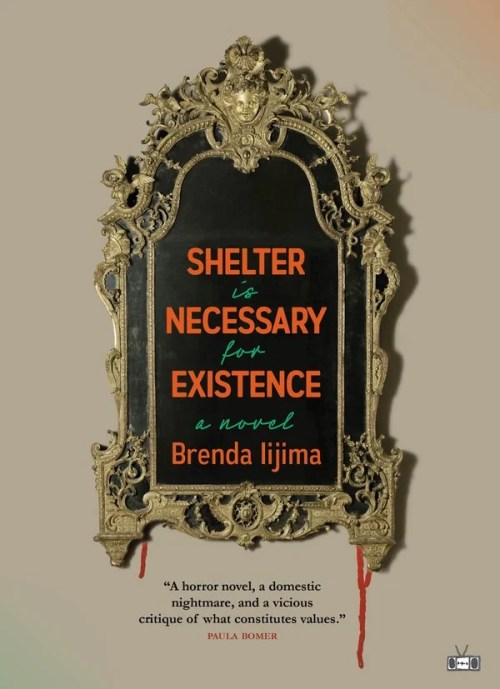
The same thing could be said, with considerably more condemnation, of the most privileged in our society. And in Brenda Iijima’s new novel, Shelter is Necessary for Existence, the idea of unexamined, unconcerned, destructively oblivious privilege is put under the harshest light possible. The reader is trapped in the mind of one of the most relentlessly incurious characters captured in literature.
The mind belongs to Sue: New Yorker, corporate lawyer, wife, mother of two, and recently the buyer of a multi-million-dollar home. We meet Sue and her family in the throes of the pandemic, “preoccupied, as it seemed everyone was, eyeing real estate online in other neighborhoods, other places.”
That may or may not have been your pandemic experience; for most, it rarely went past “idly looking at Airbnbs.” But for Sue and Luke, buying the brownstone in need of a total renovation was accomplished without difficulty.
And that total renovation was very much in order: the brownstone was rotting, walls were unsteady, there were strange smells, and Sue sometimes heard weird voices coming from a mysterious place in the house, and the yard needed landscaping.
Your curiosity may have perked up with “weird voices.” Sue’s did not.
“Often the sounds I heard were part of some kind of discussion. Two commentators in a heated conversation. Maybe it was a podcast. There was an outburst of laughter. About what I could not ascertain. The only valid explanation was my first impression: there was a radio somewhere in the house, but where it was, who brought it in, left it on, and why, I didn’t pursue.”
Sue is not really the “pursuing” type. She regularly goes to a therapist, but it doesn’t seem to be with any real intention (indeed, she spends most of the time imagining what her therapist looks like while she’s having sex). In one early episode, Sue suddenly stands up and grabs her therapist’s notebook, and sees words like “passive with a zombie shadow of self-destructive tendency” and “Vapid, vapid, vapid.” The therapist grabs the notebook and says, “This can never happen again.” And that is it: the entire episode.
In many books, this could be a hinge, a point of reflection or destruction. But it never comes up again, and Sue continues to see the therapist like nothing has ever happened.
Indeed, the entire book reads like a series of punctuation marks. The plot is linear: things happen, characters move, life stumbles forward. But there is a deliberate disconnect between what came before and what comes after. Sue lives her life in seemingly episodic bursts, with no real reflection. Iijima’s structure is a reflection of this, with chapters titled “House,” “Therapist,” “Dogwalker,” “Caroline,” and “Wheatley” (the last two being the children), repeated many times throughout the book. Sue pretends to know her children, pretends to know her life, but it feels to the reader like every moment is in an infantine present.
Sue’s sheltering of her own mind extends outward. Her job, never totally spelled out, is helping sell enormous parcels of land and resources in foreign countries to wealthy investors, with morality not a consideration. (“Ukraine-Russian conflict was a goldmine for investors.”) Meanwhile, Caroline, the daughter, is so stricken by climate change depression she is often catatonic and admires a man who set himself on fire in Central Park to protest it. Sue never quite makes any connections.
Her own life is unexamined as well. Both she and Luke despise the woman next door, Chantal, and her husband Hattori (through context, the reader gathers that Hattori is Black, and Chantal white). Sue can never quite explain why she hates them, and would be horrified if you said there is a racial component to their loathing. But they take “gleeful revenge” at calling the cops when he plays his guitar. And oh, right, in a couple’s therapy session Luke explodes in rage that Chantal “couldn’t find a white man good enough for her.” Sue is horrified merely that Luke “was speaking so frankly.”
We are in Sue’s foggy, unreflective mind, but her husband seems authentically grotesque. He doesn’t care that his grandfather was in the Klan. He begins to bring guns into the house. They stop having sex, as he is more interested in “retreating to his porn videos for gratification after taking the gun out for inspection—a private, solemn affair.” A few pages later, Sue sees some of his tabs where “young children sprang to life,” Russian and “Asian” kids, ten years old, “performing shamefully before the omniscient eye of the camera.”
The reader moves over these sentences with sickened horror; Sue slams the laptop shut, and seemingly never thinks about it again.
But then, not thinking about things is her power. The most the family ever seems to talk about is the history of their neighborhood: colonization, extermination, slaughter, slavery, etc. The American story. The children are interested; Sue finds it mildly interesting. That the last two people to live there were a mother and daughter, the latter of whom killed the former by pushing her down the stairs and then later died in the house herself, is of some curiosity.
That the voices she keeps hearing—something wrong with Siri, maybe—are of two women talking about the murderous past of the spot, and their own complicated lives and deaths, never quite seems to click.
Nothing actually clicks inside Sue’s head. Even as the plot, such as it is, evolves through the strange actions of others that accrete into something more troubling, Sue never seems to change. She buries her past (we get a particularly shocking and revealing bit right toward the end) and keeps burying her present. She ignores blood-caked syringes in her son’s hide-out under the stairs (must have been left over from the last resident, she thinks). She paints over and resolves to ignore literal blood oozing out of the walls. If her husband jerking off to child porn doesn’t bother her, why should bleeding walls?

Most strikingly, though, is that she tries, and mostly fails, to ignore the voices. Iijima uses the voices to break out of Sue’s narration every once in a while, as we read snippets of what Sue hears. The voices are clearly having a long-running and mostly good-humored ghostly dialogue about their lives, Sue’s life, and the sickness and violence that underlie America and Sue’s particular place in it. They fade in and out. Sue worries about hearing them, but not about what they are saying. She doesn’t want to think about it. She ignores what the past could mean to her.
Because understanding the past is an examination. Why else do we look backward — or willfully refuse to look backward—other than to understand how we are here: as individuals, as a community, as a nation? And the more you cut off the past—not just the historical past, but your own life—the more you shelter yourself from the process by which the present becomes the past, the less you have to think about who you are. The less you have to worry about the impact you have. The less you have to be troubled by your own existence.
But life, as Iijima masterfully demonstrates, doesn’t work that way. You have a past, you have an impact, and you can’t escape it. What is a haunted house but fragments that refuse to go away, after all? Shattered spirits, trying to make sense of being neither here nor there: those are ghosts. In Shelter Is Necessary for Existence, Iijima brings us into a haunted mind, wrecked by her own privilege, unaware of the terrors surrounding and emanating from her life, and trapped in a wealth-dimmed nowhere at all.
FICTION
Shelter is Necessary for Existence
By Brenda Iijima
Two Dollar Radio
Published October 13, 2026


