


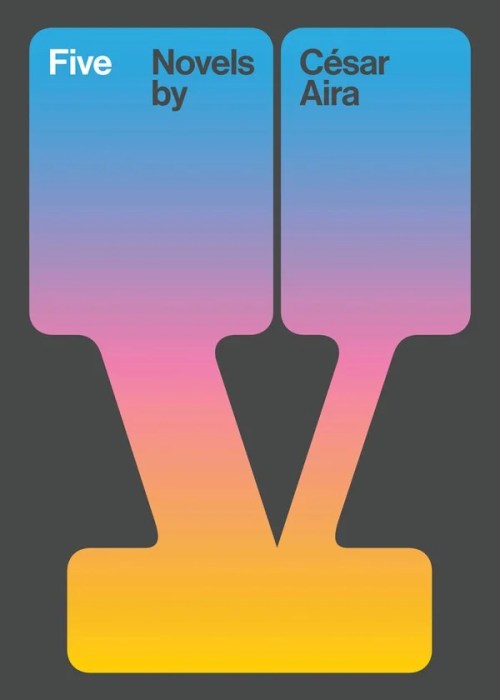
César Aira has published over a hundred works, and this number alone tells you something about his method. He calls it la fuga hacia adelante, or “flight forward,” writing without revising, allowing each sentence to respond to the previous one rather than to any fixed plan. But the method raises a question that Aira has spent a lifetime exploring: what happens to a story when the author refuses to go back and fix it? Five, which collects five works translated by Chris Andrews and includes an introduction by Jeff VanderMeer, pursues that question across its full range: what it can illuminate, what it risks, and where it finds a strange, genuine beauty.
The collection opens with “Margarita: A Memory,” which, by Aira’s standards, is an act of restraint. An unnamed narrator, anxious and bookish, recalls a summer spent with extended family in the Argentine countryside before heading off to university in Buenos Aires. The arrival of a cosmopolitan cousin, Margarita, pulls him out of his solitude, creating a typical coming-of-age story. But Aira’s prose persistently resists settling into the expected register. A passage describing the pampa will begin with careful observation and then drift toward abstraction, as if the narrator’s memory cannot hold the landscape steady. The effect isn’t decorative; it reflects the novella’s central concern: that memory doesn’t just preserve experience but transforms it into something entirely new, that our memories, like the narrator’s grief when Margarita leaves, can live on and morph into creations of their own.
“The Dream” takes a harder turn. Mario, the son of a newspaper kiosk owner in Buenos Aires, lives within the small, familiar routines of morning deliveries, regular customers, and the nuns at a nearby school. Then the story explodes. Mario tries to rescue a young woman from a shelter for single mothers and uncovers a conspiracy involving the nuns, who are secretly running a sinister techno-religious operation. The shift is so sudden that it retroactively unsettles everything that came before. The cozy barrio scenes don’t disappear; they become eerie, as if the realism was itself a kind of conspiracy, lulling the reader into a false sense of knowing what kind of story this was.
A similar logic operates in “The Hormone Pill,” a story spanning a mere ten pages, in which a man randomly takes one of his wife’s hormone pills for his own amusement. The narrative quickly spirals into a hallucinatory reflection on light and the cosmos, a digressive “flight forward” that exemplifies Aira’s approach, in which the mundane can serve as a springboard to wonder.
The most accomplished work here is “Musical Brushstrokes,” set in 1950s Pringles, Aira’s birthplace. The narrator recalls the town’s only painter, a widower who, ironically, does not paint. He constructs a pavilion of his own design where ghosts visit him: his deceased wife, a dwarf, a wandering philosopher. The expected arc never arrives. Instead, the story becomes a reflection on what it means to create art when the desire to do so has been consumed by grief. Aira is uncompromising; he does not sentimentalize the painter’s paralysis or resolve it with a redemptive breakthrough. The narrative simply observes with patience as a man circles around the thing he cannot do.
This patience is what sets “Musical Brushstrokes” apart from the collection’s most extravagant display, the closing novella, “Princess Springtime.” A princess living in a castle off the coast of Panama translates pirated pulp novels. An army led by General Winter invades; his lieutenant, Christmas Tree, is equipped with blinking lights. The embalmed corpse of Vladimir Horowitz plays piano through a mechanical setup. The accumulation is intentionally absurd, creating a manic pleasure, but it also risks turning into a catalog of inventions rather than a story that deserves our attention. Where “Musical Brushstrokes” finds its strangeness by focusing on a single difficult subject, “Princess Springtime” compounds inventions until the accumulation itself becomes a way of not arriving anywhere. It is an extreme example of Aira’s approach and the one that most clearly reveals its limitations.

Chris Andrews’s translation merits special attention. Aira’s sentences can shift midway, starting with domestic observation and ending in speculation or surrealism. Andrews’s English doesn’t smooth these out; you can feel the transitions happen before the writer or reader is ready for them, which is exactly what makes the prose work.
What holds Five together is not a theme but a formal commitment. Aira’s digressions are not departures from the story; they are the story’s way of discovering what it is actually about. This may not be to every reader’s taste, and some of the narratives feel unfinished, but that is the point. The question Aira poses is whether the unfinished thought, caught in motion, tells us something that the polished, revised, completed thought cannot. Five does not answer that question definitively, but it asks it with enough intelligence, beauty, and daring to make the question feel essential.
FICTION
Five
By César Aira
New Directions
Published July 28, 2026


