


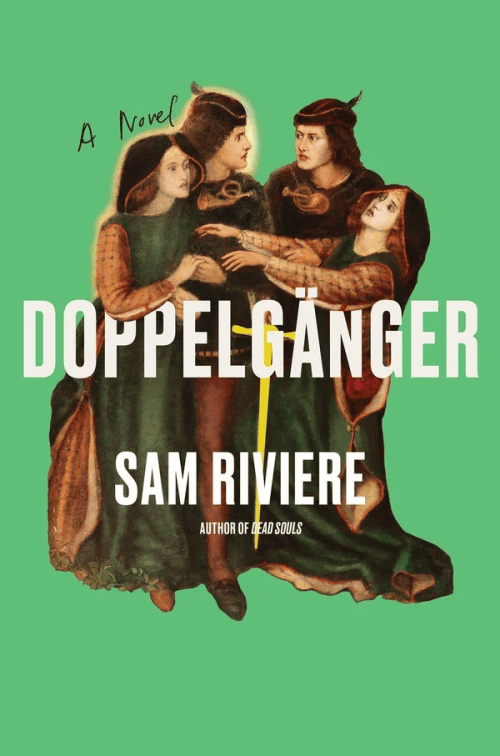
Have you ever finished someone’s sentence, or voiced a thought that, to you, felt so singular, only to have the friend you’re talking to say, “I was just thinking the same thing!” The flurry of relief from that moment of understanding might make you wonder: in what other ways are we alike, and what does that sameness mean? Sam Riviere’s Doppelgänger looks at the idea of a shared consciousness—its benefits and detriments, as well as how it can occur naturally or be engineered, and to what end.
The story begins on the campus of the fictional Northwick Author Development Academy in England. Riviere describes these academies as “specialised, elite institutions for the technical training and advancement of storytellers, artists, poets, all advanced members of the creative classes, whatever their tools and however they preferred to be labelled.” We are introduced to a gathering of sophomores, one of whom, Carl Sample, is regaling the rest with the story of his fixation on getting pummeled. After a non-violent run-in with some of the folks from town—who generally see the Academy students as pretentious and entitled—Carl says he became obsessed with the idea of angering someone from town so much that they would decide to beat him up, with his most specific fear being a punch to the head. To diffuse the anxiety that has built up in him over this future possibility, Carl proposes a plan to go into town and deliberately antagonize someone there into punching him so that he can get it over with. It is also understood, though unspoken, by those gathered that Carl’s ultimate intention is to use the entire experience as creative inspiration. In the middle of this discussion however, a different member of the cohort comes in disheveled and bloody, having just been attacked by someone from town. This coincidence seems to be the catalyst for the twinning phenomenon that eventually becomes a cultural trend for a brief though impactful period of time.
Throughout, Riviere focuses on one character long enough to get you invested in them before sliding into yet another narrative. We either move from centering one character to centering another, squatting inside their heads as they tell us about a past experience, or—more interestingly—we begin with one character’s recollection only for them to include their experience hearing someone else’s anecdote within that recollection, like a matryoshka of tales that do not decrease in their level of description or emotional impact. The twinning can be seen everywhere at the academy. Students wear the same clothes, combine their names, and share the same thoughts. They swap demeanors over time. Even on a sentence level, names repeat. “Part of the problem is the American stream system, as I’m sure you’re aware, Philip, Philip read.” Riviere pushes the reader like this in little ways throughout, forcing rumination on the double from every possible angle. Sharing your thoughts and experiences with someone else as if those thoughts are a room that can be entered by multiple people. The version of you that you know vs. the version others have constructed inside their minds. The inverted form as double. All these scenarios and more are explored in this novel.
What I found most interesting in Doppelgänger is the construction of doubles. Riviere shows us how, ostensibly out of greed, but really out of loneliness, one might create entire generations of people who think and talk and create like one another. When I first started reading, I thought Doppelgänger must be a critique of the MFA programs that some claim function as factories, churning out the same type of writer over and over. But the doubling in Riviere’s novel is shown to be both good and bad. Due to its reliance on opposing personalities, it can lead to greater productivity and perspective on the one hand, while leading to a profound loneliness on the other, because two different individuals coming together will always result, the novel seems to say, in a power imbalance.
There is also a mystery to keep in mind as the story unfolds. One student goes missing, and in the unraveling of that mystery, numerous other questions that weren’t initially apparent get answered. I was happy to find my mind twisting and turning in provocative ways as I read.
I came across at least three mentions of American exchange students with “giant” or “enormously fat behinds,” which snagged in my mind as incomplete commentary. A one-time mention could fly under the radar as one character’s comical bafflement at another culture, but three mentions in as many pages feels pointed, especially in a novel that is, in its own words, chronicling a trend. Yes, large bottoms have been a trend in American culture, but to say no more about BBLs or the ways that the Black body is often borrowed from when it is convenient or fashionable to do so (especially in a story set primarily at an academic institution) struck me as odd. Even if the character who was so caught up in how big these students’ butts were spent some time wondering why without coming to a definitive conclusion, I would have been more satisfied by these mentions than I was.

That aside, Doppelgänger is a fascinating novel. It excavates the many ways people are able to connect with and influence one another, as well as the true value of individual identity. It also highlights capitalism’s relationship to creativity in ways that will hopefully spark transformative discussion. Our true creative twins may or may not be out there, but either way, Riviere contends, each of us can still be the catalyst for someone else’s evolution, if only by living our lives.
FICTION
Doppelgänger
By Sam Riviere
Catapult
Published October 20, 2026


