


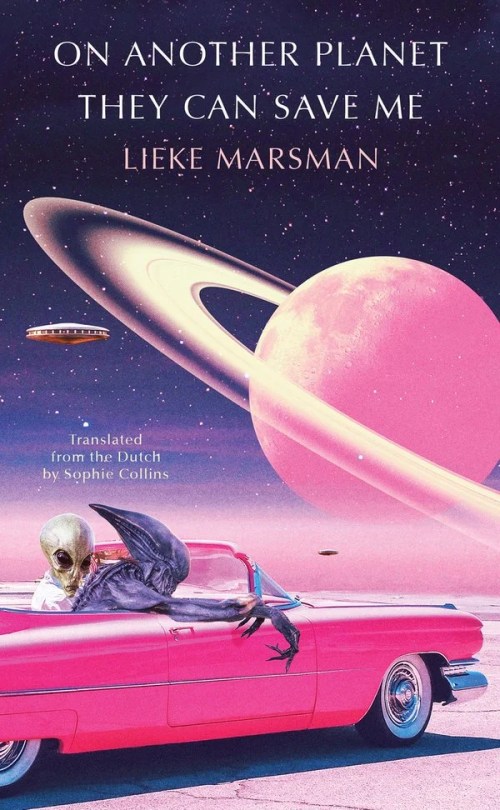
Earlier this year, the Dutch poet Lieke Marsman died at the age of 35 from a rare form of cartilage cancer. Marsman, who served as the Netherlands’ poet laureate from 2021-2023, left behind an admirable body of work for her young age: two books of poetry, two novels, and a bestselling collection of essays—On Another Planet They Can Save Me, translated into English by Sophie Collins.
I wish I could begin this review differently; it feels uncomfortable, even voyeuristic, to begin with an author’s misfortune, as opposed to the details of her work. However, Marsman’s terminal illness is On Another Planet They Can Save Me’s central subject. At the very least, her illness serves as a quasi-inciting incident for its series of sometimes-spiritual, sometimes-material conversions. Marsman is not the first poet this century to make brilliant work in the face of a grave diagnosis—My Bright Abyss by Christian Wiman is one of Marsman’s touchstones throughout the book, and Letters from Max by the late Max Ritvo and Sarah Ruhl shares some formal similarities. Marsman herself even pokes fun at the risk her work might come off as derivative: “It fulfills those clichéd expectations to an extent that I can hardly take myself seriously anymore (‘Young Poet Becomes Gravely Ill and Writes Her Best Poems in Anticipation of Death’).”
If Marsman gestures at the idea she may posthumously be flattened into a literary archetype, who can blame her? Our cultural efforts to elevate the work of the recently departed are mostly well-meaning, but they can feel insufficient to both the person and the writing itself. In the case of On Another Planet They Can Save Me, it’s a much more unwieldy and adventurous volume than, to use Marsman’s own language, the work of the Young Poet [who] Becomes Gravely Ill and Writes Her Best Poems in Anticipation of Death. Between formal essays, journal entries, and writing that can at times read like aborted attempts at poetry, I found myself delighted by this book’s intimacy even if I often found myself flummoxed by her willful uncertainty.
The majority of this book is animated by an achingly personal question: Can rationality survive in the face of imminent death? Can it withstand the pressure of a terminal diagnosis, and should we even want it to? Marsman describes her first conversion—from strident atheist to spiritual thinker—with a sincere curiosity and a growing awareness of a higher order: “God, perhaps” as she puts it. Quoting the aforementioned Christian Wiman, she finds her old ideas about the world “inadequate” to describe the oscillations between joy and grief. She finds herself consistently turning to God, even if she is unable to articulate what particularly that means to her.
Marsman’s emergent sense of faith never settles into something easily categorized, but she doesn’t lack for moments of spiritual clarity: “This is the closest a human being can come to a revelation,” she writes. “Not the knowledge that God exists, but the knowledge that you can and will allow yourself to believe in things that cannot be proven.”
And what does she believe? It isn’t always obvious. In fact, throughout the first half of On Another Planet They Can Save Me, Marsman appears more interested in reconciling her experience post-diagnosis than she does wrestling with her experience’s philosophical implications. Perhaps this is simply a poet’s impulse or perhaps it’s due to the intimacy that emerges from capping each essay with a series of journal entries. Perhaps it’s an act of bravery, for as she notes in the essay, “What If I’m A Coward?,” choosing a single reality for one’s self risks limiting possibility.
Marsman is at her best when she makes such calls for radical uncertainty: “Life is beautiful, but only as long as you remain willing to revise all of your ideas about how the world works, every day.” This makes for a wonderful—and yes, brave—sentiment that trickles outward into her approach to the book’s final essay on her “second conversion”: a sustained inquiry into reported UFO sightings, near-death experiences, and consciousness itself. This final essay may be best described as a tour through the unexplainable—a self-described materialist’s attempt to, in the spirit of authors like Benjamin Labatut, make sense of the senseless.
For those few readers who are already plugged into philosophical and scientific debates surrounding consciousness, they will likely find this section to be lacking. Whether Marsman is writing about double slit experiments or the “radio model” of consciousness, she doesn’t provide a great deal of novel insight—its subjects of study are almost predictable. She is comfortable not knowing, and like anyone else her knowledge has limits. Though, to echo Zadie Smith: “In this positivist world—in which our friends at Google have indexed everything that is the case—how I treasure any artwork that preserves a silence or recognizes a limit!”

Indeed, On Another Planet They Can Save Me is a book that doesn’t just recognize but actively honors our limits: the limits of scientific inquiry, the limits of empathy, and death—that last and greatest limit: “At best, my death is an event in your life,” Marsman writes, “something you can discuss, something you can mold into the shape of acceptance by appealing to your stoic philosophy or scientific objectivity—at least I hope. But my death is not ‘an event in my life.’ It is my life’s limit.”
I don’t know if we can mold Marsman’s death into the shape of acceptance—nor should we want to. This book though is, as she writes, an event for its reader; Marsman, like the writers she admires throughout—Markson, Woolf—molds the limits of her life into a fine volume of essays.
NONFICTION
On Another Planet They Can Save Me
By Lieke Marsman, Translated by Sophie Collins
Catapult
Published on October 13, 2026


