


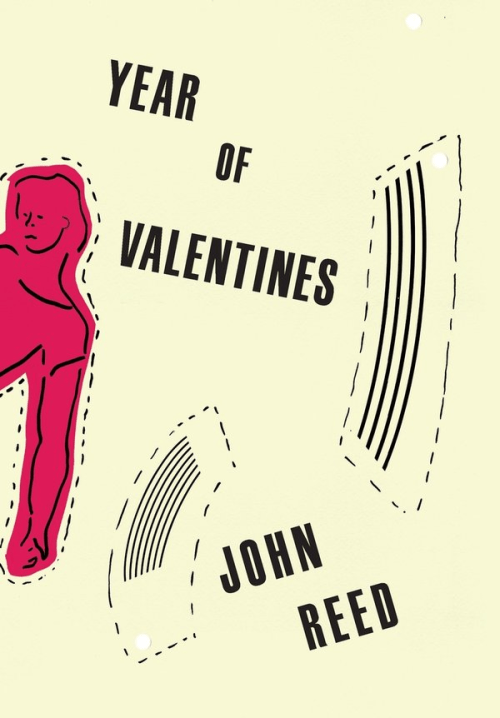
Year of Valentines by John Reed is a collection of sonnets, compact and rich. They offer the distinct, greedy pleasure of being legible in one go. They are not boring. A tight motion, a direct gesture, runs through each one, to the last line. (Though like any worthy poem, they do reward more measured, subsequent readings.) They are in the voice of a declarative “I,” frequently speaking to “you”: an extended hand, immediately intimate. They are sonnets of the experimental American variety, with no strict form.
These are valentines both sweet and bitter, offering roses and hiding knives. There are invitations to go for a drive, to stay out longer, to escape here and get to there, a striving to outrun the inevitable “days of disappointing gifts, and wet landings in unknown diseases.” There’s nothing naive about them, which is maybe what makes the love poems trustworthy. Disappointment does make an appearance, and a preoccupation with the necessity of lies.
If our world were to be obliterated and only replaced by the contents of this book, you would still be able to wander around downtown New York, go to a swanky bar, or take the D train to Coney Island and have a hot dog at Nathan’s. We would not miss out on the small wonders of cherrystone clams served on ice, spearmint mojitos, “candy bowls filled with wooden matches,” among many others. But remnants of the old world would be there, too. Sounds of horsehooves and bells ringing, stuff like a beekeeper’s hive, lions and bears, crows in the corn, ghosts, and “weedflowers in childhood meadows” buttress the glass city with earthiness and mystery. The sonnets’ variegated language reflects this balance of worldliness and otherworldiness: breezy modern slang (“floofy towels” and “crazy, crazy paperwork”) is sometimes deployed with a wry touch, while a rhythm of spells, songs, and children’s rhymes threads through poems in other modes (“But who then, darling, who, will name the roads? / Who then, darling, will shiver with the doves? / Dearest, darling, once my love, and who will rove?”).
John Reed is the author of 10 books, including novels, non-fiction works, and drama, as well as poetry. His essay “My Grandma the Poisoner” was selected for Best American Essays, and his work has appeared in publications such as Tin House, Artforum, Harpers, and Rolling Stone. He is the Director of the MFA in Creative Writing at The New School. I had the chance to ask Reed a few questions about his Year of Valentines collection over email.
Editor’s Note regarding John Reed’s portrait above: credit to Ann Craven

Megin Jimenez
I have to start with asking about the form as it’s the DNA that runs through the whole collection. Were classic sonneteers like Shakespeare and Keats an influence, or were you picking up on the American reinvention of the form? Or maybe you were coming from somewhere entirely different with the sonnet?
John Reed
For many years I thought of myself as a failed poet; I’d grown up around poetry, LANGUAGE and I suppose a Post-New York School—but then, during the course of my MFA, I shifted to prose. I could write good lines but I was aware that a whole poem, which I could recognize, had eluded me. My assumption was that poets should work without a net, and yet somehow arrive at denouement. Magic. (Ann Lauterbach comes to mind; and you do that beautifully too, in your collection, Mongrel Tongue.) But I had no idea how to accomplish such a feat, and didn’t expect I ever would.
In 2008 or so I worked through a project I began in college; I took apart the known works of Shakespeare and put them back together as a new tragedy, “All The World’s A Grave.” Hamlet goes to war for Juliet, a bloody unnecessary war, and Lear, Juliet’s father, goes wild with rage—as Iago sees his moment to exact revenge. Etc. Could AI do that now? But anyhoo, back then, I had to get mechanical with the text to make it fit together—I retained the meter, etc., of the Shakespeare. There are sonnets all over the place in the plays—more often embedded in longer speeches, and sometimes embedded without, even, line breaks (which you can find if you count out). That’s when I began to see the sonnet as this perfect machine. Very prose-y, with an argument structure that short stories deploy as well—so that was something I could take hold of.
Did I like the rhyme? Not really. Too hard on the ear, too insistent. So I worked more to slant rhyme: para, assonance, consonance. I wanted the sonic relationships to register, but not consciously. I guess as many people would these days? The ABAB form was too stiff for English, as it was even in Shakespeare’s time—that’s what I recall of the historical critiques, anyway—so I looked for an adjustment. And I like 13s. Friday the 13th, hanging day? European, medieval? Maybe. Celtic? Halloween? My favorite. So American, you know, waiting around for the Great Pumpkin. So, that.
Um, meter? Well, I suppose, but how could we forget about the elegant, spoken language of Berrigan’s sonnets? Or, Michael Lally’s snarly metrical charm? Michael’s son was my close friend when I was, I don’t know, eight? (PS41 forever. Callout, too, Tina Cane!) So, are the valentines still sonnets? I think yes, but I have heard them called “ghost” sonnets, which is also appealing to me.
Megin Jimenez
Ah, interesting to hear that both Shakespeare and Berrigan are in your ear! I’m glad you mentioned your attachment to 13. There’s always such an emphasis placed on the closing couplet when sonnets are taught; it’s interesting to set this expectation off-kilter. Reading through the collection, I began to be able to sense when a sonnet was 14 lines instead of 13. I wonder if this odd number affected your sense of trajectory, or the construction of the little machine, to use your metaphor?
John Reed
The expectation of 14 lines was so established I wanted to end them a little earlier. Off balance. Sonnets can be so round. Also, the poems are pretty witchy overall. There are a few spells in there. You know, lying in bed, casting out spells? I do have a sense that when you write a poem for someone, and publish it, the poem always finds them. Always. That’s a divine gift to poets. Oh, and also, the last line of the valentines is usually part of a tercet, so there are still the same number of rhymes, or arguably couplets, in the poem.
Megin Jimenez
There’s a striking series of seven poems or so where the speaker realizes there are strings attached to him. He is a puppet, and he comes to realize the entire world, the beloved, even the sparrows in the air, are also attached to strings. It’s an eerie series, and a departure from the sense of downtown freedom of the poems that precede. Could you speak to the metaphor or imagery of puppets? What was compelling and what made it stick?
John Reed
I’ve always been fascinated by puppets; or, ever since the life-sized marionettes first terrified me at the theater attached to the Carmine Street library. (Kindergarten?) In the sequence, there’s a moment where two puppets are trying to kiss: bonking their wooden mouths together. I saw that, first time, in the dark at Carmine Street: the horror and futility of love. And then, of course, there was COVID—right in the midst of me working on the sequence—and we were all heads in a Zoom puppet theater. You know how you put your hand in a puppet and it’s alive? !!! And then you take it out and it’s dead.
Megin Jimenez
To me, it translated as an awareness of a lack of control, or a loss of control, that has to be accepted in love—fair enough. But what was unsettling was the sense of a predetermined movement and outcome, so that any attempt at changing course is futile…
John Reed
Oh, that’s true. Thank you. I don’t have a sense that one can change course in these poems.
Megin Jimenez
The collection could be read as one long sequence, there are no sections or parts. In putting together the order, were you thinking of it as a single speaker on a journey from one place to another, or was there another pattern or sense of movement determining the order?

John Reed
Gosh, the order was really hard. In ordering, I was thinking about not having ideas conflict or feel repetitive—and then there was the problem of which poems to pair in the spreads. I had help in the final sequencing; lots of reads. On the one hand, the poems were written as standalones, but because they shared NYC, and themes, and the second person POV, I discovered there was more of a “narrative” than I’d planned. But, oof, the order. There were moments when I was, like, queasy, looking down the rapids, not sure there was a line.
Megin Jimenez
The motivating impulse of so many of the poems is a command or an invitation, a direct engagement with “you.” I wonder if this is how you started—the poem as a question or demand—or did it take this shape later? And, maybe relatedly, the title of the collection is “Year of Valentines.” What does “valentine” mean to you?
John Reed
Hmm, so a few of the sonnets are, uh, “actual” valentines, at least in my estimation: “Be Mine” and “Momma.” And then so many of them feel pretty Valentine-ish to me, but maybe that’s because I was thinking about it? That invitation, as you say: “Ten Years,” “K,” “Early & After.” A bunch of them. But then also I have this notion that by the time you write a valentine it’s usually too late, and most of the remainder fall into that category. Maybe a few are more biographical, maybe a few are about work? A few about friendship? The work and friendship ones are still love poems, no? And the biographical ones, I thought maybe necessary as a key? As an unlocking of the “I”? “The Dutiful Fireman” was the last sonnet I wrote in the sequence, and I think was required to make the project complete.
So, process-wise, they didn’t all start valentines, though some did. Usually, I’d compose the poems in my head and then write them when they were drafted through, probably mostly done, and share them out on whatever social media platform—I’d tweak after that, based on how I felt or comments, and then I’d take them down, and repost in the next draft. I suppose in that way the poems drew closer together, and I did note a leap of the “like” ticker around Valentine’s Day, so I asked myself if there were a few more I could revise into valentines. That had me wondering what a valentine poem was. Hmm, I decided: epistolary & second person. I tried the measure as a revision for the poems that fell outside the constraint. Hmm, much better. So they all ended up that way.
Mmm, and there’s also this element of valentines that I think is common to sonnets: the forms do very well, simultaneously, with the quotidian and the big stuff. All the better, together. That’s what the form likes.
Megin Jimenez
I first read many of the poems on Instagram. I thought it was brave to post them as they’re decidedly not “Instagram poetry” (as we’ve come to understand the term). But it was wonderful to encounter them on Instagram, surprising. The abundance and range of their language gave me a woozy feeling, in a good way, in a “place” that seems hostile to complexity. It sounds like posting the series as you were working on it was a positive experience for you. Can you speak a little more to the experience of relating to a readership via social media? Would you recommend other poets post work in progress?
John Reed
I don’t know that I’d recommend it on Instagram anymore. I was lucky in the timing: when I started posting them on Instagram the algorithm was really favorable and I was getting attention. Then reels came along, so it’s a fraction of a fraction of the views. Not as fun. I’m always hunting around for that next platform, but alas, none of them have been satisfying to me. If anyone can help, please help.
POETRY
Year of Valentines
By John Reed
Spuyten Duyvil
Published May 6, 2026


