


The first story in Lucy Caldwell’s Devotions, “Hamlet, a love story,” quickly and compellingly constructs a whole world. Sonya, the narrator, is part of the cast of Choose Your Own Hamlet, a Hamlet reimagining in which Hamlet chooses the direction of the play after Act I, repeating scenes as needed, “as if each time he might notice an escape route that’s eluded him before.”
The conceit is background for the events of the main story, in which Sonya reviews scenes from her own life as if wishing she could get back to the time before Spencer, her husband and the original lead in Choose Your Own Hamlet, died. Instead, she can only move forward. In the Choose Your Own Adventure books, Sonya remembers, “inaction was punished. Your only hope was to push on through—to seize the narrative.” Caldwell’s characters attempt to do so in the face of grief and uncertainty.
Caldwell’s collections are some of the most thematically unified that I’ve read, and Devotions is no exception. “Hamlet, a love story” sets the stage for a series of stories in which ghosts and memories of the deceased abound, as do the more complicated hauntings of made and unmade choices.
In “A Family Christmas,” the narrator is wondering whether her husband’s medication has stopped working when she has the sudden realization that she might be pregnant. The story becomes another sort of choose-your-own-adventure as she maps out her possible next steps. One of Caldwell’s writerly powers is a precision in capturing characters’ internal lives, so that even reading about someone’s decision-making process is engaging: “And all the while, all the while all the while all the while,” the narrator of “A Family Christmas” thinks, “to have such a dark and secret alternative reality opened up inside you—she couldn’t quite square the cognitive disconnect, nor believe that she was capable of it, this level of dissembling. Capable of talking Nectar points, of listening to carols and drinking mulled wine, and making meals, and making conversation… I have become a stranger to my brethren, she thought. I am a stranger unto myself.” Who hasn’t had moments like this, of feeling one’s brain running on two entirely separate tracks at once?
The other side of choice is regret, and Caldwell’s stories capture the pain of it with that same precision. In “The Day He Met Jesus,” the narrator looks back on a moment when she wishes she had taken one of her grandfather’s stories more seriously, even though her grandfather has been dead for years. Even Caldwell’s characters who live with fewer regrets are overthinkers—or maybe just artists with a tendency to dwell on the past, like the narrator of “Harmony Hill,” who spends a plane ride remembering the chocolate-box violin on which she first came to understand music.
Some of the tension in these stories comes from the characters’ astonishment at the passage of time, at how hard it can be to find order and neatness in one’s own lived narrative. “How can you have grown up, have married, have chosen the things to which you will be, to which you are, devoted?” wonders the narrator of “Little Lands,” a story about the Captain’s dance with Maria in The Sound of Music. “Is there something awry with your life… that you have so often missed the point of things entirely?” the narrator of the final story, “Devotions,” asks herself. “Or is the lesson that grace, true grace, is an unsought-for gift, that can’t be expected or achieved by striving? That we misunderstand when we try to wrest things down to our level, and into narrative—into story?”

Caldwell stops her stories short of wresting, and while that might frustrate readers who want to know what happens to her characters, others will find her mix of optimism and melancholy, her acknowledgment that there might not always be a meaning to grasp, reassuring.
One of the longest stories in the collection, “All Grown Up,” reads like a sort of coda to “Choose Your Own Hamlet.” In the latter story, Sonya leaves the first man she’s slept with since Spencer, unsure what will happen next in her life, what choice she’ll make, knowing only that she needs to take some kind of action. In “All Grown Up,” Luke, grieving the loss of his mother and a recent divorce, reconnects with Emma, the younger sister of a girl he dated as a teenager. Luke’s life is in transition as he cleans out his mother’s house and tries to figure out what he might want to do next, and Emma is struggling with her own grief and life changes. The actions Luke takes feel almost minute—putting some of his mother’s crystal on Facebook Marketplace, volunteering locally—but each small action opens up a new set of options, eventually adding up to a changed life. When Emma consults a medium over the phone, the medium tells her that whatever Emma and Luke “chose to do, or didn’t do, it was all ok in the end.” What matters is the act of trying, of testing—of deciding to seize the narrative.
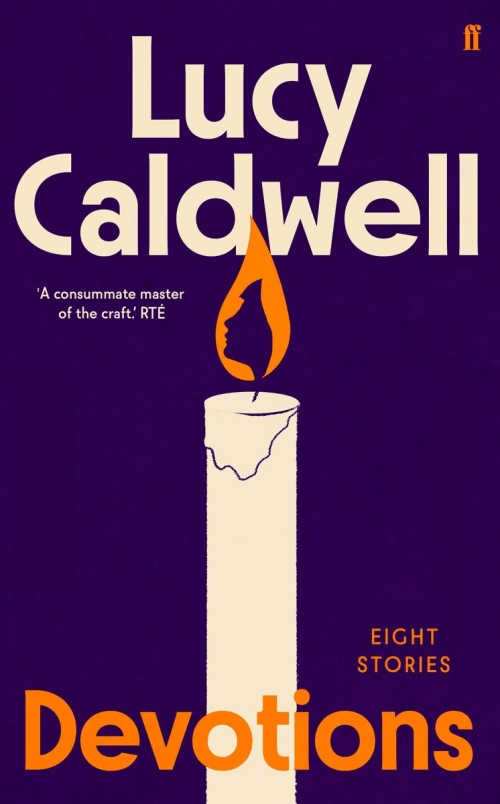
FICTION/SHORT STORIES
Devotions
By Lucy Caldwell
Faber & Faber
Published June 30, 2026


