


In honor of the 10th anniversary of the Chicago Review of Books, The New Chicago Renaissance series revisits exemplary works of literature about Chicago from the last 10 years and explores their continued relevance. Join us all year long as 12 leading writers and artists explore books that they love and why they’re meaningful to our understanding of modern Chicago.

I get super embarrassed when I think of The Great Believers. My face is hot and red right now reflecting on it because back in 2017 I asked Rebecca Makkai for an advanced copy. We had known each other for all of 15 minutes—I had zero business making this request, but I couldn’t stop myself. A few months earlier, I had read her excellent short story collection Music for Wartime and was low-key obsessed the way you are when you discover an author you love.
How was it possible she lived right here in Chicago? I so adored her short story collection that I needed to be in her company right away (OK, so maybe I’m high-key obsessed) and reached out to invite her to be part of my storytelling show and (GASP) she said yes. I couldn’t believe it—I didn’t even have to give her the hard sell or offer to clean her house! When I met Rebecca in person the night of the show, she was so supportive, charming, funny, and kind—a total delight—everything you want your new favorite writer to be. She’s an extravert—I didn’t know writers were allowed to be extraverts—it was disarming and made me more confident about my place within the world of writers.
At the time, I didn’t know many writers with real-life books, and was fascinated with the idea of reading someone’s work before the rest of the world. So, when I heard Rebecca had a new book coming out, I threw myself at the chance to read it as soon as possible. Afterall, it was a story about the AIDS crisis in Chicago. I am gay—AND— live in Chicago—I was supposed to have this book. I put on my very best “this is not at all a wild out of my league request” face and asked her for a copy. She said yes, and my jaw is still on the floor this many years later.
When The Great Believers arrived in the mail, it felt like magic. I never had a free book appeared on my doorstep, and for sure not one that most of the world hadn’t had the opportunity to read. I vibrated as I cracked open the giant manilla envelope it arrived in, grabbed the book and dove into my bathtub. The bathtub, in case you aren’t aware, is the very best place for novel reading. I was engrossed in the story from the first line and could not put it down. As I read, I kept filling and refilling the tub with hot water to keep my bath at an acceptable temperature (the only flaw in tub reading), but eventually had to transfer to the couch due to pruning (the only other flaw of tub reading). I read right through the night only stopping for snacks.
Beyond the Chicago and gay of it all, I felt a special connection to the book right away. Yes, someone I sorta kinda knew had sent me a novel they had written and that felt significant, but it was bigger than just that. The Great Believers felt personal. I was coming of age in the brutal time of the 1980s when part of the book is set. I’m about 10 or 12 years removed from the generation of gay men most directly impacted by AIDS, but every night the evening news treated me to heartbreaking scenes of its devastation.
In the 80s, I knew there was something different about me, but I didn’t have the vocabulary to put a name to it. Yes, I was effeminate in all the ways that earned me the wrong kind of attention—I was obsessed with Rainbow Bright and Madonna, tied my jacket around my head at recess so my long flowing “hair” would blow behind me on the swing. I didn’t know, but everyone around me sure did. The word most often hurled at me was “sissy.” My mom would tell me, “So what, who cares? Liberace is called a sissy and he’s laughing all the way to the bank.”
Sure, she was correct, except when he died from AIDS in 1987 that sentiment lost all its power. I was in 5th grade and the pejoratives exploded. I was a fairy, gay, queer, and my personal favorite—a fag. It was relentless. “Run,” they would yell, “He’s got AIDS like one of those fags on TV.”
Gay and queer people were so reviled at the time that I was certain those kids were right. I was light years away from any sexual experience, but I was certain I must have it. By the time I understood myself to be gay, the prevailing idea in my small Southern hometown was that gay equaled AIDS. There was a direct line from one to the other. A fever, a cough, a rash—everything was a sign I was on my way to the grave.
The world was a different place then. There were no counselors or social workers at my school to speak with, no therapists, and the internet didn’t exist. There was nowhere to turn to help me walk back this bigoted and unhealthy thinking, and so it stayed with me for a very long time.

What so many of us could have most used back in those days was a team of mentors. I sometimes daydream about the set of gay or queer ancestors and all the guidance, love, and support they might have offered us. The magic of The Great Believers for me is it brought those queer ancestors of yore to life. It made that generations of aunties (I think they would like this monicker) real. Thanks to Rebecca, I could at long last put down the visions of stick thin men in hospital beds, and finally see my fully realized living breathing forefathers.
This might all sound dramatic given our current world where we have made incredible strides with HIV and AIDS. Queer folks are everywhere. We’re on TV and in the streets with gorgeous lives and opportunities I wasn’t allowed to imagine way back in elementary school. I was so full of fear, so riddled with internalized homophobia that I couldn’t fathom being supported in the way we are now. I couldn’t see the life I now live with my husband in a house with neighbors who talk to us as if we’re famous simply because we’re a couple of married dudes. We are the hopes and dreams of Yale Tishman and his friends. An over-the-top and absolute factual statement all at once.
Everyone once in a great while a novel comes along that feels personal—as if it had been written just for you. The greatest books do that, and for me (despite my embarrassment about asking for a copy) that is how The Great Believers feels. I will always be grateful to Rebecca Makkai for The Great Believers, for the generosity of sharing her work with me before it was released, and for giving me and so many of us our aunties back. I love The Great Believers. It healed my heart.
FICTION
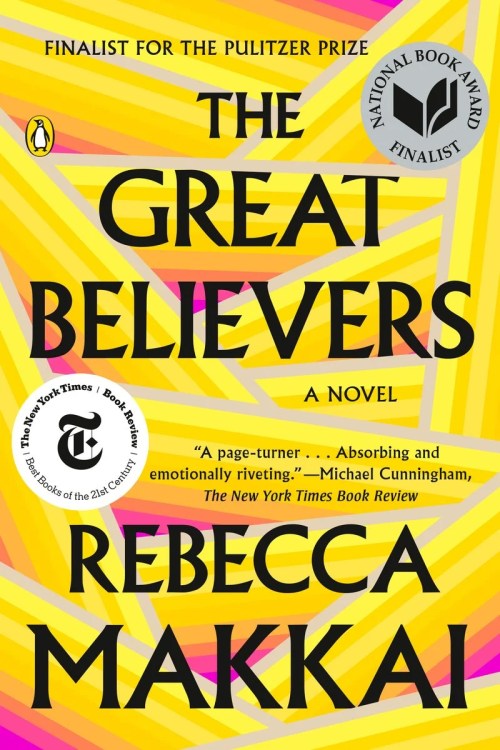
The Great Believers
By Rebecca Makkai
Penguin Books
Published June 4, 2018


