The working poor have receded from view even as their numbers have increased. In fact, they have receded from view because their numbers have increased; their erasure from public discourse is part of a widespread effort, conscious or otherwise, to obscure growing inequality, as though the problem could be resolved by refusing to acknowledge it. Trump’s constant insistence on American prosperity and his claim that “the word affordability is a Democrat scam” is only the most visible example of an attempt to identify the nation with its wealthiest members rather than its struggling majority. The problem is not confined to government talking points. The working classes may appear in news reports and documentaries, but they are absent from much of popular culture. Despite growing anxieties over the cost of living, online platforms are crowded with videos and images of conspicuous consumption, of people documenting their experience of exclusive flights and resorts, their collections of rare cars or watches. Even everyday activities have been reimagined in these terms, with cooking videos often now focused on luxury ingredients, on wagyu, caviar, and truffles, prepared with similarly expensive equipment. Between these glimpses of unobtainable lives are advertisements for schemes to make money by gambling, often represented as investment or prediction, as games of skill rather than of chance. The result is not only to fetishize wealth, but to sever its connection to labor. The idealized internet subject consumes without producing.
In this environment, literature about work and workers has a particular significance. As Jacques Rancière argues, politics is the struggle over “the visible and the sayable,” over who matters and who does not. Vanesha Pravin’s new volume of poetry, Gold Country, insists on the ability of literature to intervene in this process, to explore people and practices that are always present but rarely acknowledged. Its pages are haunted by those working low-wage jobs, particularly in the hospitality industries. Wait staff appear in several poems, for once in the foreground. Service has traditionally been invisible, enabling the privileged to benefit from labor they barely acknowledge; the houses of the wealthy still sometimes have concealed corridors so that staff can move around without being seen. It consequently exemplifies work that is not merely ignored but deliberately obscured. The narrator of “US Military Budget for Fiscal Year 2019 Reaches over $700 Billion” evokes this tradition when she observes that diners “saw me without seeing me.” Pravin makes her visible. This means emphasizing her precarity as well as her labor; she is a worker even when she is reduced to pounding “the pavement with an / updated resume like I had many other times,” searching for another position as the bills accumulate, “late fees on top of / interest.” The deliberately prosaic title, its source carefully noted in the acknowledgements, encourages readers to understand her situation as the product of deliberate policies rather than just impersonal forces; the American government spends more on its military than the next ten countries combined but does not provide its citizens with a meaningful safety net or essential services such as healthcare. This absence of support contributes directly to her insecurity; when she sells “a third of my possessions” it is partly to meet “hospital bills.” Despite being worn out by her unacknowledged labor and the “joint pain hushed by the frenzy of the / dinner rush,” she asks “Good Samaritans” to “never ever call an / ambulance for me again. Each one costs / ten thousand dollars and one CAT scan is a year of college tuition.” Her “work ethic” results not in the independence promised by the American dream, but the slow breakdown of her body.
The damage caused by work is a recurrent theme in Gold Country. In “Vegas: The Cocktail Server,” the woman who “drops off / highballs” endures a “double shift in gold stilettos.” Her “body testifies” to the strains of a job that is rarely seen as physically demanding, but which leaves its trace in “a pinched nerve in the / ball of her right foot, the night / a toenail fell off, the time of the heel spur, bunions thickening / under gold straps.” The glamor she performs causes and obscures her pain. In “Soccer,” the waiters watching the World Cup in a “sixth-floor walk up— / sparsely furnished with used mattresses, / lawn chairs, and a television,” use their shared experience as spectators to “forget that their minds have been trapped / and that slowly, their bodies will fail them.” They are not merely used by others, whose comfort depends on their exertions, but used up, worn and aged by their repetitive labor. In “Career Waiter,” the central figure embodies the end of this process, as he finds himself “[g]rowing older in the wrong place at the wrong time,” after a life “[d]reaming feverishly at a chance of independence.” People may take pride in their work, in their skill and efficiency, but it rarely provides the agency, the possibilities for self-development, or even the material comfort and security it promises.
Fortunately, work is not everything. Gold Country both focuses attention on labor and challenges its centrality to our lives. In the opening poem, “Civilians,” Pravin imagines the “ghosts of dead workers” and asks “[h]ow many of them / mourned the committees they did not chair // when they were still alive?” There is a world elsewhere, and even, occasionally, suggestions of what it might look like. In “How to Read the News,” Pravin notes that “Headlines exist, but let them // Appear far away with the smartphones in the trunk so / The cormorants can be seen in entirety for once— / Some subversive, perched on the rock, spurning // Groupthink.” It is important to recognize work, to see the necessary labor society conspires to obscure; it is also, sometimes, necessary to ignore it. Gold Country manages to do both.

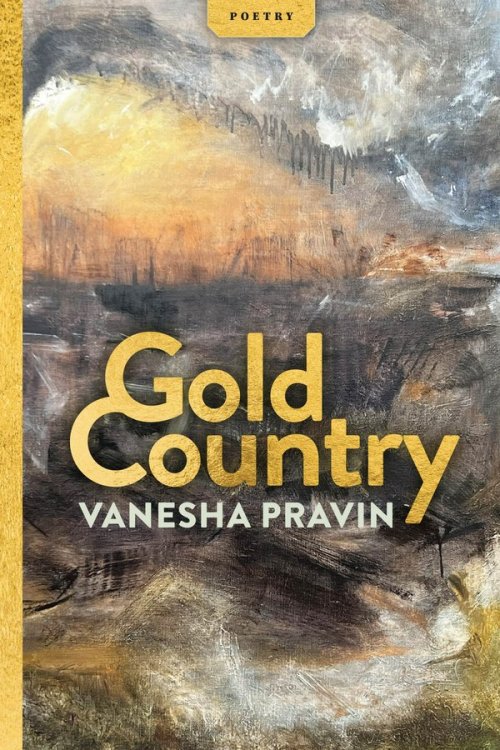
POETRY
Gold Country
By Vanesha Pravin
Ohio State University Press
Published November 2, 2026