


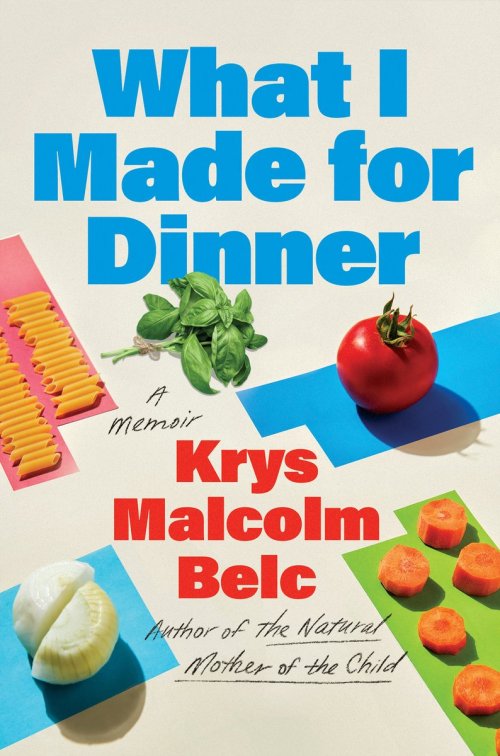
Everyone eats, but not everyone cooks. There are few domestic chores as repetitive as cooking dinner, a daily routine required with more frequency than other household tasks. For Krys Malcolm Belc, cooking for his family is more than an essential chore. It’s an act of caring, of love, and in the case of his new memoir, What I Made For Dinner, a lens through which he analyzes his own life.
Krys and his wife Anna have four children. He’s also the author of a previous memoir, The Natural Mother of The Child, where he examines his experience conceiving, birthing, and breastfeeding his first son. Krys, a trans man, since transitioned, began a regiment of testosterone, and identifies as he/him.
What I Made For Dinner begins with a simple premise: Krys was at home with the children, “so was now on the hook for feeding five people.” He makes it sound like a burden, but the reality is Krys loves feeding his family, and preparing the food, a task his wife Anna seems indifferent to. But like many recent narratives, the pandemic becomes the narrative’s inciting incident, upending their lives, and serving as a catalyst for Krys to combine cooking with close personal analysis.
The memoir is more than simply reflecting on the dinners prepared for Krys’s family. The narrative is braided together with reflections on the television cooks behind Krys’s passion. Cooking is a learned skill, and for Krys, he learned to cook watching Sara Moulton, the host of Sara’s Secrets, and editor of Gourmet, and the first section of the book. The memoir is organized around the cooks Belc has watched and worshipped and learned from, including Claire Saffitz, Deb Perelman, Ina Garden, Alison Roman, Ree Drummond, Stella Parks, Bridget Lancaster, and Julia Collin Davison. But Krys’s narrative within the memoir builds chronologically, woven in and out of these celebrity cooks.
Belc wanted another baby. If the pandemic set in motion the writing of this memoir, Krys’s story begins with the desire for another child, a baby he births himself. He gives up the testosterone that he has only recently begun a regiment of, but that transformed his body. He observes the changes, and then confronts the reality of getting pregnant. It’s related for many parents, not because he’s a trans man, but because he also acknowledges he’s continued to age since his first son, and his body is simply older.
Weaving his story around the lives and television shows of his favorite celebrity cooks provides an essential structure to the narrative. It’s more than a lens, but a reason to read. Krys and Anna’s enjoyment watching these cooking programs creates a clear familiarity between reader and writer. More importantly, at least for those who are familiar with the culinary personalities, reading the book feels like spending time with old friends, or at least, gossiping about them.
Belc also offers an examination of these hosts, analyzing their behaviors, and sharing their not-so-secret secrets. For instance, Belc examines how Claire Saffitz code switches on camera from “snottilty telling” Brad Leone his show, It’s Alive, about fermenting foods, was easy, to sweet talking a baby on set. Part of the allure of Safftiz’s Bon Appetit show, Gourmet Makes, was the increasingly difficult challenge to recreate highly processed foods, but using methods and ingredients that are far more high brow. Belc recognizes how these personalities are a representation of these people, but one that is curated and crafted.
Krys juxtaposes the presentation of these culinary celebrities with his own journey on and off testosterone, and the different ways we all manifest public personas. “We are all acting to some degree,” Krys says, right after complimenting a coworker for seemingly having their life pulled together in comparison to his own.

This book is more than a memoir. It’s a commentary about how we consume food media. Several of the personalities like Saffitz and Roman are primarily online exclusive, first through the polish of professional publications’ streaming, and then through their own channel. In the shifting media, the loss of power among big, traditional publishers like Condé Nast is made evident not just in the fact that these hosts have cast off their corporate binders. They have altered the way we perceive media. Belc observes, “I liked that online food programming didn’t have the artifice of plot, and I liked that there was no live audience. I was the audience.” The new media landscape is one that has a more casual intimacy with the viewer, and that’s replicated in Krys telling us, the reader, about the intimate changes to his body, to his relationships, to how his family has evolved.
The success of What I Made For Dinner is in tying together two seemingly entirely disparate narratives into a compelling commentary on the present moment through the banality of domestic life. The book is both a close reading of celebrity culinary personalities, and a personal narrative of wanting and struggling to conceive another child. It’s smart commentary on feminism, gender, and consumerism, but also a compelling personal story. Alone, either one of these plotlines would wither, but bound together, Belc delivers a unique, while relatable, journey of an ordinary family.
NONFICTION
What I Made For Dinner
By Krys Malcolm Belc
Catapult
Published June 9, 2026


