Trash! A Garbageman’s Story is a chaotic, contradictory memoir that accomplishes author Simon Paré-Poupart’s goal to shatter the fantasy that trash magically disappears. The memoir focuses on observations over solutions, which will disappoint readers who, like Paré-Poupart, want to fight excessive waste, but he successfully provides an antidote to implicit messages of throwaway culture: to be a garbageman is to be a failure, and like our trash, garbage collectors should be invisible.
Simon Paré-Poupart is an anomaly among garbagemen. The author grew up middle-class in Quebec, began working as a garbageman in the Greater Montréal Metropolitan Area immediately after high school, and continued through his bachelor’s and master’s degree program. He kept working as a part-time garbageman after graduating, while also working as a journalist and social worker. At the beginning of Trash! Paré-Poupart states that he wants “to give you a glimpse of the world of trash as it came to be revealed to me: through a series of surprises…. I’m telling my story because I want others to understand this passion of mine. I want the garbagemen of the world to be seen for what we are. Above all, I want you to stop believing that your waste disappears ‘by magic.’”
The memoir bounces between anecdotes about collecting garbage and how people view garbage collectors, short profiles of his fellow garbagemen (Paré-Poupart observes that almost all trash collectors in Montréal are men), pithy quotes about trash and trash collectors from social scientists, and brief explanations of the origin and problems of excessive trash production. The author’s choice of breadth over depth allows readers to dip their toes into the world of trash collection though it doesn’t permit for more than a quick visit, making the book feel like a series of short stops on Paré-Poupart’s collection route.
Paré-Poupart states that his passion for the physical challenge and logistical puzzle of the job is what’s kept him a garbageman for twenty years, and anecdotes about him and his coworkers focus on the split-second decisions and athleticism necessary to collect trash. The focus on physical details makes it easy to admire the garbagemen of the memoir—who wouldn’t admire a man who can calculate in seconds the most efficient way to maneuver 200 bags over fresh snow versus ice? Or who can pick up a washing machine with one hand and chuck it into a truck? By peppering the reader with stories about the strength and ingenuity of garbagemen as well as the history of planned obsolescence and the overproduction of waste, the author easily wins his case that being a garbageman is as civically virtuous as it gets. Paré-Poupart’s multiple examples of our specific demands of trash collectors, such as pressuring them to get the garbage out of sight as quickly as possible while also being as invisible as possible, support his argument that society vents its anxiety about the endless amounts of trash we generate onto the people who deal with our garbage.
Throughout the book, Paré-Poupart draws clear lines between those who collect trash and those who only produce trash, whom he sarcastically refers to as “the good citizens” and “the virtuous taxpayers.” His memoir takes an unapologetic “us vs. them” stance, and his style of describing the characters of the memoir flips the usual depiction of trash collectors, making garbagemen stand out against the background of neighbors and “good citizens,” instead of being part of the background themselves. The garbagemen of Paré-Poupart’s memoir have names, histories, personalities, even signature movements while handling trash. In contrast, the “virtuous taxpayers” are always nameless, always the same persona, always physically idle. Although it comes at the cost of making the non–trash collectors into caricatures, Paré-Poupart’s decision to only differentiate garbagemen makes invisible labor visible and smashes the illusion that trash takes itself out.
In addition to the tension running between those who collect trash and those who only produce trash throughout Trash!, Paré-Poupart’s memoir features another contradiction that is never answered. The author is a garbageman who loves collecting garbage but hates excessive waste production, including the bureaucratic waste of trash collection systems. Garbagemen’s tasks, he points out, are made unnecessarily harder by the choices of community members and leaders: from refusing to pause or modify garbage collection during extreme weather to ergonomically bad compost bins that don’t take actual garbagemen’s bodies into consideration. The author doesn’t offer solutions to these problems beyond asking readers to listen to garbagemen when making decisions about waste collection, encouraging individuals to consume less and reuse more, and telling governments to outlaw plastic production beyond what is absolutely necessary. At the end of the day, Trash! A Garbageman’s Story is exactly what the title states, not a blueprint for overhauling the work conditions of trash collectors or curbing waste production, but simply a garbageman’s story.

NONFICTION
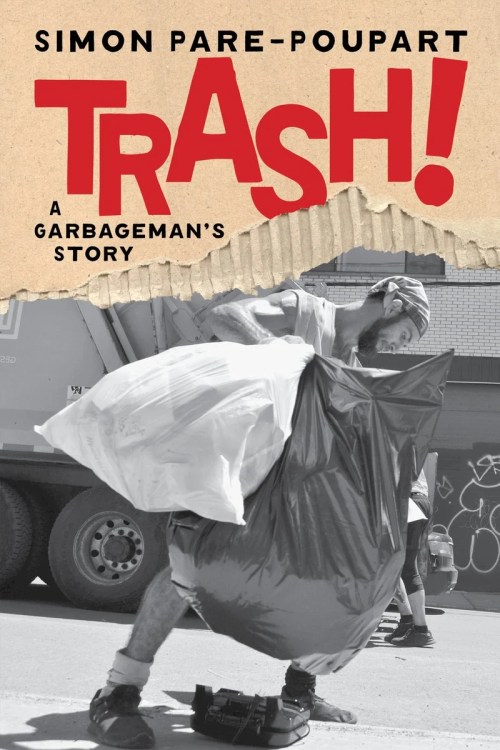
Trash! A Garbageman’s Story
By Simon Paré-Poupart
Melville House
Published June 16, 2026