


There are lots of parenting books, and fewer queer parenting books. But I’m hard-pressed to find queer fertility books that don’t end with a baby at all. The baby, I joke with friends, is like Chekov’s gun: if you write a fertility journey into the book, it has to end with a baby, or at least this is what conventional book publishing wisdom might say.
I would know a bit about this myself: I’ve tried and failed at IVF with my XXY partner, our known donor, being a carrier for a rare disease, and many other complications. But Joseph Osmundson took a different tack. Their journey made room for the sort of book that didn’t yet exist: a wildly inventive structure, an extended metaphor, and a fish kid named Fry. I loved his first book, Virology, and was so delighted to discover that their new book, Spawning Season: An Experiment in Queer Parenthood, contained many of the same characters. I tore through this book in one sitting, falling in love with the sentences, the way that the book unfolded, how it could have also easily been a food memoir, and the way in which he explicates the science of it all.
I spoke with Joe via Zoom.
This conversation has been edited for clarity and length.

Emily Maloney
Can you talk about how this book came together? Because it’s so different from anything else I’ve ever engaged with on any level.
Joseph Osmundson
My favorite thing about Mo Crist, my editor, is that they [initially] said, “Joe, this is not a good book.” Some of the writing was good, but the main thing was that the structure wasn’t there yet, and so that was really a collaborative process with me and Mo. I went over to their house and they made a Chinese boiled chicken set with chicken rice, and we ate dinner with them and their partner, and didn’t talk about the book, and then spent about two hours talking about the diverse threads of the book. The science writing, the memoir, ecology, food writing was all sitting there, but that’s a lot, and it’s not a long book. I wanted it to be a short book, and the interweaving wasn’t working yet. All those threads were there, and it felt completely overwhelming. Mo said, what if the food came out of the book? Or what if it were two things instead of four things? I was really committed to interweaving all of those aspects, because that’s what I lived, right? I didn’t want to write this book as a novel, even though I had to fictionalize elements of it to protect the privacy of the other people involved. This happened to me. I lived this experience.
I went through where my body did my half of making a child and then that child did not get made. There’s writing about these types of losses, but not usually from the person who doesn’t have a womb, who isn’t wanting the child inside of them. I know that is a much easier position to be in, in a lot of ways. But it was also very weird that I went through my biological process outside of my body, and then it ended. I often tell people that craft is how you survive the writing of the thing. And it became so for this project: how can a reader experience this with me? Because it was so overwhelming at the time, and the reader was not going to experience that; they’re going to get the information as I share it with them. How can I share the information in a way where they go on this journey with me?
Emily Maloney
Were you constantly shuffling sections until everything felt like it came together? Tell me more about the editing process with Mo. Did you label or color code things? Can you tell me more about how crafty you got here, especially with plot?
Joseph Osmundson
Mo gives both high level edits and then low level edits, so line edits on the writing and high level edits about structure, but they basically ask me to figure it out, and that’s sort of why we work well together. Their notes always come to me where I’m given the keys to unlock the boxes. For me, one of the surprising things that happened in the book, and one of the things that I needed to be reflected is that when I didn’t have the child I thought I was going to have, I had this ghost grief about losing my ex. What got me through the worst grief of my life thus far, at that point, about losing my ex, was that he didn’t want to have a kid this way, and was preventing me from doing it. When [not having a kid] imploded, it made it feel even more that way. We shouldn’t have children to fix our own grief, but we all kind of do in a way, and so that that grief came back.
Structuring the book with this first chapter, all the reasons why I’m not going to have a kid because of someone else, was a lie I was telling myself. I was making that choice. I was participating in that choice. I hope that the reader experiences what I felt a couple of years after that: how lucky am I that this horrible thing happened to me, such that now I can be a dad. When that was lost, the grief was compounded. That was always going to be the plot of the book that I wanted, and what had to shuffle was all of this shit getting in the way of that, which was the science writing, the fish stuff, it all needed to be amplified. That was really hard, because there are a million different orders that it could be in outside of the memoiristic plot. There was a lot of shuffling back and forth of spreadsheets, thinking: what is the metaphor of this particular story of the life cycle of salmon? What is the metaphor for what happens when farmed salmon get out of their fish pens, the freedom that they have achieved, and God bless them, escaping their pens and then the ecological destruction that they create to local populations? There was so much about longing and brutality. You want a kid so bad you would kill for it. And that is reflected in large salmon eating smaller salmon of their own species, the relationship between orca whales and the fish that they have to eat, and the orca whale’s relationship to their young, the salmon sharks. Ecology was so full of the longing that I felt, and so it was about ordering it in such a way that whatever was happening in the main plot felt not distracted from but amplified by what was happening in the other types of writing.
Emily Maloney
The science always feels so smooth. There’s a way in which you zero in and tell the science story in a way that I don’t know you’re a scientist. Most scientists do not tell the science story; they’re not made in this way. Can you talk a little bit about that?
Joseph Osmundson
I wrote that essay recently about Anne Carson and Richard Siken, and there’s that tension between the two of them, because Anne Carson clearly longs for control in her writing and in her life, in such a way where zooming into cells and molecules gives her that agency. With Richard Siken, writing about his brain and his stroke overwhelms him to the point of disgust. I am the type of scientist who imagines life as a collection of molecules, which gives me agency over understanding the molecular forces that drive my decision making. Grief is a complete systemic overwhelm, and turning to the molecules inside and outside of us and other animals calms me and gives me a sense of agency. I think many scientists feel this way, but are not always aware of the macro reasons why they do science. It’s what I tell my students all the time: a scientist will spend 20 years of their life discovering something so minute that it will never have the possibility of going into a textbook, and you have this faith that your tiny push in knowledge, combined with everyone else’s, will do something esoteric to the world. I think one thing that a liberal arts education gave me was the ability to do a meta-analysis of why I want to spend my one small, insignificant life toiling at questions on the margin. I think that that curiosity shows up in the writing, and that that impulse to take something that’s happening in my life and to zoom in so far past the visible to the invisible in my life as a human, that gives me solace, and so I think that that shows up in the writing—that turn is almost inevitable in my thinking.
Emily Maloney
Can you tell me a little bit about the spreadsheets? (There were spreadsheets.) How are you using spreadsheets to structure the book?
Joseph Osmundson
There were so many spreadsheets. They’re all Google Docs. I should code it all in R. I could get into playing with coding language and spit out the book in a totally different order, and I could read it and that would be fun to play with. I enjoy writing most on the sentence level. There’s something really transcendent about finding the correct language to say a small thing, the perfect placement of a comma to give breath to a sentence on the page. I knew how I wanted to tell the story: more or less chronologically. The in between can be really difficult, placing paragraphs and sections and chapters. So, I have Google Docs, and I rearranged the book there. I can look at the spreadsheet from the book, however many versions ago.
I sometimes put paragraphs into cells, but usually it’s more an exercise. There are these plot craft books that tell you to give a score from 1 to 10, from happiness to devastation, for the mood of each section. Books can have different shapes, but the typical shape is: the worst thing happens. And then it’s resolved and the book ends. I tend to resist very normative plot structures, but it helps you see what you’re doing. Suddenly I could see what Mo saw when they first started editing the book. The loss of the child that I thought I was going to have comes pretty early in the book. The resolution takes a really long time. Most first responses were: this is way too early. [Mo] didn’t really tell me to change that. It was about making that feel more intentional.
Emily Maloney
At what point did Fry emerge as a character, or was she always there?
Joseph Osmundson
She was, but I wasn’t willing to admit it. She came after Mo’s initial edit. The animal that we really called the child we were going to make was not a salmon. It was very important to those involved that the animal not be named. My friends were right, and turning Fry into something that was just mine was incredibly healing. That I could have a separate thing that could speak to me and she was always there. I think she was there when I was in Lamaze classes with my mom, as a child. When I read some Jung philosophy about the anima, and I admitted in therapy that there was something in my subconscious that was screaming and I was not allowing [that thing] to come out. And writing is not therapy, right? But I would not have written this book, in many, many ways, if I hadn’t [gone]. I was tapping into my subconscious in a way that would not have happened, at least not on this time scale. Maybe after decades of Freudian therapy. But a lot of the early drafts were inhibited. I think Mo’s request for me to not be inhibited allowed my subconscious to speak in a way that was really necessary, both for the craft of the book, for its outcome, for its impact on readers. And, ultimately, for my own healing.
Emily Maloney

How do you avoid being consumed by grief?
Joseph Osmundson
Writing it is one way to externalize it. The way I write nonfiction is: if people are still in my life, they read the book and consent to it going out to strangers. That being said, I felt if the folks who lived this with me couldn’t let me turn something that was a void in my life into something that was an object, a book that that was so essential to me, externalizing the grief, making it an object, making it less lonely, because it was really hard to find other stories of people who had lost children in the way that I felt as though I had experienced this loss… I’m of the belief that forgiveness is not real. Forgiveness is a lie we tell ourselves to feel better, and I don’t particularly tell myself that lie. Grief is just an experience that is co-constitutive with the human experience and the grief that I had when I lost the Wesley character in this book, and the grief of losing Fry. I really am a different person than the person I was before I felt the grief of losing Wesley, and that was the first grief I felt in my life that did that to me. With Fry, it could not have been more different, because they felt very different in my body. But I think that’s one of the big things that writing and art can do: American culture wants you to go to a funeral on Sunday and go to work on Monday, to eliminate our humanity on a very profound level. I think art that reflects grief in all of its messiness and all of its humor, in the way that twenty years later, that grief might be smaller some days, but might also not be smaller other days, is really important to me, and I don’t know that it makes it better. But with this book, it was inevitable.
Emily Maloney
Current reads or inspirations?
Joseph Osmundson
I really like interviews with authors, and also reading all their texts. Marguerite Duras has written some not great novels, but I have read them all, usually both in French and in translation, because she writes these weird minor characters from The Lover that come up in The Ravishing of Vol Stein. You can read it more deeply by reading the texts together.
At AWP, at a panel on [Susan] Sontag, I asked a question about what allowed her to write an essay on x, and then ten years later, to write an essay that is the exact opposite of x. The panelists talked about her trust in her intellectual ability and the permission she gave to argue against herself. I think that word permission is really important to me in nonfiction, especially. This Anne Carson essay that I cite all the time, that I have tattooed on my arm, called “Essay on Threat,” where the narrator of the essay is fighting crime in a clearly fictionalized small town with the help of two talking crows—Carson calls this an essay. I think fundamentally, I agree with her, because its primary goal as a piece of writing is thinking. These are tools through which the narrator does their thinking. God knows, Carson, as a classicist, knows what an essay is. Who am I to tell her that this is not an essay, even though it has fictional elements in it? Reading that piece gave me permission to let my subconscious speak through Fry. Thinking about Sontag gave me permission to say, “Oh, I wrote this essay that was published in 2017 that was all about me choosing not to have kids, and I was lying to myself in that essay. I was not telling myself the truth in the Guernica essay.” But now I can.
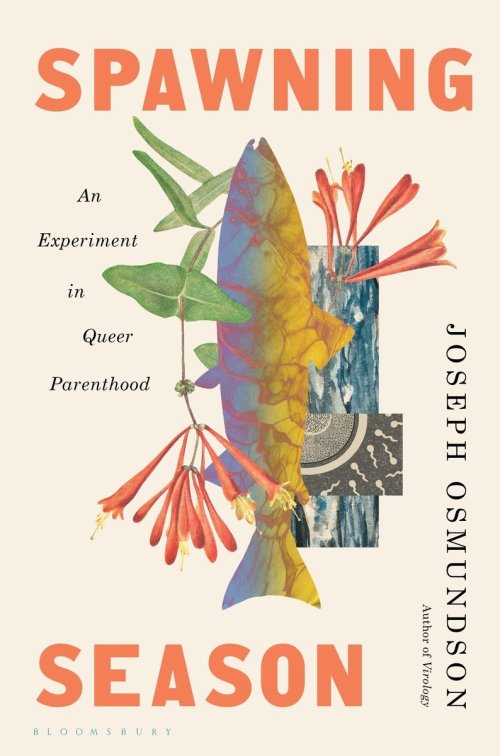
NONFICTION
by Joseph Osmundson
Bloomsbury Publishing
Published on May 26, 2026


