


Cynthia Pelayo is a Chicago writer who specializes in mining timeless fairy tales for their darkness. The tales that inspire her work have had their sharp edges smoothed down by the likes of Walt Disney, and a demand for light-hearted stories that make for cozy bedtime reading. But in her novels, such as Children of Chicago, The Shoemaker’s Magician, and Vanishing Daughters, Pelayo scrapes off the safety and easy palatability spackled over fairy tales by popular culture.
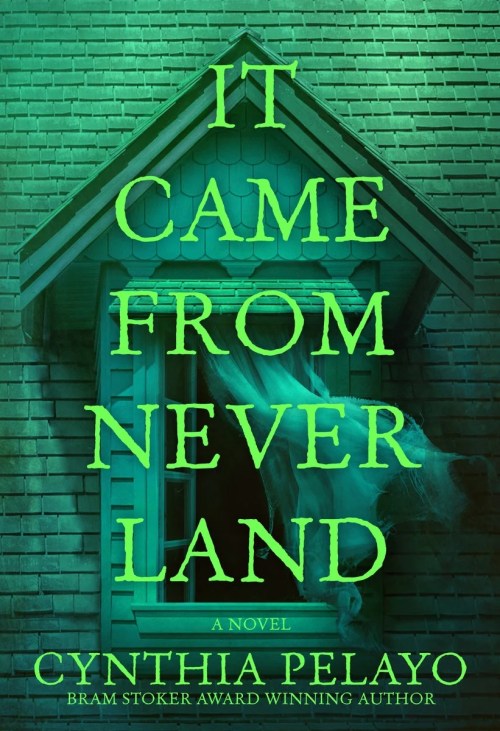
In It Came From Neverland, Wendy Darling has grown up and managed to stay far away from the boy who refused to do the same. Her family had been scattered by the aftermath of her and her brothers’ disappearance during their time in Neverland. Wendy is now teaching in a home for children orphaned by World War I when signs of the child killer whom she knew as Peter Pan turn up in London in 1914.
I had the opportunity to speak with Pelayo about her novel.
This interview has been edited for clarity and length.

Devi Bhaduri
The original Peter Pan, by J.M. Barrie, was originally a play, which he then novelized. What about Barrie’s story made you want to write a horror novel about Peter Pan?
Cynthia Pelayo
I grew up watching the Disney version of Peter Pan. I love the Robin Williams adaptation—I think I’ve seen it a hundred times. But there was always something dark beneath it, and especially being a mother now, I think of the story much differently. Your children being whisked away through the window because someone promises them that they can live forever and never grow up. There was a sinister thread there that I wanted to explore over time.
Devi Bhaduri
That’s such a primal fear—both for the children who know their parents can’t help them and for the parents who can’t save their own children.
Cynthia Pelayo
I remember looking around, thinking, Does no one think Peter Pan’s a little strange and a little scary? When I started bringing it up to people, the response I’d get was, Oh yeah, I guess when you look at it from that perspective. So I really wanted to explore it. So many people love this story, and they love the characters, so there was this sense of nervousness going into it, like—I’m going to do something with these beloved characters that might make people unhappy—but I have to follow the story.
Devi Bhaduri
What was the scariest thing about your Peter Pan?
Cynthia Pelayo
The manipulation is what’s terrifying in my novel. It’s something that I heightened from the original story. Peter promises Wendy—you’re going to come away with me, and we’re going to live forever. You’ll never grow up, and you’re going to tell stories. But when she gets there, she becomes a “mother” to these boys—not that it’s monstrous at all—but the boys would go on an adventure, and she’d be left mending laundry and cooking and cleaning. It’s like you promised me one thing, and you flipped the script on me. I researched narcissistic personality disorders quite in depth, so I think that’s what Peter did early on. He love-bombed her, and he started devaluing her once she was in Neverland. There’s a conflict when she wants the autonomy to get away from this because it’s not what she was promised. She wants to go home, and that creates a lot of anger.
Devi Bhaduri
I was pleasantly creeped out by how your Peter wears a boy or human identity, but he’s not embodying it. There’s a falseness that comes through. He reminded me of manipulative people I’ve met.
Cynthia Pelayo
Exactly—it’s very unsettling. For some of us, people who are neurodiverse, we are much more at risk for being manipulated by these personality types. For some neurodiverse people, it’s difficult to identify manipulation. To me, a smile is just a smile, but I’ve had to learn that there are different degrees. And sometimes when a person is laughing, they aren’t laughing in joy, but at your misery. There are subtle behavioral and personality things that, as humans, we’ve learned to pick up. And unfortunately, children are more vulnerable to manipulation. I also think that if you’ve been a victim of gaslighting and manipulation, it’s not your fault. They’re really good at what they do. It’s essentially a mask that they wear. I really wanted to show how unsettling that is with Wendy, and the internal conflict of “I love him, but he’s a monster. I fell in love with someone who’s not real.”
I’ve told people who are on the spectrum—when in doubt, your safety comes first. Like Wendy, many of us who are neurodiverse were taught to people-please. Maybe because of culture, maybe it was gender, maybe it was the historical period—we were taught that your value is to what extent you made other people happy. There was a factor of that with Wendy’s character and her being a woman in this time period. Feeling you have to people-please opens you up to those types of manipulative personalities, and they know that. They take advantage of that. If you’re unsure, it’s better to look like a weirdo and cut somebody off and stay safe.
Devi Bhaduri
I want to talk about storytelling and the role it plays in your novel. Wendy keeps a journal of her experiences in Neverland even though it’s dangerous for her to have it in the normal world. She tells stories to the Lost Boys, her brothers, a war veteran. It’s like the stories are keeping them all alive. What does storytelling represent for you?
Cynthia Pelayo
In It Came From Neverland, storytelling represents the truth. The truth of a woman who society and her family refused to believe. She knew—if I maintain this record of stories—if I give care and love to my stories—then I am the keeper of truth, regardless of what anyone tells me.
Devi Bhaduri
I think that’s one of the strengths of horror, in fact. It delves into the truths that people don’t want to see. Whatever makes a protagonist “special” in the story enables them to see this dark truth. As an audience, the genre lets us see that dark truth.
Cynthia Pelayo
I definitely think horror is the genre of truth. Horror has the tools and the capabilities to provide an unflinching look at the most discomforting things that we want to look away from. Societally, so many of us are raised with: “Don’t talk about that! Ignore that!” There are many situations where truth-telling is smeared, ignored, and the truth teller is called the crazy one. But horror is the genre where the community is saying this person is wrong, and this person is saying they’re being attacked. What has happened here? A master of that is Shirley Jackson. She loved spotlighting how communities and neighborhoods try to portray themselves as being good, but beneath the surface, there is something sinister.
Devi Bhaduri
In the novel, when Wendy and her brothers are still children and come back from Neverland, none of the adults believe their accounts of what they went through. What they endured seemed too fantastical, but also too horrific for adults to believe that children could have gone through it at all. The kids are then gaslit into pretending that nothing happened. Wendy, most of all.
Cynthia Pelayo
Yeah, Wendy received the brunt of the criticism from the adults most of all. The young woman who said we were taken and that something very bad happened to us. And her punishment for that was to be humiliated, to be isolated, to be mocked. You know, I was writing this when the Epstein files were coming out. And there are so many other cases. I write a lot about missing and murdered women. That idea kept hovering over my head—the number of women and children who, throughout time, said, Something bad happened to me, yet the adults silenced them, humiliated them, called them crazy, damaged their reputation so that they can’t be believed. This is something that’s been done to women throughout the history of humanity. A woman steps forward and talks about harm, and one of the main things we do to her is call her crazy to dismiss her claims.
Devi Bhaduri
It is. I appreciate how you showed the genderedness of that phenomenon. Even though the boys were gaslit, it was easier for them to pass as what the adults considered normal. Though Wendy was speaking the most truth and speaking with the most authority on what happened, she was seen as the least credible and talked out of her version of events. She doesn’t even believe herself at the beginning of the novel.
Cynthia Pelayo
When a survivor speaks their truth and says that they were harmed—the pushback—it’s never one person. When someone wants to disagree with the survivor, it’s like they recruit an army of people who point and say, No, no, no, you’re wrong. The community comes together and builds this case and a network to discredit them. That’s another layer of violence to the survivor, to where there are times survivors are questioning, Should I even have come forward? What was the cost of coming forward? Am I misremembering things? The whole operation of telling the survivor they’re wrong—the purpose of it is to discredit and create confusion.
Devi Bhaduri

Speaking of surviving abuse, when Wendy was volunteering in a hospital, a friend told her, “Your life belongs to you, Wendy. Not to what hurt you. You can’t keep mourning a life you haven’t lived yet.” This seems to echo something many survivors struggle with when moving on with their lives. Is there something you hoped to say to survivors with this?
Cynthia Pelayo
Oh gosh—so much. Of course, this is about Peter Pan, but it’s also about the nature of trauma, abuse, and honoring the survivors. Trauma distorts our perception of time. The rumination is exhausting. When reliving each and every single aspect of these events, the survivor thinks, What could I have done differently? Could I have made a different decision? Could I have prevented it? It gets too close to guilt and shame. I wanted to show the grief of knowing: I can’t change what happened. That is one of the hardest things to come to terms with. Like what Wendy’s friend was telling her—you have to live your life. That is an act of rebellion. I’m going to take back my life and my experience. This awful thing happened, but I can’t allow it to dictate the rest of the time I have here. I want to enjoy things—to go outside and enjoy the sun and the light, and stories, and reclaim who I am. That is how we win and fight against our abusers.
Devi Bhaduri
You show us an unexpected side of the villain of the original Peter Pan, Captain Hook. He becomes the father of a young boy on his ship named Roger.
Cynthia Pelayo
Roger’s a completely new character in Neverland. I thought he was a good symbol of youth and childhood and wonder—and so much that could have been for Wendy. Whenever I’d write about Roger, I’d sob because he was like a stand-in for that.
Devi Bhaduri
There was one scene in particular with him where I teared up, too. I appreciated that Roger was a boy who was validating Wendy’s version of events. I don’t see enough stories where a male character validates a female character’s point of view when she says, “This happened!“
Cynthia Pelayo
He was the one who acknowledged her, saw her for who she was, and loved her for it. He didn’t want to change her at all. He wanted to accept her for who she was as an individual.
Devi Bhaduri
One last question: what’s next for you?
Cynthia Pelayo
I can mention Something Followed Us Home—this comes out September 29 and is an anthology I edited. It’ll be out with Atria. It includes the work of Augustina Bazlerrica, Isabel Canas, and Mariana Enriquez.
So, I don’t know if it will be announced yet, but I’m going to hold up a book, and you can say it’s a hint for what will come out from me in 2027.
Cynthia holds up a copy of Mary Shelley’s Frankenstein.
FICTION
It Came From Neverland
By Cynthia Pelayo
Crooked Lane
Published June 9, 2026


