


As a reader who tends to prioritize literary fiction and narrative nonfiction when crafting my reading lists, it’s easy to neglect the sheer amount of craft and restraint that go into solid works of genre fiction. While restraint can beget an enormous amount of creativity, it also can stifle ideas and lead to many books in genre fiction feeling trite or formulaic. The thriller genre is no exception. However, writers of color have brought new life to the genre without overhauling its necessary restraints, by providing a much needed social consciousness. A prime example of this is When No One Is Watching by Alyssa Cole, an unmistakable thriller that also sheds light on gentrification and socioeconomic inequality from a Black woman’s lens. One can also look to film for examples of this, most notably the works of Jordan Peele. Strangers Behind Closed Doors by Catherine Adel West is another addition to this new canon, a socially conscious thriller that abides by genre restrictions but seeks to break new ground.
The novel centers on two characters, luxury hotel concierge Giovanni and detective Redding, two workaholic Black women who find themselves entangled in an ongoing case. Women all over Chicago are disappearing, their assailants leaving snippets of poetry and single orchids, and Redding feels alone in her pursuit of the case. Giovanni gets mixed up in the suspect list when a former friend, Natalie, is the latest woman missing. The novel has the characters questioning not only those closest to them, but those in positions of power, previously thought of as ”untouchable”, and their attempts to solve the case are not only career-threatening, but life-threatening as well.
The novel is a propulsive one, taking on the erasure of Black women as crime victims and the inherent corruption of law enforcement. Giovanni and Redding both confront their people-pleasing tendencies, and this serves as a larger comment about unnoticed work, particularly in predominantly white institutions. These themes are handled well in the novel, seamlessly integrating into the overall mystery.
Other craft elements, however, fall a little short. The genre-required fast pace leads to the inclusion of too many characters compressed in a relatively short narrative, few of which are given room to breathe and stand out from one another. Giovanni and Redding, though given space as point of view characters, tend towards singularity when it comes to voice and narrative. While their roles in the novel stand out, the weight of the underlying mystery prevents us from truly getting to know them, besides one or two personal characteristics that serve as boilerplate motivation. For Redding, her strained marriage. For Giovanni, her unresolved grief. Additionally, there are some instances where plausibility comes into question, especially considering how alone Redding is in her suspicions, despite the sheer magnitude of the crimes at stake. This in and of itself can serve as commentary, and I am certainly no criminal justice expert, but some suspension of disbelief may be required of the novel’s readers.
The ending of the novel constantly twists and turns, with many of these pivots well crafted and foreshadowed in the novel, and others feeling shoehorned in for the sake of propulsion. This is an instance of the genre’s inherent limitations, as there is little space to set up some of these other ideas and give them adequate page time.
For those who enjoy a socially conscious thriller, Strangers Behind Closed Doors will check the boxes and excel in dialogue, snappy prose, and unexpectedly humorous moments. However, to prioritize plot and movement, other elements are necessarily sacrificed, such as character development and varied voice. Overall, though, the novel is a page turner and understands both its goals and audience from the very beginning, and this must be commended.

FICTION
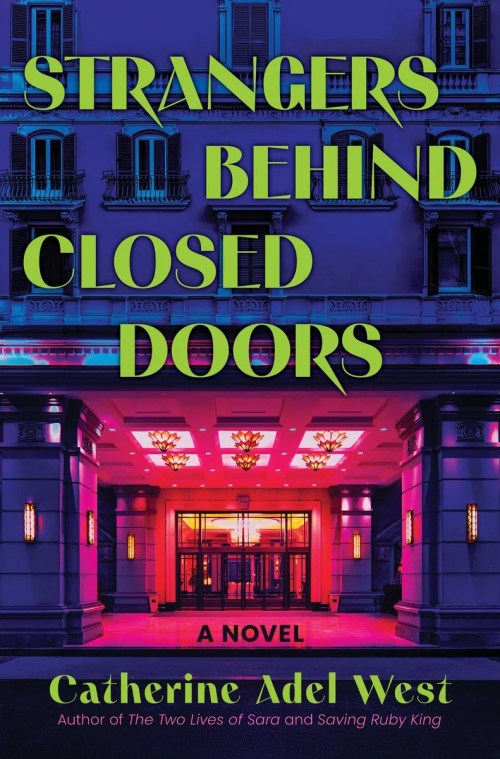
Strangers Behind Closed Doors
By Catherine Adel West
Park Row
Published June 9, 2026


