


In 1949, renowned Harlem Renaissance poet Langston Hughes published a volume of verse titled One-Way Ticket, which captured many of the bitter realities that Blacks who fled the Jim Crow South in the Great Migration encountered when they reached northern destinations like New York and Detroit and Chicago. In “Restrictive Covenants,” Hughes minced no words about the city-sanctioned housing segregation that kept Blacks “hemmed in on the South Side” where they “can’t breathe free.” In “Visitors to the Black Belt,” Hughes railed against South Side “hell” and “kitchenettes with no heat and garbage in the halls.”
The “kitchenettes” described in Hughes’s poem refer to illegally subdivided, often criminally neglected apartments in the Bronzeville district on the South Side of Chicago where “hemmed in” Black tenants—largely prohibited from buying or renting anywhere else in the city—lived with four or more families crowded into spaces zoned as single-family dwellings. Iconic Chicago authors such as Lorraine Hansberry, Gwendolyn Brooks, and Richard Wright portrayed the struggles of kitchenette life in some of their best-known works. Hansberry’s multiple Tony award-winning play, A Raisin in the Sun (1959)—the first drama by a Black woman to run on Broadway—takes its title from another Langston Hughes poem about a Great Migration “Dream Deferred”: “Does it dry up / Like a raisin in the sun?”
Although every scene in A Raisin in the Sun occurs in a cramped South Side kitchenette apartment, it is not, of course, a play about kitchenettes and kitchenette life so much as it is about Black aspirations and the difficulties of escaping that life. But the built environment in which the play unfolds and the historical, cultural, and civic conditions that created it are well worth exploring, as scholar Dr. Amani C. Morrison demonstrates in her new book, A Kitchenette to Fit Your Needs: Housing Chicago’s Great Migration. Morrison’s book plumbs both the Chicago Renaissance literature and art that dramatizes kitchenette life and the spaces from which it emerged. Morrison’s book reveals that kitchenettes not only housed (however miserably) the overland migrants who bet their future on a one-way ticket to Chicago, but literally and legally circumscribed the South Side lives that began when they arrived.
By focusing on these residential spaces, the restrictive urban policy climate that effectively confined Black Chicagoans to them, and the exploitative racial capitalism that made kitchenette apartments reliably profitable death traps, Morrison offers critical insights into the Great Migration experience—particularly in Chicago—not found in such essential and widely read works as Isabel Wilkerson’s The Warmth of Other Suns.
In this interview, Morrison and I discuss what she discovered about kitchenette trauma and (occasional) transcendence in her deep dives into Chicago Renaissance literary landmarks like A Raisin in the Sun, Richard Wright’s Native Son, and Gwendolyn Brooks’ “Kitchenette Building.” We also explore the broader story the book traces of how kitchenette housing eventually declined and mostly disappeared in Chicago in the 1950s and 1960s, forcing new migrations, and leading to more opportunities denied and dreams deferred.
This interview was conducted on Zoom. It has been edited for length and clarity.

Steve Nathans-Kelly
In the acknowledgments at the end of the book you talked about your father introducing you to A Raisin in the Sun. I’m sure it would be an oversimplification to say that your early exposure to that play was what spurred your interest in the built environment of 20th-century Black Chicago, but I imagine the play would be an entry point for a lot of people. Can you tell me what drew you to this topic?
Amani C. Morrison
I appreciate that you read the acknowledgements and saw me mentioning my dad, because once I realized that I was writing so much about this, I was like, “Wow, I remember that moment of first being given the book.” It was the first book that I had read substantively about Black life in a way that felt like it wasn’t a paragraph in a textbook that was kind of glossed over.
But what led me to the kitchenette in particular was when I was in grad school trying to narrow down what I was going to write about for my dissertation. As someone who was very much invested in literature and cultural production as a thematic or generic focus, they said, “What’s the literature that you continue to return to?” And for me, that was literature of the 20th century, and more specifically, literature of the Great Migration, which is disproportionately focused on that movement from the South to northern, midwestern, and western urban centers. A lot of times they’re not necessarily interested in the migration itself, but what happens once people get to where they were going. I had heard much about the Harlem Renaissance, but I realized that a bunch of people were writing about Chicago and I didn’t know much about that particular migration. The more I dug into it, I saw that there was a Black Chicago Renaissance.
That was a kind of a synergistic moment for me. My project was originally going to be a book about migration literatures, but the thing I kept writing about in my coursework was the kitchenette. So one of the people on my committee just said, “Start with your kitchenette chapter. That’s the one that it seems like it has the most teeth and you might be surprised that it might end up growing into something more.” But I couldn’t really find much about it. There was Gwendolyn Brooks’s poem, “Kitchenette Building.” Richard Wright’s Native Son starts with Bigger Thomas’s family in a kitchenette. And so I thought, “I can do a literary read of this.”
Steve Nathans-Kelly
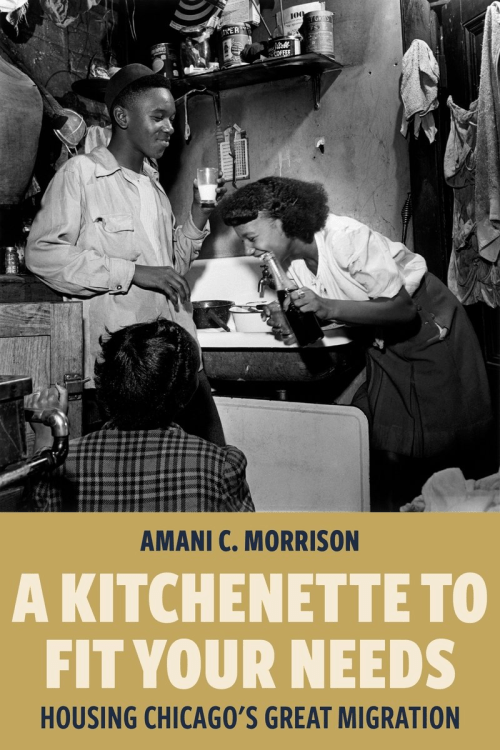
You have a beautiful photo of a family in a kitchenette on the cover of the book that shows real joy happening in these difficult spaces, but so many photos inside the book that show how grim kitchenette life was, more like squatting in an abandoned building than a commercially rented apartment. What did you discover about the origins of this kitchenette photography, and the impact it had in its time?
Amani C. Morrison
The images that I use in the book are primarily from a couple different sources. One is the Farm Security Administration. The FSA was essentially tasked with documenting all of these big population moves that were happening primarily during the Great Depression. Mostly we think of people moving onto homesteads and photographs like Dorothea Lange’s iconic image of the Depression Era Mother. But some of the photographers necessarily went to the urban centers that people were also migrating to. And so there’s this whole subset of FSA photos that take place in the city. And so you have Edwin Rosskam, Russell Lee, and others just walking down the streets of Chicago and they’re like, “Here are the populations that have migrated and here’s where they’re living, here’s how they’re living,” and trying to capture some of the vibrancy in their lives and “cultural ways.”
The bulk of the rest of the photos in the book are taken by one photographer, Mildred Mead. She was commissioned in the late ’40s and ’50s by the Metropolitan Housing and Planning Council, which is an entity that writes Chicago’s housing and building codes in the mid-20th century and pushes them to the mayors, and they’re adopted in large part. They’re trying to do these studies and campaigns to advocate for why we need a housing code. They used documentary photography to create a social message and that message was, “These conditions are terrible. These people deserve better.”
The catch is, the folks living in kitchenettes that are being documented become associated with this discourse of degradation and dilapidation. I don’t think that the photographers set out to do that, but it becomes this kind of representational discourse of, “These people are not getting the housing that they deserve. Therefore, this housing should go away.” This was not exactly untrue, but if you take away their place to live, then what?
That becomes the problem with the transition from kitchenettes and so-called slums to public housing, because there is never enough public housing to accommodate all the folks who are being pushed out of their housing once the housing code is taken up and all this demolition and urban renewal is happening. Many folks were displaced and didn’t have homes. Some of the kitchenettes were terrible to live in, but people were still making lives, and at least they had homes. And so there’s this weird transitional moment that is in part facilitated by some of this documentary photography happening in the late ’40s and ’50s.
Steve Nathans-Kelly
One of the most eye-opening parts of Isabel Wilkerson’s widely read book about the Great Migration, The Warmth of Other Suns, was the tremendous risks Southern Blacks took just to escape the Jim Crow South and find what they believed would be a better and freer life up north. Given that the Great Migration happened over decades, do you have a sense that successive waves of Black migrants to Chicago knew at least something about what they were getting into, at least on a residential level?
Amani C. Morrison
I talk a little bit in the book about the ways that people used to stay connected to folks in the South. People wrote letters that said things like, “Hey, I’m doing great here. I joined a church. I met some other people from our town. There’s lots of work here and lots of fun here. You should think about coming, and send my love to this or that person.” Most of these letters are from the early Great Migration, so 1910s. I haven’t seen the same kind of archive of letters for the period that I’m primarily focusing on, which is the ’40s and ’50s.
I also know that the Chicago Defender is being circulated by Pullman porters in the South and along train routes, and that the Defender is covering what life is like for Black folks in the North. And it’s not all bad. You see all this advocacy work that’s happening among the Black middle class and the Black working class. And so that’s being advertised, which I think [would have appealed to] Black Southerners who felt like they needed some type of out, despite other things that maybe are running alongside it, a fire here, or arson because of racial intimidation there. For some folks, that was still better than the South, and for other folks, it was like, “I would’ve never thought that the North looked like this.”
Steve Nathans-Kelly
When I first saw the movie version of A Raisin in the Sun, I just assumed that Lorraine Hansberry grew up in a kitchenette apartment and that the story of a family struggling to escape it was her life. But her relationship to that world is so much more complicated. Can you talk a bit about Hansberry Enterprises, and how they operated in the world of kitchenette landlordship and racial capitalism in Chicago?
Amani C. Morrison
When I was writing that chapter, I wanted to be careful not to demonize the Hansberry family or Black middle-class aspirations generally, although capitalism is not necessarily our friend in terms of actual liberation. But to the extent that I analyze Hansberry Enterprises vis-a-vis Hansberry and Raisin in the Sun, the question I’m interested in is, how does centering the kitchenette in this kind of relational, familial story about Black Chicago help us to understand how things are not black and white, and they are always more complicated than they might seem?
Carl Hansberry, Lorraine Hansberry’s father, creates Hansberry Enterprises as essentially a property management company. And he is able to begin acquiring properties both through his own business acumen and because people are losing their shirts because of the Great Depression. Carl Hansberry is able to start acquiring some of the properties that are underwater or because other landlords are not able to get to the residents because they don’t live in the Black Belt. Carl Hansberry is also converting some buildings into kitchenette buildings. Some landlords are doing this to maximize profit, and others are doing this because Black folks didn’t have places to live because of redlining, restrictive covenants, or violent aggression when they tried to move into neighborhoods elsewhere.
Simultaneously, Carl Hansberry is working with various civic organizations and creating zones to fight housing discrimination, while he’s also trying to meet the need of the community for housing. Because the landscape of the Black Belt is only as big as [the city will allow], and no new housing construction is happening because of the Depression, landlords are subdividing properties into kitchenettes. Carl Hansberry is one of the landlords who does it. This creates more additional housing which is not ideal for families, but it might be for single people who don’t need a seven-room flat. It also creates revenue for the company. And what’s interesting about Hansberry Enterprises in particular is that they’re using this money essentially to fund their civic advocacy work.

Buying into a system that is created and structured by racial capitalism in order to solve problems that racial capitalism created [put the Hansberries on] a slippery slope, and there are tenants who sued Hansberry Enterprises because of their housing conditions. When the city started trying to steamroll everyone into the new housing code in the late ’50s, they attacked more precariously positioned Black landlords like the Hansberries. Hansberry Enterprises is trying to stay afloat and trying to stay out of court while also trying to meet community needs.
So it’s complicated and messy, but I think it exposes the position that Black folks were in and trying to meet their own needs [in circumstances] where the city wouldn’t.
Steve Nathans-Kelly
You also have a chapter on Frank London Brown’s Trumbull Park which captures in a different way from A Raisin in the Sun the difficulties of trying to move away from the kitchenette, in this case the transition to public housing. One thing that’s really interesting to me is the way you talk about flashbacks to the kitchenette propelling the characters to keep moving forward, no matter how much resistance they encounter. It almost felt like the trauma of the kitchenette had supplanted the collective memory of the Jim Crow South that drove people to Chicago.
Amani C. Morrison
Trumbull Park is published in ’59, and Frank London Brown is an activist and labor organizer as well as an artist. And so he’s kind of participating in the movement on multiple fronts and his family was one of the families that was integrating the actual Trumbull Park housing project. So it’s semi-autobiographical. In the novel, the family that moves into the housing project had grown up in his kitchenette building, and his mother was there before then, so it becomes almost like a generational difference.
So, Frank London Brown as a person—or the character in his novel that represents his experience—would not have been the person who chose to leave the South. Their generational choice was to choose to leave the kitchenette, and that becomes a different front on which they are actively choosing something for their own opportunity, their own safety, and their own aspirational future. They’re also meeting a different landscape of racist antagonism in a different built environment in a different part of the city. But as taxpaying citizens, it’s their right to inhabit these public housing projects that are only being integrated on a quota basis.
Steve Nathans-Kelly
In an era when racial capitalism and predation persist in the private housing market in American cities, is there one lesson in particular from the kitchenette era in Chicago or the way that Black tenants endured it and escaped it that this history can teach us today?
Amani C. Morrison
I think there are a couple of ways of thinking about where we have already been in history and not forgetting it, so we don’t reproduce it by saying, “Okay, the building should be condemned, but we don’t really want this or that set of the population to live elsewhere, so they should also feel that it’s good enough.” People should have access to housing that is humane. We need to understand how there are multiple points of systemic failure for populations that are maligned or marginalized, and a lot of that marginalization occurs in discourse as a way to validate or justify or reinforce the material aspects of it in policy. It’s important to not oversimplify issues that are multifaceted, to be serious about remediation, and also to take seriously the art that comes out of the moment. Sometimes artists doing part of the work of reflecting are also doing the work of constructing the possibilities that we are more prone to overlook in trying to elevate an issue.
I think the kitchenette does a really good job of helping us to think about mass migrations, which we’ll continue to have, globally, because of natural disasters—all of these once-in-a-hundred-years things are happening every other year—and rampant wars or other types of imperialist aggression. So there will be population shifts. We need to understand historically how people have responded to population shifts and work to do better than they did in the past.
I think it would be unwise of us to not anticipate some of those changes. We have the resources available to deal with them, both from a historical perspective, but also from present-day technologies, capacities, and critical thinking, to create spaces that can meet these needs.
NONFICTION
A Kitchenette to Fit Your Needs
By Amani C. Morrison
New York University Press
Published June 16, 2026


