


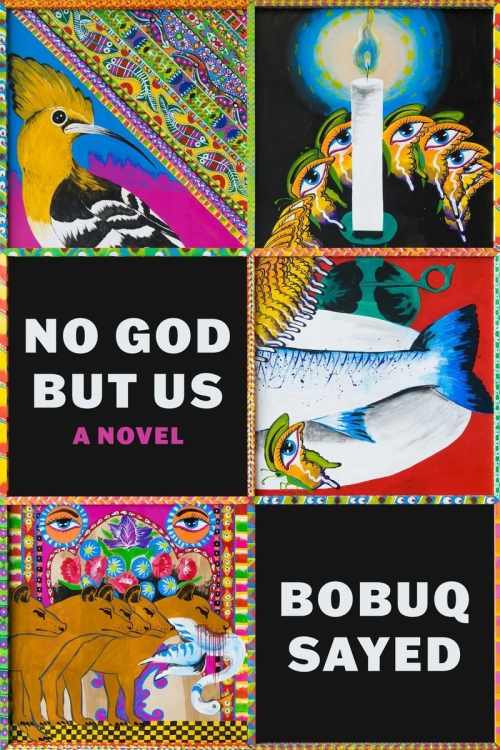
No God but Us tells the dual narrative story of Mansur and Delbar, two gay Afghan men who find themselves stumbling through the global metropolis of Istanbul under the intensely difficult circumstances of their queer existences. Delbar, an aspiring drag queen, first-generation American, leaves suburban Washington DC to live with his aunt after he is cruelly outed to his unaccepting family. Mansur, a former Tehran resident, comes to Istanbul as a refugee seeking a better, safer life. He is determined to make enough money to support himself and send money back to his family in Afghanistan. Far from home, unsure of what is next, both men earnestly and resolutely play the very different hands they have been dealt against the backdrop of the mid-2010s.
This is a story of love and lust, resistance and persistence, friendship, family, community, and the consequences of choices made freely, and of choices made by force. It is thoughtful, emotional, ardent, funny, and hot. To compliment Bobuq Sayed on this work as just a remarkable narrative, a breathtaking account of underrecognized experiences, feels like sand slipping between my fingers. I can’t stop thinking about No God but Us, Sayed’s debut novel. I am walking around with their prose in my pocket.
Mansur and Delbar’s stories cross paths when they both become involved with PeaceMeals, a non-profit that supports queer and trans refugees and asylum seekers as they await next steps. The characters they interact with are vibrant, fully-formed, and welcoming. They contribute poignant pieces of dialogue that linger, altering perspectives, ranging from uncontested compassion, to painfully honest tough love. In between diverging plot lines, evolving relationships and uninterrupted adversity, No God but Us discusses the limitless experiences of being a migrant, the family you have versus the family you find, and the comforting, dazzling ambiguity of gender. Sayed’s writing is casually profound, direct yet eloquent, memorable—all without being overly verbose.
Delbar and Mansur’s alternating points of view seem, at times, to be in conversation. Delbar, a university-educated American, is headstrong with firm convictions about his country and his family’s unacceptance. Despite being mostly in the closet, Delbar has a stronger sense of self, having been able to quietly embrace and even pursue his queerness in ways that had not even—could not even—occur to Mansur. Mansur is older, far more reserved and levelheaded. He came to Istanbul seeking safe survival and consistency, more than salvation. Sayed sets up their vastly different experiences and perspectives parallel to each other, without insinuating a right and a wrong, but with the overwhelming acceptance that multiple truths can exist together. One of their most compelling differences occurs on the matter of family, and what it means to have one. Mansur says, while speaking of Delbar’s relationship with his disapproving mother:
He and I had different expectations of love. I would never ask Mādar (Mansur’s mother) to declare her approval for something private in my life… I had never asked for her permission, and as a result, I had never received it. Yet that was the core of what Delbar wanted. He said he refused to tolerate her homophobia, her “psychological warfare,” as he called it. Either she was with him or against him. It reminded me of something Anahita had said about him after the first night he showed up. She had said he held onto big ideas because nothing had ever been taken from him.
Very little of No God but Us takes place in the United States and Europe, but their imperialist whispers, a monster under the bed, inevitably inform the narrative. Set between 2013-2015, this is a time period that American culture has recently begun to apply nostalgia-core to as a better, happier, more optimistic era—comparatively. It was uncomfortably refreshing to be confronted with a queer story that does not hesitate to treat the Obama era for what it was: still mostly bad for an unknowable amount of human beings. Among the countless harmful things the United States and the West do really well, one of them is the ability to simplify thousands of people or thousands of miles into one-size-fits-all arrangements. LGBTQIA+, the Middle East, immigrants, drag queens, Muslims: these English terms can label, categorize and describe while also having the power to other and diminish when spoken by an immoral tongue to a spoiled audience.The very existence of No God but Us stands directly contrary to the cruel, clickbaited society we reside in. Its themes are not only pressing, but strapped down under an authoritarian microscope. And while booksellers will benevolently use similar terms to categorize and market this story off the shelves, No God but Us deserves success and reach merely for being an engrossing love story from a formidable new voice. Stories about resistance are also just stories about people. On our planet, that is what most people must do, resist, in one way or another. We do a lot of other things too. What choice do we have?

No matter who you are, or how much fight you are forced to show up with on an average day, it is sometimes difficult to find the comfort and warmth of humanity through the loathing, the despair, the helplessness of not being able to help our friends. I think many will find that inextinguishable, ferocious need to keep going within the pages of No God but Us. I am so glad it exists, and thank God it does.
FICTION
No God but Us
By Bobuq Sayed
Harper
Published May 26, 2026


