


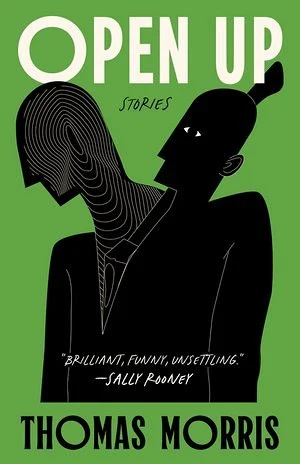
Emotional intimacy is at stake in Thomas Morris’s latest story collection, Open Up. The stories feature characters struggling to find connection with others, and not often succeeding. These results are particularly depressing given that many of the relationships Morris explores are those of families—fathers and children, especially. Too often these characters, who are expected to be close, end up with distance between them.
Vulnerability is a recurring theme through these stories, and an examination of the way people guard against the emotional entanglements that can leave them hurt. The characters intentionally maintain their distance, sometimes physically, sometimes emotionally, to protect themselves. The choice they all face is in risking it all on the chance of connecting.
The opening line of the first story in the collection highlights this emotional and physical distance. Gareth is set to meet his father before a football match, and observes, “It’s been three months since they saw each other, and Gareth wonders if his father will recognise him.” This time and space is repeated in different iterations throughout the collection. The story unfolds as the two attend the match, and attempt to find common ground. Told from Gareth’s point of view, we can sense the frustration he feels towards his father for wasting twenty minutes looking for free street parking rather than simply paying, and there’s even tension as they debate Wale’s likely success in the Euro championship matches.
For Gareth and his father, the ups and downs of the match, the banter about the team’s success, and attending the event together is enough to bridge the gap created by the time and space separating them. They aren’t having deep, confessional conversations, but they are finding that link between each other. By the match’s conclusion, they end up “hand in hand.” Despite this brief convergence, they ultimately return “back the way you came.” They revert to a state where they are separated. The bond generated by the match will have to sustain them going forward as the distance between them expands again, presumably until the next match.
One of the more unique stories in the collection, “Aberkariad,” follows a seahorse family as the young foals mature. The seahorse patriarch has remained present in the lives of his children, assisting in their maturity. In the wild, male seahorses incubate embryos and give birth to live young. In a collection where father and child narratives are under examination, the seahorse offers a particularly useful allegorical creature. The seahorse father in the story tells his children they are awaiting the return of their mother, who he still loves and believes will one day return to their family.
Uncle Nol is there to tell them otherwise. He’s happy to head out to Aberkriad, an invented word describing the place where young male seahorses meet and mate with the “fillies.” Uncle Nol is an enthusiastic visitor of the place, but unlike father, feels little kinship to the young he births, and doesn’t worry about hanging around to see them grow up. One of the skills Morris shows off is an ability to capture humanity through these seahorse characters. The seahorses feel like real people, like he is writing about the failed expectations of his own family or a close friend. And as for Uncle Nol, Morris has crafted a story with the sensibility of an 90s sitcom where an irresponsible uncle is eagerly leading the protagonists astray.
The young seahorse narrating the story eventually finds out the truth—their mother isn’t coming back. The knowledge shatters his perception of his father, though he suppresses the need to confront him. Instead, he begins to see his father differently, and sees him age. Meanwhile, his brothers all run off to Aberkariad, and even the protagonist eventually leaves home. The story concludes with the father dying alone.
The relationships between parent and children are constantly under the microscope, even when they are not necessarily the focal point of the story. In “Passenger,” for instance, Geraint recalls an argument with his father about Avian marketing water by convincing people to drink two liters a day, and later we learn that Niamh’s father “left her in the lurch for thirty years.” Geraint and Niamh are on holiday in Croatia, and we are witness to the evolution of their relationship during the course of the trip, but the spectre of their parents looms over their conversations. Their present is haunted by their parents’ past. Although the story centers on the relationship between Geraint and Niamh, how their parents influenced them persists.
Likewise, in “Birthday Teeth,” both characters express relief at losing a parent because of the inherent sense of freedom they feel. The narrative follows Glyn’s quest to have an underground dentist turn his teeth into vampire fangs. The fangs are an obsession of his because he suckles blood from people for gratification. The story is filled with wry irony, like the fact that his mouth is filled with cavities that threaten to derail his modifications. There are some astute observations in this story with the narrator questioning whether his childhood is a fiction, and recognizing “I am not the self I think I am.” Morris is setting us up to question our perception of past events, and how our changing interpretation will alter our present.
The collection is tied together by characters who constantly reflect on their inner selves, and examine the parent-child relationships that have created them. The past is consistently informing the present and molding the future.
The stories themselves are dense narratives better consumed one at a time, but they stay with you, lingering. They are meant to be pondered. Luckily, while linked by common themes, they stand on their own. There are moments that feel all too real, like Big Mike struggling to buy a frozen pepperoni pizza while the self-checkout machine yells at him, but also fantastical elements, like a fable featuring a seahorse family. Morris is adept at capturing the flaws of humanity, even when the characters aren’t human. Open Up is a short collection that dives into the nature of the self, and how the individual relates to the people who should be close to them—yet often are not.

FICTION
by Thomas Morris
Unnamed Press
Published on April 8, 2025


Superbe article. J’aimerais en savoir plus sur les modifications que vous apportez à votre site web. Comment puis-je m’abonner à un blog ? Ce compte m’a beaucoup aidé. Je connaissais déjà ce blog et mon message a été clair et net. Pendant que vous modifiez votre site, comment puis-je m’abonner à un blog ? Ce compte m’a été très utile. Je connaissais déjà un peu ce blog et votre publication m’a offert une idée claire et précise.