“This time it’s personal,” the press letter shared with advance readers of Marlon James’ latest novel, The Disappearers. The novel reads like a warning. In it, James announces his return to the Jamaica of the recent past, teasing at clandestine encounters and violence in a Jamaica wilder and more dangerous than today’s: a Jamaica that conjures evergreen memories of stones biting at skin, near misses exploding into clouds of hot dust on the road. At times, the warning feels necessary. This novel begs the reader to share the weight of the shame and abuse the eight queer men at the center of the story must bear, then run a marathon alongside the surviving characters as they build a life in the aftermath of a traumatic assault. What often blindsided me in my reading, however, were the sweet, dark twists of levity, hope, and humor that so often go hand in hand with a life lived with oppression and suppression as constant companions. James populates his 1980’s Kingston with well-read, quick-witted queers like the sweet Eddy Porteuous and churlishly endearing Jordan Brown, then chases them down as they attempt to pull off their own disappearing acts. The Disappearers sprawls across decades and shifts perspectives on its own terms, dropping lines that devastate and restore in its messy wake. In all its messiness it reveals a truth. With this novel, which at times feels like a precious artifact, James interrogates a specific yet universal history of colonialism, masculinity, and violence.
Prior to publication the book was longlisted for The Booker Prize, an award James won in 2015 for his third novel, A Brief History of Seven Killings, and the new novel has been warmly received by critics, released as an instant New York Times bestseller, and has placed James at the center of a multi-city tour and a flurry of positive media coverage. I caught up with Marlon exactly one week after The Disappearers was released in the United States and I’m not sure I’ve spoken to a man more exhausted. Sporting a black tee featuring a leather daddy straight out of one of Jordan’s Tom of Finland spreads, he fought through yawns to charmingly touch on his screenwriting, how he lets his characters become the people they need to be, and to bust the myth of the permanently lubed gay butt.

Stephen Patrick Bell
So, you’re fresh from a photo shoot? Travel? How has it been in this first week since The Disappearers came out?
Marlon James
It’s been wild. The response to the book has been so massive and tremendous, and I’ve just been on the road. I was in South Carolina, then I was in Boston, two cities that have absolutely nothing in common whatsoever. I’m headed to DC in a couple days. So, yeah, just kind of super busy and super hectic.
Stephen Patrick Bell
I think I want to start talking about your novel by talking about your screenwriting. I recently caught Get Millie Black, and I found that a lot of the textures of Hibiscus’s story were present in The Disappearers. How did the work you put into that show influence how you approached the novel?
Marlon James
It’s funny because if you were to ask me that while I was writing it, I’d have denied it. I’d have said they have no link whatsoever even though both spend a huge chunk of time with Jamaican queer life, and the people called the gutter queens appear in both the TV show and the book. In some ways writing that subject matter for TV prepared me for writing this similar subject matter for the book, almost like it was a road test. When Hibiscus is in a scene, the scene is centered on her, and the story is centered on, in her case, trans life. This novel is more of a full-blown story, as opposed to just the side story that it is in the TV show. There’s no “just a story,” but in the show, it was part of the action as opposed to the action itself.
Stephen Patrick Bell
I like the idea that it was a bit of a test run because I do feel like The Disappears goes into these settings in a much deeper way than television can. One of the things that I sense in both of these stories is delicious, almost joyful revenge and a deep, sophisticated exploration of rage. That comes up a lot in your Dark Star Trilogy. Would it be safe to say that you like a revenge story?
Marlon James
Yeah. I didn’t know I wrote so many of them. The thing about revenge, they’re right about it being a dish best served cold. My characters, even after they’ve gotten revenge, still have to deal with the emptiness of the life that made them seek revenge in the first place. That revenge restores nothing. It repairs nothing. There are few things that electrify us more than the idea of revenge, but the characters who seek it, particularly Jordan, end up with a kind of emptiness.
Stephen Patrick Bell
When I was reading the novel, I was identifying very strongly with Eddie, but I keep finding myself thinking about Jordan more and more after completing it. I noticed that he often would try to define Jamaicanness by just saying what Jamaicans are not. How would Jordan think that Jamaicanness and the boundaries of it have changed over the course of his life?
Marlon James
In some ways, it changed for the worse because at least in the 70s up to early 80s before AIDS, Kingston had several gay bars, and the usual response if you were not gay is, “Well, just don’t go there,” not “Let’s burn it down.”
It is easy to make claims, and it’s easy for him to make his declarative statements when he is essentially still a kid and most of the lessons that Jordan learns, he learns the hard way. Jordan is a little bit sure of himself to put it mildly. He has a lot to learn and I’m not sure he learns it. He learns some of it, but he also unravels in very specific ways. In a lot of ways, he leaves the novel a lesser person than he entered it.
Stephen Patrick Bell
It occurred to me to reread the book starting with Havelock’s one-sided epistolary sequence and see how that might change the way I saw him through Eddy’s eyes. I was wondering what sort of planning went into fitting these sections together the ways that you did, and what order might you have written them in?
Marlon James
Oh God, if only I could plan. Then I’d have shorter books. I keep thinking the reason why my books are so long is because I don’t plan them, which is weird because I write pages and pages of plot lines and plans and all sorts of stuff before I write a book. Then, as soon as I start writing a book, I throw away all of it because characters become people, and they just stop taking any BS from me; they certainly stop taking directions from me. They do things that humans do that we can’t necessarily account for. They surprise and they disappoint. You have to give the characters free space to do that. Most of my stories are about people telling a story, so they’re in first person, and it’s a very narrative first person. I’m very much interested in the craft of storytelling. Who gets to hear the story? Who gets to tell it? In this novel, characters with varying degrees of reliability are telling us a story.
Stephen Patrick Bell
Each section has a character or characters that are speaking to a specific audience, real or perhaps imagined. Because the reader never gets to see or hear a response it does create that pervasive sense of loneliness. For me, it heightened the isolation that queers who are closeted for safety reasons might experience. Were there ever any versions of this book where that included those unseen characters?
Marlon James
Even when they speak, it’s reflected in terms of the reaction to them when speaking. I wasn’t interested in that because I didn’t really want the cacophonous novel, and I wasn’t trying to write Brief History again, which has dozens of characters talking. I don’t know how a novel is going to end when I start them. I don’t know what process I’m going to adopt or if I’m going to adopt a bunch of them. I like the sense of a novel moving the way life does, where certain things happen with a certain regularity, but also some things just come out of nowhere. To have the characters reel from that, learn from that, is one of the great things about writing books.
Stephen Patrick Bell
The characters in this book, for many reasons both in and out of their control, can’t seem to navigate interpersonal relationships without addressing the reality that, for them, love and affection are intertwined with violence and aggression. Were you attempting to reconcile that while you were writing?
Marlon James
I’m not sure I resolved it. I’m not sure that I come to any sort of conclusion or peace. I acknowledge that a lot of times these encounters, even romantic encounters, have violence or flirt with violence. These guys come together; they cruise as a response to violence because they don’t get to stumble their way into adulthood. They don’t get to stumble their way into sexual maturity like straight people. Their maturity comes in fits and starts. I wanted the novel to reflect that the rules are different for queer people because they didn’t create the rules. There’s a sense of desperation at some of the encounters in the novel, because there’s a sense of desperation in their lives. This is what happens to people who have to scramble for choices, who don’t really have any, honestly. In that way, you can’t separate Jamaican homophobia from Jamaica. It’s part of this sort of Jamaican mythology.
Ultimately, what I’m really talking about is masculinity. That’s a bigger subject than just homosexuality. It shapes the ways in which Jamaican men respond to anything that presents anything more than a black-and-white view of sexuality and how it disturbs them. So, it’s a bunch of things bigger than people disparaging or attacking a bunch of gays.

It’s funny because in the blackjack section, one of the attackers is gay. Several of them have an almost pathological love of violence. They could have been beating up anybody. When I’m writing these books, particularly books like this and Brief History, I know I’m playing with a really big canvas, and it doesn’t necessarily have to add up because that’s what some people are. We don’t add up.
Stephen Patrick Bell
I’m thinking about who your characters tend to read—this novel is almost a primer on queer literature, but I find myself thinking on how the world your characters inhabit is so far from the spaces where those texts were written. With that in mind, I wonder who might you imagine discovering The Disappearers, either in Jamaica or beyond?
Marlon James
It’s something I don’t necessarily think about much. I write the books primarily for me. I think it’s an uncompromising book, and I wasn’t interested in writing gay intimacy for straight people. It was very much a book in the queer gaze. There are things I find very funny about gay stories popular with straight people. For one, in those stories, like Heated Rivalry—and I watched Heated Rivalry four times, just like everybody else—but there is what I call the pre-lubed and ready gay butt. They just throw off their clothes and they’re at it! Homophobic is too much of a stretch, but it’s very much gay intimacy, not on gay terms. I was definitely not interested in that. I also believe that, as uncompromising as the book is, there’s a clarity and hopefully people realize that the book is for them. I can’t think of who shouldn’t read the book.
Stephen Patrick Bell
Which of your characters do you think had the best fashion sense?
Marlon James
Oh shoot! I was gonna say Jordan, but a lot of times he’s not even wearing clothes. It takes some courage to pull off a green bell or turtleneck in 96-degree weather: I’m gonna go and say Havelock.
Stephen Patrick Bell
Are we going to see you in any green velour on the awards circuit?
Marlon James
Oh God, I hope not.
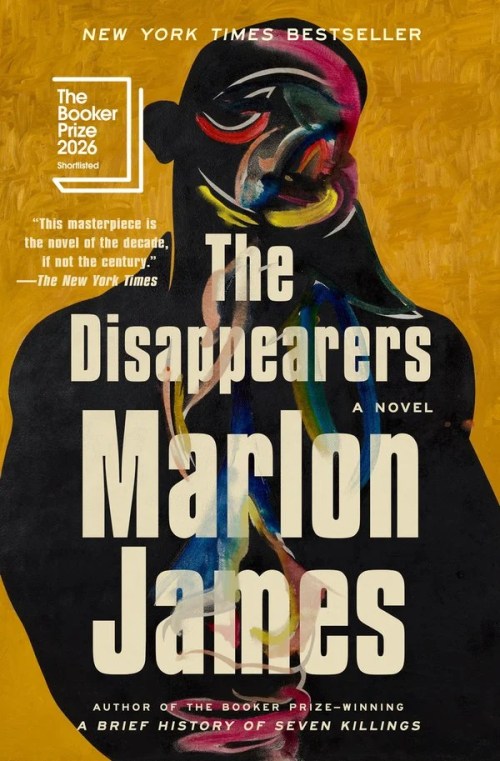
FICTION
The Disappearers
By Marlon James
Riverhead Books
Published September 1, 2026