In Natalia Theodoridou’s debut novel, Sour Cherry, a nameless narrator tells us a fairy tale.
The story begins with Agnes, a wet nurse hired by a wealthy lord to care for his newborn, nameless son. The lord and his family live in a house surrounded by forests, fields, and gardens, atop a hill overlooking an ordinary village. Guarded by black iron gates, the family’s home is filled with shadows and dust. Paintings of barely human creatures line the house’s many walls. They are silent but they watch.
The boy’s parents are mysterious. His father wears an aura of blackness that matches his black clothing and black hair. The mother exists merely as a rumor to the cook and gardener that Agnes works alongside; she haunts the house’s many rooms and long hallways, but there is little sign she truly lives in them. The child is mysterious too. There is a darkness about him that Agnes can sense through her own motherly tenderness. As a baby, his screams sound like screeches. His eyes are black like the forest, he smells of dirt and soil, his fingernails grow like weeds. He is naturally kindred with animals, but not with children. Agnes finds him loving despite. Having recently lost a child of her own, she sees the boy as a light in her contained life. Agnes bears witness to the little lord’s childhood, and watches the shadows that float around him, thrive.
Eventually, the little lord grows out of needing a nurse and into a man who resembles his father, attractive. As a man, he takes a wife of his own, Eunice (his first). Soon, Eunice gives birth to a son, who grows up under the dark silhouette of his parents’ marriage. This darkness seems to manifest into a plague that pollutes and dirties the land around them. Regularly, the man and his family must move from village to village, from country to coastline, from haunted house to haunted house, to try and escape this infection that follows them wherever they go. It rots the roots under their feet, pollutes the water, destroys the crops, kills the flowers and livestock, and swallows the color from the world around them. Every town the family inhabits, the villagers show up at their doorstep, angry, demanding an end to the suffering. Every time they come with their torches and pitchforks, the family leaves, and repeats elsewhere.
The nameless man carries a viciousness that cycles through his veins and is eventually dumped out over the heads of his wife and son through tragedy and violence. He cannot outrun this sickness that is woven within him, so the victims pile around his feet. Flower after flower, lamb after lamb. Wife, after wife, after wife, after wife.
Sour Cherry gives domestic abuse a shape, a contained form, and applies a fairy tale to its succession. Through gothic horror settings, and writing that is eloquent, creepy, and digestible all at once, Theodoridou describes how cruelty cannot be bound to the walls of a home. Instead it festers, latches onto our beings, and grows, following us around. He asks us—how can you leave something that blooms inside of you? More importantly, what Theodoridou begs to know with this work, is cruelty acquired by the men we love, or does it already inhabit them?
Throughout the novel, we are pulled graciously between two worlds. In the first, the narrator tells a child a story that is haunted by the truth of what happened to her. As she speaks, the narrator addresses an ensemble of ghosts that linger in the corner, asking them for guidance and reassurance to keep going. The other world is a gloomy land of once-upon-a-time, where the true story lives under a fantasy, and can’t touch the narrator or the child. “This is a fairy tale because I need the distance,” the narrator says.
As readers, we know we are back at home in the world where the lord and his family are merely a story by the brief descriptions of light, signifying time, that Theodoridou leaves at the top of a new page. I found it easy to dissolve into the child who is being spoken to and be addressed by the narrator directly. Eagerly turning the page, unaware of the passing day, the setting sun, the shadows forming around me, unsure of how much time has passed in the world I really live in. I too allowed myself to be protected by the separation of fairy tale and truth.

I devoured these pages. Theodoridou’s vulnerability in word choice, the decision-making shown with brief, lyrical descriptions of grief and pain melded beautifully with the complex, shifting scenes we spend time in. With sentences that read like heinous sweet nothings, or are gracefully savage, Theodoridou forces you to feel the dread of it all. There were a few instances where it seemed plot fell second to the daydreamy, flowery descriptions that were meant to juxtapose the bleak world we were visiting. When the critic in me started wishing for a little more restraint with this style, the narrator, and her broken heart, brought me back. There is comfort in a fairy tale, even in the dark. When it comes to thick, difficult topics like domestic abuse, gender roles, toxic masculinity, and the battles against patriarchy, we know that this is but a story, within a story, within a story—and there will be others, still. I consumed this novel with empathy, nervously, and with the feminine intuition that I was being watched.
This is a novel that does not answer questions about violent men, but asks them. Sour Cherry is a reimagining of Bluebeard, a French folk tale about a rich lord who can’t stop murdering his wives, and what his present wife does to avoid falling into the same fate. Folk and fairy tales are meant to both entertain and teach us moral lessons. They suggest that the laws of a world with dragons and witches can apply to our real lives. Goldilocks is a reminder to treat others how you would like to be treated. Hansel, Gretel, and Ali Baba show us the dangers of greed. Cinderella insists that your true love will come if you are generous, kind, and have enough perseverance. Snow White warns of the obsession with vanity. The boy who cried wolf, cried wolf—and now we know better because of it.
But what does a ghost story like Bluebeard teach us? I believe this is among the questions Sour Cherryleaves us with. Is it a warning, a hazard sign, for women who go looking? Does it create a vice out of a gut feeling? In his version, Theodoridou gives dead wives not just a voice, but opinions and regrets. Their phantom presence wants us to ask them why they stayed, as they whisper their fairy tale into our open ears. But we must listen carefully. The ghost women don’t say, Now, you’ll know better because of me, but instead, I am one of you: what now?
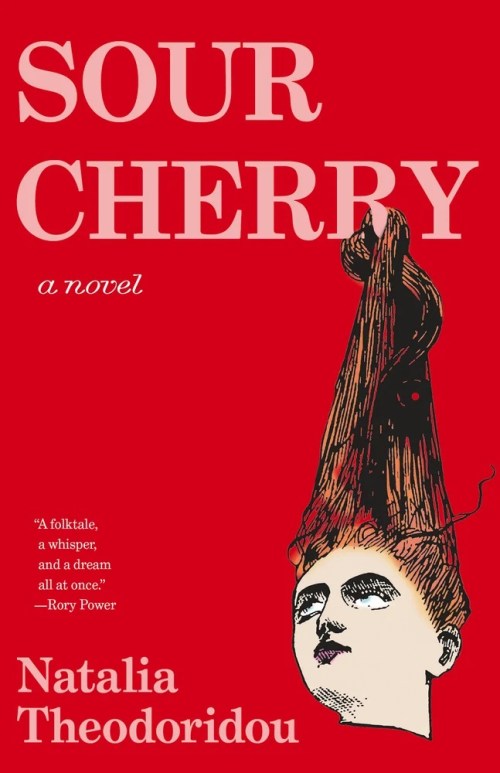
FICTION
Sour Cherry
By Natalia Theodoridou
Tin House Books
Published April 1, 2025