


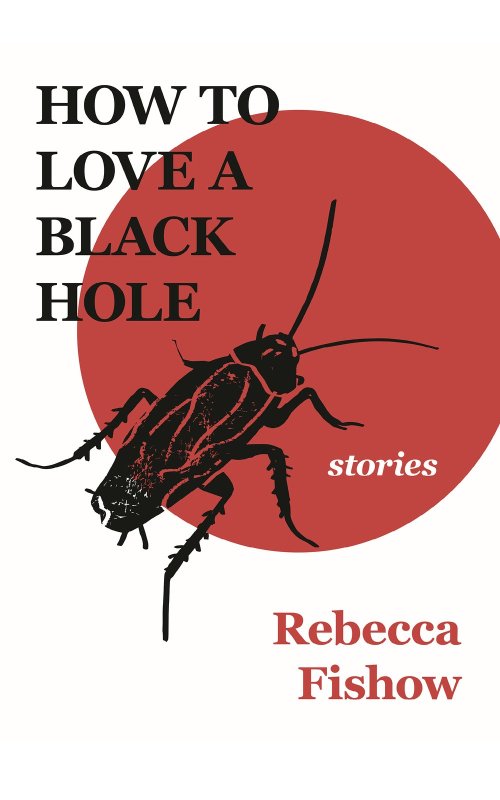
Prose writer, creative writing instructor, and visual artist Rebecca Fishow’s latest book of short fiction, How to Love a Black Hole, is a rapid, deft, and illusive collection. Moving between narrational mode with skill and fluidity, these stories explore the domestic, the quotidian, and the intimate within an often surreal, consistently inventive architecture, built out by sharp, surprising prose. The result is a work that entwines compositional acumen with thematic depth across an impressive and disparate collection.
What follows is a conversation between Rebecca and D. W. White of Chicago Review of Books.

D.W. White
How did your book come to be, and what do you want readers to know about your work?
Rebecca Fishow
The book was a stroke of good luck. James Gapinski, who writes fascinating, strange fiction, and edits Conium Press, enjoyed my first collection, The Trouble with Language, enough to reach out and ask if I had new work I’d like to publish. I’ve been a fan of Conium since I read Melissa Reddish’s Girl and Flame a few years back, and I knew my writing would fit their aesthetic. I sent a collection of new stories and things rolled along from there.
I’m interested in the affective and emotional truths produced through language and form. One of the most beautiful things about fiction for me is its ability to honor the ambiguities and ambivalences of life so much better than most of the stripped-down, oversimplified, and often blatantly misleading forms of discourse we’re subjected to each day. When I’m working on short fiction, I approach each story on its own terms. Sometimes that means it needs to be fast and irreal, others quiet and approaching realism. How To Love A Black Hole explores some new themes for me, like motherhood and the children-parent relationships. I also visit from new angles some of my endless obsessions, like mental and physical illness, sex and relationships, women behaving “badly” and people behaving badly towards girls and women, the psychological effects of everyday violence, the difficulties of communication and my wonder at the fact we can understand one another at all.
D.W. White
How do your academic studies, and your work in literary theory done as part of your PhD, influence your creative work?
Rebecca Fishow
My first instinct is: minimally, and I’d like to keep it that way. In general, it doesn’t do a writer good to consciously allow literary theory to guide their artistic intentions. In my experience, thinking about theory and meaning mucks up the creative intuition and dulls sensitivity to the page. Let people concerned with assigning meaning to a finished product determine how theory might be grafted onto art.
But on another level, if I really consider theory’s influence on my writing, a better way to describe it might be subconsciously. The ideas I’ve considered through my academic studies surely swirl around my mind, right along with the fiction and poetry I’ve read over the years, my memories, etc. That presence certainly counts for something and oozes its way onto the page in ways I can’t parse.
It’s actually my creative work that has influenced my academic studies much more directly than the other way around. My proclivities as a writer have guided me to the kinds of theoretical traditions I’m drawn to, and the conversations I want to enter. Further, because of all the years I’ve spent close reading and studying form, I can’t help but think through these modes of reading when doing theoretical work, as well.
D.W. White
Same question regarding your visual artistic practice?
Rebecca Fishow
Academic studies and literary theory probably influence my visual artistic practice even less than my creative writing practice. For me, painting fulfills almost an unintellectual drive and need. When I’m painting, I’m concerned almost exclusively with visual perception: color, shape, line, positive and negative space, proportion. Once upon a time, my visual art was more conceptual, and “meaningful,” but now it creates a space for cognitive lightness that counterbalances the cerebral weight of both my fiction writing and my academic studies.
D.W. White
A really fascinating aspect of this book is the shifting done between and among narrational modes, and the momentum it provides. I’m interested in how you see that element of your work, both within and across individual stories, and if point-of-view (movement) is something that you intentionally work to layer into a collection.
Rebecca Fishow
I think of narrational mode or point of view as the filter through which all other elements of a story pass, so finding the right one is a crucial step. The short story, or the short-short, seems like an ideal venue to explore possibilities for narrative structure, and push the idea of what a story’s shape and perspective can be; it can become difficult to sustain something innovative or untraditional over the course of a longer piece of writing.
Narrative mode is a real guide for me. In the past, I’ve had impulses for stories that I just couldn’t shake, but I needed to write them maybe five times in five totally different, ultimately failing ways before I finally found a mode that worked. Other times, I’ve begun with a narrational constraint, such as a single-sentence story, or a story that deals with possible futures, and let that shape my intuitions. Each narrational mode, paired with voice, and whatever else is really guiding the prose, provides its own set of questions and challenges, and guides things like musicality, rhythm, syntax, and scene progression, for me.
As I’m writing short stories, I have a lot of faith that because they all come from me there will be some innate coherence amongst them, at least on the level of thematic concerns and level of care for language. Beyond that, the shifting of narrational modes itself can be a kind of cohesion-forming element of a collection. That said, when I’m putting together a book of short stories, I absolutely think about layering for flow and overall reading experience. I try to weave the more conventional stories into the stranger ones, all the while considering the overall narrative flow. It happens via intuition and feeling.
D.W. White
How do you see the interaction between the world-building in your stories, especially, at times, the surrealism, and their thematic concerns—specifically through a compositional lens; that is, in what ways does the former deepen or develop the latter?
Rebecca Fishow
I want fiction to do emotional work, and what I’ve found is that straightforward realism doesn’t often get me where I want to go. When my stories get a little weird, either image or form, it often comes from a sensitivity to how those decisions might inspire affective responses and encourage a sense of disquiet that, for me, feels more complex than theme, which is another word for argument. To some extent, I also see irrealism as a challenge to the disenfranchised, positivist nature of so much contemporary discourse. I like to entertain the idea that there are possibilities outside taken-for-granted terms of the real.
D.W. White
An especially impressive aspect of both this book and your previous collection is how you’re able to wrangle some of those monumental themes, several of which are very much in vogue right now in literature—domesticity, marriage, motherhood—and distill them down into stories of, at times, only a page or two. What do you think the short story offers you in that respect?
Rebecca Fishow
That’s a good question! I haven’t thought much about the relationship between my particular subject matter and the length of my stories. In general, I consider really short fiction to be more capable of doing what a song might do than longer forms. There’s a possibility for quick heightened emotional experience through musicality and rhythm as much as characterization and narrative. Pauses and blank spaces around an experience have a heightened sense of impact, and that seems true to life to me. I want my shorter work to offer something nuclear and intense, but also allow phantoms to linger after the final sentence, in the spaces between stories. There is an immediacy and intensity to the short-short form, and I’m not sure if there’s any subject matter, be it the themes you’ve listed or any others, that wouldn’t work if approached with care.
D.W. White
And then, what about working in the short form, and perhaps the extremely short form, appeals to you in terms of process, praxis, or production?
Rebecca Fishow
Besides what I’ve mentioned above, there’s a pragmatism to it. I love writing, and I love playing with words, but securing the time and headspace to do that is a luxury sometimes. Many of these stories were written while I was a full-time creative writing and English teacher at a pretty time-consuming arts high school. Public school teaching is the kind of job that expands to fill up every free minute of your time if you let it. Unfortunately, I never really got the hang of not letting it. Combine that with the fact that I like finishing things—I like finding the ending and experiencing that sense of closure. The very short form is good for that, while also allowing me to pursue more ideas.
In hindsight, too, I love how much the short form encourages me to consider the nitty-gritty of language. I’m much more tuned into words, sentences, sounds, and pacing even on the smallest level, than I was a decade ago. Now that I’m working on a long-form project, that sensitivity to language has remained, and I think it’s going to continue to shape my style and writing process for the better.
D.W. White

To what extent, and how so, does How To Love A Black Hole trace an evolution from your earlier work, perhaps especially The Trouble With Language?
Rebecca Fishow
Many of the stories in The Trouble with Language were written with a real sense of imperative and immediacy. It felt like an outpouring, like the stories had to be written. It marks a turning point in my relationship to writing where I was kind of able to finally, after many years of being overconscientious and self-conscious, embrace a “fuck it” attitude, and really write in a way that felt honest to myself. That meant trusting my writing to get weird, to get grimy or vulgar at times, to tell things like I felt they were, and to be sincere about it. That was huge for me, and it opened up, and inspired a level of confidence I really needed to find. This new book is probably a result of that confidence.
In terms of thematic evolution, I once heard that every writer has maybe five or six obsessions— five or six burning questions—that they keep coming back to. That’s true for me, but How To Love A Black Hole approaches those obsessions or questions from what hopefully feel like different angles. It was written from a bit of a calmer place, and I think that’s reflected in the prose. I was also more conscious about structural experimentation, and I was playing with form more intentionally. I think this collection shows development in my style and thematic interests, while also still maintaining my off-kilter essence, and the grittiness I can’t get away from.
D.W. White
More generally along those lines, I’m always interested in literary ancestry, a concept somewhat removed from influences that encompasses the work that, much like genealogical ancestry, finds its way into one’s writing—intentionally or otherwise. Are there writers or works that you might see as your literary ancestors, as a writer generally and/or with regards towards this project?
Rebecca Fishow
I’d consider myself kind of a literary mutt. I read widely, and a lot, and I consider myself a fairly generous reader. I feel a kinship with so many authors, in various ways, and everything has the potential to burrow itself somewhere inside my brain and gets a fingerprint or two on my work.
Particularly, I feel a kinship with writers who operated through various modes of irrealism, be it surrealism, magical realism, absurdism, slipstream, etc. Clarice Lispector, Leonora Carrington, Anna Kavan, Barbara Comyns, Rachel Ingalls, and Donald Barthelme come to mind. These authors were deft at constructing honest psychological landscapes and nuanced emotional domains through inventive images and language. In the same vein, George Saunders, who was my advisor at Syracuse University, feels like a literary dad, for sure.
I also have some of my impulses to authors sometimes labeled as dirty or gritty realists: Denis Johnson, Lucia Berlin, Raymond Carver, Tobias Wolff, Elizabeth Tallent, and others who understood that something fiction does well is discuss and make art out of things that nobody is willing to talk about in “polite society” despite their ubiquity. Things that, when not communicated, probably make us more ill, lonelier, and more detached from our natures and one another. I also have some modernism in my DNA, and owe a thing or two to masters of free indirect style: Virginia Woolf, first and foremost. Then, there are some rock star minimalists, like Amy Hempel and Lydia Davis, whose brevity and timing taught me a lot.
Beyond the ancestors, I feel like there are some amazing literary “siblings”—writers working today, doing amazing, innovative work, whose work feels close to mine, and who I greatly admire. I won’t get into that because the list is too long.
D.W. White
One last, and related, thing about which I’d like to ask is the journey of the book, we might call it, and how you perhaps locate it in the context of your career, as your third book, and second full-length collection. I’m always interested in how writers view their own projects through larger-scale prisms. So a bit of an open question, I suppose, about those ideas.
Rebecca Fishow
I probably don’t consider a large-scale trajectory enough! Usually, when I work, I’m really writing in the moment and focusing on what feels important and perplexing in a vital way at any given time. I’ve never been very good at hammering out a long-term action plan regarding writing or publishing.
Looking back, though, I think of my chapbook, The Opposite of Entropy, as a precursor to The Trouble with Language because many of the stories in the former appear in the latter. TTWL was the long-haul apprenticeship book, and it includes stories I wrote over the course of about nine years, from graduate school through the messy, post-grad years when writers try to find and sustain a balance between creative pursuits and the realities of needing a career, or at least a job. It feels like a project that, while working on it, I really needed to maintain my faith because it can take so, so long for an emerging author to put together a first book, and just as long to find a home for it, especially when it’s a book of short stories rather than a novel.
Publishing that book probably freed me of some anxiety and provided some space for me to slow down and explore a bit with this second book. Both taught me a lot about my voice, sensitivities, and ambitions as a writer (if writing stopped teaching me, I’d probably stop doing it). Now I’m working on a novel, which I’m ready for in a way that I haven’t been in the past, at least for the moment. I love short stories; they are absolutely their own beautiful, dynamic, and largely underappreciated art form. But I’m having a lot of fun tackling the challenges of the novel, finding an approach that works for me and excites me.
FICTION
How to Love a Black Hole
By Rebecca Fishow
Conium Press
Published March 4, 2025


