


Samm Deighan is a film historian, the editor of Revolution in 35mm, and author of the new book Hysterical Excess and Inhuman Ecstasy: The Cinema of Andrzej Żuławski. She’s also a special features producer for independent film preservation company Vinegar Syndrome, a frequent commentary contributor, and host of the Eros + Massacre podcast.
Deighan’s newest work examines the work of the great Polish director. It offers a deep dive into the themes behind Żuławski’s work, exploring the countless references and political context of his films.
Samm joined me for an interview to discuss these complex themes: Żuławski’s politics, the line between misogyny and feminism in films featuring complex women characters, and how excessive emotion can help us push the boundaries of gender.
This interview has been edited for length and clarity.

Ashley Hatzenbihler
Before we get too far into the conversation, I think it’s important to set up some working definitions. The book has a great title. As you worked through these films, and the various women within them, what were your working definitions of hysteria and ecstasy?
Samm Deighan
For me, when it comes to Żuławski in particular, I tend to see hysteria as less gendered because he has so many hysterical male characters. Because I have academic training, hysteria is a word that I tend to use pretty carefully. Because, especially if you’re talking about anything to do with Freud, or Freudian psychology, and a lot of the literary theory that is based on that, hysteria can mean very specific things.
And Żuławski didn’t really like the word applied to his work for that reason, but he is someone who deals with emotional excess, and I think he comes out of this tradition maybe more of literature and theater than cinema, where, if you watch any of his films, you know these are not realist films. These characters are not meant to be people. They’re symbolic.
Because the performances are so incredible, and the way he writes characters and leads you through often incomprehensible plots and difficult dialogue to this place of really feeling emotionally connected to these characters, it’s easy to confuse them for real people. But to him, this idea of hysteria is all about leading with emotion; very large, overwhelming emotions that are more like forces of nature than the way that we’re socially conditioned to express emotion, especially when it comes to things like pain and suffering and the deep feelings that we might have for other people. And I think part of what makes his films so powerful is this idea that emotional excess is at the heart of all of the connections between characters, whether they’re toxic, painful, abusive, or they’re more transcendent, like this idea of ecstasy.
To Żuławski, really experiencing love—and I don’t mean, like, erotic love—I mean, in a very broad sense, experiencing love is akin to ecstasy, but it’s something that doesn’t fit within conventional society. Like, there’s no place for it because it’s too big; it’s too transcendent. It takes you outside of yourself and your concerns with ego and things like gender roles and roles based on class and where you’re from. I mean, he has all these characters who are outsiders, who literally are expatriates in a new country or town, who just don’t seem to fit in.
So, those two opposite poles—this idea of hysteria, but also of ecstasy—I think through his really subtle explorations of religion and spirituality, they often overlap because they’re these things that take you out of yourself.
And so, my title is a little cheeky, because Hysterical Excess was the name of a film series that they did at the Brooklyn Academy of Music that really upset Żuławski. He didn’t want that to be the title, but I do think it is apt in a way, because while he didn’t view hysteria in those typical gendered terms, he has such incredible portrayals of female characters, and he shows how they suffer because they’re forced to, or expected to, repress and contain their feelings. You have these pressure-cooker characters where those feelings get bigger and more complicated, and eventually explode.
Ashley Hatzenbihler
Your book does a great job of breaking down and framing the fact that it’s so easy for these kinds of character explorations to be misogynistic, if we’re specifically talking about these big emotions as they’re applied to women, and this physical manifestation that allows women to push the boundaries beyond the constructs of femininity. And I think that’s probably also true for the flip side of pushing boundaries of masculinity through this excessive emotion. And it’s common for folks to write off movies that feature excessive women, and to kind of reduce them to just being exploitation.
Can you expand on this idea of pushing beyond the boundaries of gender through these kinds of roles, and what brings it from potential exploitation into what is actually a critique and commentary on gender more broadly?
Samm Deighan
There are a couple of important points here. One is that he was really influenced by techniques connected to shamanism, and this idea that you want to have this ecstatic experience pushing you to transcend your current state. He encouraged actors to step outside themselves. I think that’s why he’s able to get these very physical, very demanding, very unconventional performances from so many incredible actors. One of his chief strengths is casting, working with, and directing actors, especially female actors.
I started writing about his films about a decade ago, and those early essays led to the book. Part of why I started writing them was, on one hand, his films are really difficult and challenging, so writing was my way of understanding his art, or trying to explore it, but also, I felt like I needed to defend him because I saw so many lazy critiques of “Oh, well, these are just misogynistic.” Just because something is outside of the conventional and outside of traditional gender roles doesn’t mean it’s bad or wrong. It often means it’s critiquing the thing that’s making you uncomfortable.
One thing that really drew me to him is that he has these very physical performances for women in ways female actresses are rarely asked to.
Mainstream cinema, especially dramas, romances, comedies, was really frustrating for me growing up, because there’s this sense, especially in a lot of, like, 70s, 80s, 90s mainstream films, that women characters are expected to be nice and polite and pretty and all the things I did not identify with growing up. He casts incredibly beautiful women, many of whom are known for their glamorous roles and beauty, and dresses them in costumes that are mostly not sexual. They’re often not glamorous or elegant; they’re usually awkward.
When you think about Isabelle Adjani’s costumes in Possession, she’s not really sexualized at all. She’s wearing this everyday housewife dress, and it looks glamorous at certain times because it’s Isabelle Adjani. But he often does these things where he has women crying; their faces are snotty, there’s a lot of saliva, there’s vomit. There are female characters who aren’t wearing makeup, or at least not a lot of eye makeup, or the things we associate with feminine beauty in fashion and cinema.
In That Most Important Thing: Love, actress Romy Schneider really struggled with this because she was in her 30s and felt like her career was over. She was aging, and she had been acting since she was, like, 12 or 13. Her identity was so tied to that sense of beauty and glamour, so when she plays Nadine, she often looks kind of puffy and tired and worn down by life and the men in her life. Something like that feels, to me, feminist or at least definitely not misogynistic. He explores gender roles, not only how women are expected to behave, but how we’re expected to look, and he does that in pretty much all of his films.
Also, the way he casts these female characters, as opposed to a lot of the men around them, to me is fundamentally not misogynistic. A lot of his male protagonists are little bitches, and it’s like such a recurring theme. They’re passive, they sit in the corner, and they wait for someone else to solve the problem. And while his female characters are sometimes presented as being victimized, if that happens, it’s usually a side character who’s meant to symbolize something. It’s rarely ever the leads or the protagonists. So he has some of the most complex women in all of European cinema, maybe all of cinema, period.
Ashley Hatzenbihler
Obviously, he was in post-World War II Europe, in a very tense time in Poland in particular, making movies that feature suffering, and his career spanned a significant amount of time, so you see this political spectrum and his different circumstances throughout. So through the course of this work, did you find that suffering and politics intertwined in his films? Was there a kind of progression that became clear?
Samm Deighan
He has a really interesting relationship to politics as a filmmaker. I believe it’s the Possession commentary where he talks about this idea of leaving Poland because of censorship, and certainly the type of communism that he was living under in the 70s. It wasn’t true communism; it was often quite totalitarian, and censorship ebbed and flowed. He got some degree of protection because his father was a diplomat; his father was considered a hero of the Polish resistance during World War II.
So I think Żuławski is more concerned with oppression overall than particular political movements. He didn’t seem specifically anti-communist or even anti-Polish communism. He was anti-oppression and anti-censorship. I tend to be drawn more toward leftist filmmakers and those concerned with radical politics and revolution, which Żuławski is not. But he said something that’s always stuck with me. Someone asked him how it felt making films in Western Europe, where you don’t have to deal with that kind of censorship. His attitude was, “If you don’t think you have to deal with censorship in Western Europe, you’re not seeing things clearly. You’re dealing with the censorship of capitalism.” Which means that if you’re trying to make films that someone doesn’t want you to make, about a topic people don’t want you to explore, you’re not going to get the funding, and you can’t make the film.
This idea that there’s a one-to-one parallel between literal totalitarian censorship and the censorship of the dollar was mind-blowing for me. You see it strongly throughout his films: that economics and class lead directly to suffering. Even though you can’t call him either a right-wing or left-wing political director, he’s critical of left-wing politics only when he thinks that left-wing radicals are causing more violence and suffering.
So when he made films like La Femme Publique and L’Amour Braque in the 80s, a lot of them dealt directly or indirectly with the kind of political terrorism happening at the time.
He’s more interested in exploring the different causes of social oppression than any particular political agenda, which is kind of unusual. It’s like he doesn’t feel the need to take a side. To him, oppression is just oppression.
Ashley Hatzenbihler
In some ways it’s easier to analyze art from the past because you have the full context—you have those quotes from him, you have the full context of whatever was going on politically, where he was making the movies, and you have the distance to explore the themes and how they adapt, and hopefully, a lifetime of the artist’s work to explore. But it’s also challenging, especially when artists were exiled, faced overt censorship of work they’d already made, or faced censorship that kept them from making the work they wanted.
For you, what was the most challenging part of conducting the research and building this book?
Samm Deighan
I think the most challenging part is the sheer number of references. As I said, Żuławski was the son of a diplomat. He grew up speaking several languages. He could read fluently in several languages. When he does Dostoevsky adaptations, he’s not reading Dostoevsky translated into Polish. He knows Russian. He knows the cultural context. And he was so incredibly well-read and influenced by art, classical music, opera, theater, that sometimes his films, when you first watch them, seem incomprehensible, but the more you watch them and you start to pick up on the themes, the rhythm, the way he uses language, you also start to pick apart the references. The more references are clear to you, the more sense his films make, and the less abstract they seem. But there are just so many of them that it was kind of hard.

I’m the type of person who loves writing books. If we lived in a world where I could do this full time, and people cared enough about obscure film books for me to make a living off of it, that’s what I would do. But I don’t want to be just writing one book for 60 years that’s a million volumes. So I had to pare down the major themes and reference points I wanted to focus on, but there’s just so much.
He co-wrote L’Amour Braque with a man named Etienne Roda-Gil, a writer interested in radical politics. He wrote a lot of pop songs in that period, into the 90s and the 2000s, especially for more avant-garde French musicians and pop singers. So the dialogue is packed with references I couldn’t even touch on because I didn’t have the time.
Part of why I love his films is that they’re like little puzzles that you’re continually unraveling, and you could keep watching and keep finding more and more things.
Ashley Hatzenbihler
Was there a piece of art that you came across because of this work that stuck with you the most?
Samm Deighan
He has a later film called Fidelity that isn’t watched or talked about as often. It’s the last film he made with Sophie Marceau, who was his longtime partner. They made a few films together, and they made the film while their relationship was ending. It’s partly an adaptation of this 17th-century French novel called La Princesse de Clèves. I was familiar with the novel, but more in passing because I’m an English major and have been to grad school like 900 times (if it were free, I’d still be there now). But it was a novel that I never really connected with. But watching Fidelity gave me a totally different understanding of it, especially how you can take this early modern French novel about courtly life and show how courtly manners restrict emotion and people’s ability to follow their desires, to follow what feels like true love.
The novel is all about love versus obligation. But he updates it in such a fascinating way that it feels relevant to what people are going through now—do you make the crazy choice and follow your heart, even if it blows up your life a little bit? Do you go with what’s safe and conventional and familiar?
In Fidelity, he also has a ton of references to W.H. Auden, an English, queer poet I absolutely love. And even though I was a huge fan of Auden’s work before I saw the film and before I wrote the chapter, he has a way of bringing Auden’s poetry to life and applying a lot of these poems about really complicated relationships to these characters in a way that feels like the poems could have been written for the film when they were written in the ’40s and ’50s. And they were written by this older gay man about his relationship with basically a late-teenage, early-20s aspiring poet who he considered to be his spouse. A lot of those poems are Auden grappling with his responsibilities in love and what commitment and fidelity mean at a time when you couldn’t have a conventional relationship—and he was openly gay as much as he could be at that time. But Żuławski takes all of that and puts it into a totally different narrative with characters who are not the same as Auden…And it still clicks perfectly.
He has a way of taking literary source material and bringing it to life by showing you a different aspect of it. He doesn’t do direct adaptations almost ever, but I don’t know of any other filmmakers who can put a twist on what they’re adapting so that, on the surface, it doesn’t look like the same thing at all, but if you’re familiar with the source, it’s like you understand it in an entirely different way.
Ashley Hatzenbihler
For people who may be reading this book or reading this interview who are not as familiar with his work, what would you recommend as the entry point?
Samm Deighan
There are two answers here. If you are a fan of horror movies or cult cinema, I think Possession is the obvious starting point, and it certainly will introduce you to a number of his key themes like emotional excess, toxic relationships, and love triangles. But in some ways, it is not a great introduction because he didn’t make a ton of horror films. He made two or three more that you could think of as cult, horror-adjacent movies, like The Devil and Szamanka.
A more ideal starting point might be That Most Important Thing: Love, which has a much more conventional narrative structure. It’s essentially about a love triangle involving this actress who’s trying to get out of sexploitation films and make a career for herself in the theater. And she is really, really struggling, and so it’s more of a melodrama. It might be easier for people who don’t watch a lot of horror movies or surrealist film.
The last thing I’ll say is, I think Żuławski is best approached with an open mind. You have to be curious. Go into his films with as few expectations as possible, and be open to an adventure, a transformative experience.
There’s this line in Possession that I really love: “Love opens to absolutely unknown horizons.” That’s kind of the key theme of his work. It’s not even that they’re about hysteria or emotional excess; it’s that the profoundly transformative experience of love takes you places you never could have imagined. Watching his films feels like that.
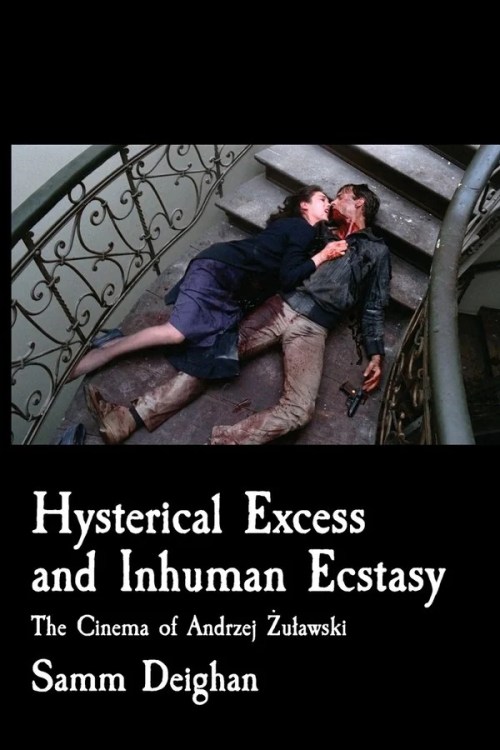
NONFICTION
Hysterical Excess and Inhuman Ecstasy
By Samm Deighan
Sticking Place Books
Published October 12, 2026


