Who has decreed that one should write only when one has something to write? Why, art consists of writing not what one has to say, but something altogether unexpected.
— Diary, Witold Gombrowicz
In late August 1939 the writer Witold Gombrowicz arrived in Buenos Aires. He had taken a ship with other Polish representatives including journalists, diplomats, and businessmen. Within weeks of his arrival Poland was invaded by Nazi Germany, and the Second World War began. Gombrowicz’s ship heads home, but the writer stays. He will spend the next twenty-four years in exile, often in poverty. Many of his greatest works will be written here: The Marriage, Trans-Atlantyk, and much of Cosmos.
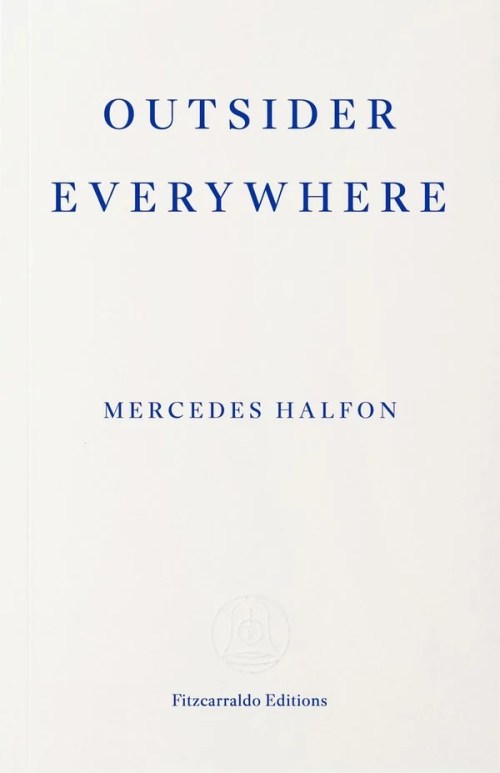
Outsider Everywhere: Witold Gombrowicz in Argentina by Mercedes Halfon (translated from the Spanish by Rahul Bery) is a biography focusing on Gombrowicz’s Argentinian years. It is a somewhat paradoxical work. Unlike many biographies, the text is not organized in an especially formal manner, but flows more like a river. The work is chronological and is composed of a series of vignettes, albeit vignettes that tell a relatively complete narrative. There are many quotes from those who knew Gombrowicz directly—told in varying degrees of positivity—as well as from academics dedicated to his work. Despite the somewhat loose structure, the overall account is not lacking: we get the story and we sense the nature of Gombrowicz as a man.
Who is Gombrowicz? Many modern readers may be unfamiliar with his legacy, unaware that he was a literary force for a time—nominated for the Nobel Prize in Literature four times from 1966 to 1969. Returning to the 1940s, the portrait of the writer as a young-ish man in Outsider Everywhere can come across as quite raw. Gombrowicz has little interest in the Argentinian writing community, and spurns the likes of legendary writers Jorge Luis Borges and Carlos Mastronardi. When Gombrowicz manages to get an office job, a coworker observes: “He’s late again, he’s dressed like a beggar, he eats oranges like a hog and spits the seeds in his waste paper bin, there’s a button missing from his shirt and, worst of all, he fell asleep again today.” The writer of the present article—initially unaware of Gombrowicz’s legacy—began to wonder if we were dealing with another Johann Most: a biographical cautionary tale, this time of an artist instead of a would-be politician.
It is a pleasant surprise to discover that Outsider Everywhere can be read as an inspirational story. It is a narrative of artistic survival. A man authentically rough around the edges survives for decades in a country far from home, barely able to speak the native language, yet continuing to write—to develop his passion—all the while. Despite his exterior oddities and times of rudeness, Gombrowicz is always continuing to absorb life and, with dedication, producing great works of literature. His play The Marriage reads as a precursor to the theater of the absurd. Written in 1947, it precedes Beckett’s Waiting for Godot by two years. (This is not to lessen Beckett’s achievement; these are still very different plays.) The Diary and Kronos are remarkably stylized autobiographical accounts, the former designed for public exhibition, the latter penetrating in its self-exposure of pain and depression, especially for the time period. One gets the impression that Gombrowicz cannot help but write—he is an artist to his core. Isolated and nearly penniless, he slowly builds a literary circle and a group of young followers.
Gombrowicz had a modest literary career in Poland but wrote most of his greatest works and lived a third of his life in Argentina. He was virtually unknown while living in South America; Europe rediscovered him. Which land claims his legacy, then? Outsider Everywhere details Argentina’s position including a former apartment turned pseudo-shrine, a renowned archive known as La Gombroteca, and an international festival held in Buenos Aires. Especially memorable and baffling are the lasting contributions of an Argentinian friend who, decades after Gombrowicz’s death, wrote an obsessive newsletter of essays. Every essay covered different topics using the writer’s philosophy and worldview. The newsletter ran daily for six years.

Outsider Everywhere is many things: an inspirational story, a strange story, a funny story, and a true story. The book is recommended to most readers, especially those with an interest in literary history and an appreciation—or at least a tolerance—for crabby writers.
NONFICTION
Outsider Everywhere: Witold Gombrowicz in Argentina
By Mercedes Halfon
Translated from the Spanish by Rahul Bery
Fitzcarraldo Editions
Published November 3, 2026