Every Christmas and during summers growing up, I traveled from Atlanta to Chicago taking Interstate 57 through southern Illinois to visit family. These flat fields of soybean and corn are the closest I’ve been to rural Iowa. And yet, I feel like I’ve been there after reading Keith Pilapil Lesmeister’s stories set in and around the state’s Driftless Region near Cedar Rapids. Ask Me About the Money is Lesmeister’s second story collection and covers a range of characters desperate for money, human connection and second chances. Drifters and grifters are searching for home or running away from it; young narrators keep hoping while the adults in their lives disappoint them again and again.
The characters and places in this collection feel so real to me: Mato, the ill-fated railway worker losing at the blackjack table; Ronald Driver, an unwanted houseguest bullying the mother and son in the home he refuses to leave; and, in the very last story, an unnamed narrator lying in the grass imagining his family taking a trip to Yellowstone you know they’re never going to take. David Gates called Lesmeister a “heartland Chekhov” and Andrew Porter described him as “one of the most exciting and talented short story writers out there.” I believe it.
Keith attended the Bennington Writing Seminars for his MFA in fiction a few years before I did. I remember reading his first collection, We Could Have Been Happy Here, while I was there and feeling proud that I was a part of the same club as him. Most of all, though, I just loved his big-hearted stories, and I love these new ones, too.
The following interview with Keith took place over email in the last few weeks about his new story collection, Ask Me About the Money.

Amber Wheeler Bacon
In a flash story near the beginning of the book, “Copper Nugget,” a six-year-old narrator says the mention of money “always triggered a response, a question” from his grandfather. He wants the grandson to spend money “wisely.” It’s a very Dickensian description. This idea of money “triggering a response” comes through again and again throughout this collection, which won’t be a surprise considering the book’s title. Talk about the process of building the collection around this theme.
Keith Pilapil Lesmeister
First of all, thank you for taking the time to read the book and formulate questions. It means a lot to me. I didn’t set out to write a book about money, but it turns out that money and its adjacent counterparts—namely, work—are some of my writerly preoccupations. As I thought about the stories I’d been publishing, it became clear to me that money was a prominent aspect in nearly all of the stories. “Copper Nugget” along with a few of the other shorter pieces—which I think of as interludes more so than stories—was written specifically for the collection.
Amber Wheeler Bacon
I’m gonna mention “Copper Nugget” again because in some ways, it feels like a thesis for the collection. The narrator of that story has a different take than his grandfather. He says, “Money had no value to me—it was a meaningless teaspoon of salt in an otherwise endless ocean whose waves only produced more and more salt.” Conversely, in “Fighting for Scraps,” we have another narrator describing his father: “For him, not taking care of your things was the ultimate display of a spoiled, privileged asshole.” I’m interested in your own thoughts about money and work and what moral or ethical values you ascribe to them.
Keith Pilapil Lesmeister
I grew up valuing so much of what I owned, materially, because I worked my ass off to earn the money to buy, say, a pair of shoes or a new CD. I’ve been working in some capacity since I was old enough to remember: joining my father on trips to the scrapyard, working on construction sites (again, with my dad, who did side jobs on weekends), and later still mowing neighbors’ yards or shoveling their driveways. Eventually, like so many Iowa teens, I got a job detasseling corn. My first “real” job was at Hy-Vee grocery store. I loved the freedom of earning my own money and spending it however I felt at the time. Growing up, I didn’t ascribe a moral or ethical value to money, but it did represent a sense of freedom. More so, though, it was simply a means to an end. I worked hard for money and money allowed me to purchase those things I wanted. Now, however, I do ascribe a moral and ethical value to how we as a society position ourselves in relation to both work and money. One example: I think it’s a crime that we live in a country of so much wealth, yet people with debilitating illnesses or diseases, such as cancer, have to host fundraisers to pay their medical bills. That’s wrong. That’s morally reprehensible. Another aspect of our so-called capitalist system that I find reprehensible is billionaires. The irony of billionaires is that by not paying their fair share in taxes, they’re leeching off the system that allowed them to earn that much money in the first place, which might, eventually, be the downfall of the very system that put them there. We as a country can’t sustain fewer people making more and more. As a country, we can’t allow fewer than 1,000 billionaires to own as much or more than nearly 60% of the country. That’s morally reprehensible. Okay. So now I can feel my blood beginning to simmer, so I’m going to stop there, but please know there’s so much more to talk about.
Amber Wheeler Bacon
I think the abstract wealth of billionaires really contrasts with the money represented in this book. Whether it’s a handful of coins, a voided check, or a bag of cash, money’s something you can hold in your stories. It’s finite. We live in a time of cryptocurrency and day trading, where money isn’t real until you cash it out. The government’s no longer making new pennies, but as you say, billionaires are amassing more and more. Through your narrators, I felt I was walking through a series of antique stores, glimpsing a world that no longer exists. Were these nostalgic callbacks intentional or are concrete forms of money still happening more than I think?
Keith Pilapil Lesmeister
Where I live—in rural Iowa—cash is still king. When I go to a locally owned boutique or grocery I try to use cash. I also barter and trade. It’s a small but meaningful protest to our current love affair with our so-called capitalistic society (which is really a socialist-light society, but half the country is too dull to admit to themselves that that’s the case). Cash is more relevant to me in rural Iowa than, say, Apple Pay, which I don’t have on my phone. Hell, I just figured out in the past year how to “tap” my credit card.
Amber Wheeler Bacon
Hahaha, I’m still working on that one, too. You know, I’ve been rereading all of Jane Austen right now for the new movie and series coming out, and all the books are about money. Even in a novel about family, adding in a question of money running out puts pressure on all of those relationships. I want to know about how you build a story like “I’d Help if I Could,” which revolves around a character who needs fast cash. At what point did the desperation for cash come into play?
Keith Pilapil Lesmeister
I realize this is a cliche, but desperate people do desperate things. It was made clear to me almost right away that Liz from the story “I’d Help if I Could” would do something drastic. It wasn’t a matter of harming anyone, it was simply a matter of needing the cash, and there was one clear path that made sense to her, and she chose to take that path.
Amber Wheeler Bacon
Reading these stories brought to mind Lucia Berlin’s A Manual for Cleaning Women and Denis Johnson’s Jesus’ Son. Who were your guiding lights as you compiled this collection? Do you have any favorite collections that also deal with the themes you’re working with here, especially money, family and the Midwest?
Keith Pilapil Lesmeister
I’ve read both of those books and love them. In addition, over the past couple of summers, I’ve returned to the early works of Raymond Carver, whose work is defined by people struggling in their jobs and relationships. Carver was an early influence on my work, and his stories continue to be important to me, especially those that focus on working-class characters.
Amber Wheeler Bacon
Reading your collection, I couldn’t help but think about how the tariffs and oil prices from the Iran War have affected communities in the Midwest like the Iowa towns in your stories. Your narrators are often desperate, broke, and trying to make their way in an unforgiving world. As someone who lives in rural Iowa, what changes have you seen over the last few years, and what effect, if any, did they have on the stories in this collection?
Keith Pilapil Lesmeister
The slow deterioration of rural Iowa is a constant influence on my work. It’s sad, to be sure, but there’s also something mesmerizing about the people who continue to live and work in rural Iowa as if nothing’s the matter; as if we’re going to somehow bounce back from the farm crisis of the ’80s; as if people are going to leave cities and flock to rural spaces to live. Ninety-nine percent of rural towns in Iowa are declining in population. That decline will accelerate as the baby boomer generation retires to their heavenly home (you gotta love a euphemism every once in a while). I don’t purport a solution to this impending and inevitable demise of the state, but I watch with both fascination and dread. And all of it informs my work.

Amber Wheeler Bacon
It’s not just rural Iowa. The physical spaces that constitute home or the loss of it in Ask Me About the Money feel extremely important. Characters live in motels, sleep on couches and crash with friends; homeowners renovate attics and basements, and boys spy on a family moving into a newly built home in the neighborhood. Talk to me a little bit about these physical manifestations of home, the houses themselves, and what makes these spaces such strong catalysts or backdrops for your fiction.
Keith Pilapil Lesmeister
Yes, I think home is one of my writerly obsessions, insomuch as I’m curious about how people maintain and protect their home spaces. Focusing on “home” creates a natural form of conflict if, say, an unwanted visitor disrupts how a character is used to interacting in what was once a safe space. Or maybe “home” becomes the brunt of insults hurled by a new neighbor. If/when that happens, how do the characters respond to such threats? How does a character react when “home” is a tenuous, transient environment? What kinds of boundaries might that person create as a way to protect that home? The hope, for me, is that these situations facilitate conflict to propel the story.
Amber Wheeler Bacon
Speaking of home, you edit an annual collection for Eastover Press called An Anthology of Rural Stories by Writers of Color. Your social media feed is full of photographs you’ve taken around your hometown in Iowa’s Driftless Region. This collection along with your earlier collection, We Could’ve Been Happy Here, focuses on characters who live on the margins in working-class, small-town Iowa. Rural America is so often portrayed as homogeneous in popular culture. What is it about the intersection of race and rural and working-class life that keeps drawing you back, both as a writer and reader?
Keith Pilapil Lesmeister
I had the idea that if I was experiencing these forms of othering, then other writers of color living in rural spaces might be as well. Examples of this othering: the constant question “Where are you from?” Or, “Do you speak [insert language]?” Or, one of my favorites from when I had a ponytail: “You’re trying to tell me you’re not Lakota?” Living in a small town is great, but there are aspects that put me on edge, and naturally that conflict has the potential to make for interesting fiction, if done well. That’s why I wanted to put together the anthology—to hear from other writers about their experiences and, more so, how they reflect those experiences onto the page.
Amber Wheeler Bacon
I noticed after reading the collection that my favorite stories were classic “stranger comes to town” stories. Even if a main character—or a story’s antagonist, like Ronnie, that stinker in “Fish and Rice” … man he was fun to hate—wasn’t actually new to town, they sometimes felt like they were. The collection tracks a range of drifters and grifters, strivers looking ahead for their next job or looking behind them covering their tracks. It’s funny to me because you seem very stable and honest. In some ways the collection reads like both an ode and elegy to vagabonds. What attracts you to writing about this lifestyle?
Keith Pilapil Lesmeister
Thank you for thinking of me as “very stable and honest.” I try to be those things, if not for myself, then certainly for my family and possibly others. I don’t like to disappoint people, and so I’ve worked hard most of my life to avoid being a fuck-up. But I’ve had my moments, and I certainly know a lot of people who have had their fair share of unsavory moments. Perhaps I can better answer the question with this anecdote: when I was at Bennington, Bret Anthony Johnston, one of my faculty mentors, encouraged me to write what I don’t know. This is contrary to the oft given advice of writing what you do know. I was open to the idea, but I didn’t know where to start, so I asked him: “Bret, good idea. How do you suggest I do that?” He replied, “Barring war or global economic or environmental collapse, start with your worst-case scenario.” I thought about it for a while and settled on addiction and estrangement from family as a worst-case scenario that, given a couple of wrong moves, could in fact be my reality. That’s how I wrote some of the stories in the collection: imagining that this could happen to me.
FICTION
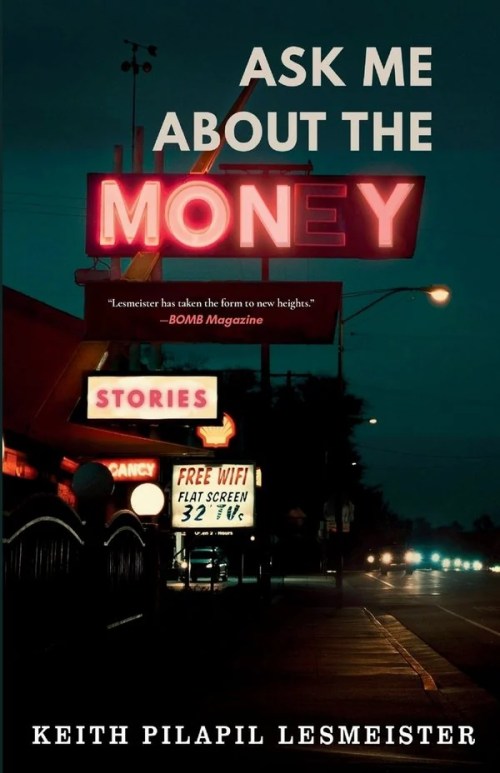
Ask Me About the Money
By Keith Pilapil Lesmeister
Cornerstone Press
Published November 3, 2026