


Alyson Mosquera Dutemple’s debut collection of short fiction is composed of thirteen stories about loneliness, loss, resilience, growing up, and the natural world: in other words, it’s a book that explores what it means to be human. It’s also funny, moving, and surprising—sometimes all at the same time.
Alyson’s work has appeared in more than four dozen journals and anthologies, including Colorado Review, Alaska Quarterly Review, Salamander, DIAGRAM, Passages North, Redivider, Arts & Letters, Best Microfiction, and The Writer’s Chronicle.
Fortunately for me, Alyson received her MFA from Warren Wilson College’s Program for Writers at the same time I was enrolled in the program; we met and became fast friends. I had the pleasure of interviewing her via email about Marvelous Freaks of Nature!
This interview has been edited for length and clarity.
Christina Ward-Niven
When you were sending this collection out for possible publication, I know that you pitched it (irresistibly, in my opinion) as “Flannery O’Connor on Zoloft.” Can you explain what you meant?
Alyson Mosquera Dutemple
I have to confess that this phrase just came to me like a lightning bolt one night as I was just about to fall asleep. I sat up, scribbled the phrase in the notebook I keep next to my bed for just such occasions, and went to sleep. The next day, I forgot about it for a few hours until my husband said something that jogged my memory. I wasn’t holding my breath that it was a great idea. Sometimes I wake up and find I wrote nonsense or that I can’t read my writing, but when I looked back at that phrase in the light of day, I thought, yes, that’s it! My stories are dark and sometimes a little darkly funny (I hope), like Flannery’s. And they show people in a most unflattering light. But they aren’t quite as grisly. I don’t have characters like The Misfit in my book.
I know it’s really aspirational to invoke Flannery’s name in a pitch, but I’m fully aware that her work is untouchable. It’s more like I’m trying to show how I’m invoking her vibe while putting my own spin on it.
Christina Ward-Niven
I love your decision to divide the collection into three parts—”Marvelous,” “Freaks,” and “Nature”—based on the title of the opening story (also the title of the book). I’ve never seen a collection divided up in quite that way. How did you come up with this structure?
Alyson Mosquera Dutemple
I was pretty far into the process when I landed on that choice. I had already written what I thought were all the stories in the manuscript and I was playing around with ordering them. I liked doing that work. I’ve made a ton of mix tapes/CDs/playlists over the years, so it felt like employing the same approach, creating a mood or a journey. But something was missing in the way I was arranging the stories; the order wasn’t really singing, for lack of a better description. Then I realized that though the whole collection centers around common themes of loneliness and longing for connection, often against the backdrop of something strange Mother Nature serves up, there were discreet categories of story in the book: the “marvelous” section is mostly characters who are suffering, but who come into their own over the course of the story; the “freaks” are characters who don’t fare quite so well and still have some work to do at the end (sorry, guys!); and the “nature” section all features characters who are engaged in a direct struggle with something unrelenting in the natural world.
The more I thought about arranging the collection this way, the more I thought about other collections that employ original structure. One that inspired me was Megan Cummins’s If the Body Allows It. I love this collection so much (and I also love Megan’s novel Atomic Hearts). In her book, she organizes each section around a body part. And the first story in each section begins with what you could call the main character in the collection, a writer, while the subsequent stories in each section read as the stories that writer/main character wrote. It’s such an inspired arrangement. It gave me a sort of permission, paging through that book while I was working on ordering my collection, to follow my instinct to do something more particular with my own structure.
Christina Ward-Niven
In the title story, the troubled young-adult protagonist (Mavis) is given a book as a gift. “Marvelous Freaks of Nature!” is the title of that book, and it’s filled with photos of “fantastically lurid … biological calamities.” The book is objectively grotesque and repellant, yet it turns out to be strangely magnetic for Mavis (and for other characters in the story). I have to ask: Is it based on a real book? If not, how did you come up with that particular subject for a fictional tome? Why do you think it drew the characters in, cleavers-in-skulls and all? (It sounds like a much darker version of books my kids used to want to buy at the elementary school book fair: big glossy paperbacks with titles like 500 Super Weird but Totally True Facts!)
Alyson Mosquera Dutemple
My kids always loved those books too! And I did have many variations on that type of book around my house when I first drafted that story. So, while the book in the story isn’t based on one particular real-life book, I’m sure it was informed by all these freaky factoid books the kids would bring home.
For some of the lurid stuff in that book, I just sifted through anecdotal stories lodged in my mind from spooky sleepover tales I heard as a kid—urban-legend kind of stuff. I remember so many of those weird stories, and it’s strange that nowadays kids can just whip out their phones and fact-check tales like that. I think I’m glad I couldn’t do that. I just filed away the strange things I was told, remaining open to the possibility that they could be real, even if I knew they probably weren’t. For example, my cousin used to tell me about a spider that could burrow under my skin and lay eggs there, and that any day now I might wake up to find millions of baby spiders erupting from one of my arms or legs. I never fact-checked that story. Or talked about it, I’m now realizing. But memories like this that I carry from childhood (or traumas like this, I should maybe say!) very much inform my writing to this day. I guess I should say thanks to my cousin!
Christina Ward-Niven
I am struck by the impressive story endings in this collection. You have some perfect last lines that, for me, open up the meaning of the entire story. Writing an excellent short story is hard; ending an excellent short story is really hard. One of my favorites is the closing line of “Herps,” about a lonely amateur herpetologist who finds purpose participating in lizard message boards: “There were consultations to get to … and questions that were posed to him, a whole long list of them, just waiting for him on the boards, posted by people like himself, people who understood the importance of learning everything there was to know about the things they loved, of knowing precisely how to care for them.”
How do you think about story endings? What should they do for the reader, in your opinion?
Alyson Mosquera Dutemple
What a compliment! Thanks so much! For me, it’s more of an instinct or a feeling that tells me when I’ve finished the story and when the line is right. I don’t outline, so I rarely know where a story is going to end up ahead of time. It’s truly like the feeling described by E.L. Doctorow of driving in the dark and having headlights illuminate a little bit in front of you at a time. I just write into that bit of illumination until I get to a place that looks and feels like an ending. Honestly, for me the harder part is editing the story after the first draft is finished and adding enough to the middle to justify a good last sentence. I’d say that most of the endings in these stories were there from the earliest drafts, but the middles had to be finessed, and the pacing rejiggered, in order to make that first-draft ending work.
Christina Ward-Niven
Each of the stories feature completely different characters and plots, but they are unified by a handful of recurring themes. Again and again, people struggle with loss, with loneliness and isolation, with romantic disappointments, with the erosion of self that often comes with motherhood. However, this is not a bleak book! I felt a palpable throughline of hope. In many cases, we are left feeling that the characters, despite the raw deal that life has handed them, have a good chance of pulling through in some way. Do you think about the role of hope when you write?
Alyson Mosquera Dutemple
Oh, what a fascinating question. I’ve never been asked that before! I guess first I want to say I’m so glad you don’t think it’s a bleak book. I was really trying to balance light and dark. Maybe I was dancing around the idea of hope when I landed on that “Flannery O’Connor on Zoloft” tagline. I wanted the darkness of an O’Connor story but with a touch more softness, which, I think, is the same thing as that “hope” you mentioned. It’s funny because I identify as a pessimist, but I don’t think that’s exactly right. I’m more of a “worse-case scenario” gal in real life. I’m always anticipating the worst, but holding out for a miracle at the same time. If I were truly a pessimist, I wouldn’t harbor secret hope. I guess you’re seeing that secret optimism in my stories, too. I hadn’t ever thought of it that way, but maybe that’s a little bit of myself coming through in the fiction.
Christina Ward-Niven
Several of the stories—such as “Everything Must Go,” “Culs-de-sac,” and “Saint Nobody”—deal with coming-of-age themes. What is it that draws you to coming-of-age as a writer?
Alyson Mosquera Dutemple
It’s a voice I feel comfortable writing, for better or for worse. Maybe it’s thanks to a bit of arrested development? I still very much feel like I’m figuring it all out, this life thing, so those coming-of-age themes still resonate with me. We all carry so much from childhood into our adulthood. I guess I find it easy to lean into that.
Christina Ward-Niven
Similarly, many of the stories here feature kids with one parent missing—either due to divorce, abandonment, suicide, or just unexplained absence. What is it about that scenario that lends itself to short fiction for you?
Alyson Mosquera Dutemple
I’m not sure where my fascination with missing parents comes in. Both my parents are very much not missing! But it could be from my interest in writing “original hurts”—that idea of leaning into the baggage of childhood and how it affects a person as they go through life. For short stories, in particular, this is a helpful situation to drop a character into because short stories have to begin in the middle, as it were, due to the compressed nature of the form. Having a missing parent is one way to telegraph that “middleness.”

Christina Ward-Niven
Your stories are written in a range of perspectives. For example, “Marvelous Freaks of Nature!” is in first person, “Three Season Room” and “Touch-Me-Nots” feature a roving third-person POV that shifts among the central characters, and “A Hill of Beans” is in second-person POV. How do you decide which viewpoint to use when you write a story? Do you ever change your mind along the way?
Alyson Mosquera Dutemple
I think the only time I changed POVs was in the story that uses the second-person POV. I just went back into my old files and I can see a draft of that story in first person from April 2019. But by March 2020, I had written a version using second-person. I can’t remember why I decided to try out the second-person initially, beyond being intrigued by the challenge of it. I do remember reading Sian Griffiths’ excellent essay in Waxwing about second person a few months after I started playing with the switch. She helped me understand what the POV could bring to the story that wasn’t there before. It’s a great essay.
Christina Ward-Niven
Narrative length also varies dramatically within the collection, from stories I would consider flash fiction (e.g., “Hazardous to Sea Life,” “Fire Sale”) to the novella-length “Touch-Me-Nots.” Is your writing process different when you are writing flash versus a traditional-length short story?
Alyson Mosquera Dutemple
Oh boy, is it! Flash is the form I feel most comfortable with. I love the challenge of writing super compressed, of insinuating so much between the lines. Writing flash feels less… can I say “onerous” here? Longer stories require a lot more patience and a lot less massaging of the language on the first draft. But that massaging of the language is my favorite part of writing, and I’m often impatient and want to jump right to that fun part. Plus there’s an immediacy in flash that appeals to that impatient part of me, the immediate-gratification part—whereas writing longer stories, or more traditional-length stories, requires more discipline and more… faith, maybe? I have to trust the mystery of the process more.
Christina Ward-Niven
Many of the stories here are set in or near New Jersey. I know you are a lifelong New Jerseyan; is there any other reason you are drawn to featuring the state in your writing?
Alyson Mosquera Dutemple
I think it’s because so much of my identity is wrapped up in being from New Jersey, this place that is so maligned in pop culture. In the beginning, I just wrote stories set in New Jersey because it’s the place I know best. But once I saw a pattern emerging in the stories—once I realized that the characters in the book all feel like outsiders—New Jersey just became another way for that outsider status to come through. Maybe also a teeny-tiny part of me might have secretly hoped that readers who pick up this book with preconceived notions of what people from New Jersey are like could have their viewpoints broadened? Just a teeny-tiny part, though. I’m mostly happy with New Jersey remaining an undiscovered secret.
Christina Ward-Niven
I particularly love “Touch-Me-Nots,” which begins with a family—wife Rita, husband Rodney, college-aged Kiera, and 10-year-old Scott—on vacation in Bermuda, and proceeds to move back and forth in time to tell us the story of a harrowing incident on that trip, along with backstory about each of the four family members’ private struggles. Along the way, we encounter pollution anxiety, a coming-of-age saga, the perceived invisibility of middle age, and a heartbreaking memory about the early days of Rita and Rodney’s marriage. By the end, the reader is highly invested in everyone on the page; I felt like I knew them. Do you ever get attached to your characters? Do you ever consider revisiting characters after you write a story?
Alyson Mosquera Dutemple
Well, I have to say thanks to you for being one of my early readers of “Touch-Me-Nots.” I wrote the first draft of that story while I was working on my MFA at Warren Wilson (which is where I was lucky enough to become friends with you!). I felt like I was on to something there, but I couldn’t quite find the right balance of character and plot for a while. I worked on it with my advisor at the time, the wonderful writer and teacher Debra Spark, and she encouraged me to keep at it after graduation, which I did. But sometimes when I work on something difficult for a long time, I can lose confidence in it and psych myself out. This was one of those stories that I started to lose confidence in. But I remember very clearly sharing a draft with you, maybe six months after finishing my MFA. I think I said something along the lines of “I need to know if this is working,” and your response to me was so generous and enthusiastic that you helped reinvigorate my confidence in the story. So I guess I could say that I got more attached to these characters after I saw how attached you were to them! I revisited them, in part, because of you! If readers like this story as much as you do, they have you to thank.
FICTION
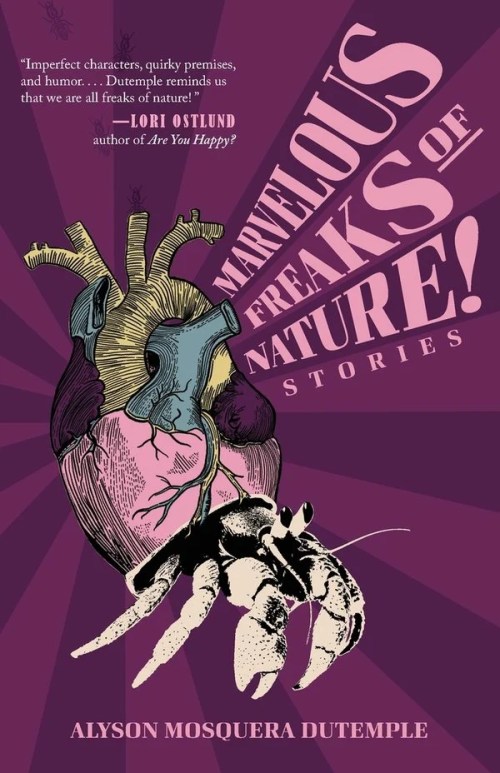
Marvelous Freaks of Nature!
By Alyson Mosquera Dutemple
Cornerstone Press
Published October 20, 2026


