


Minotaur
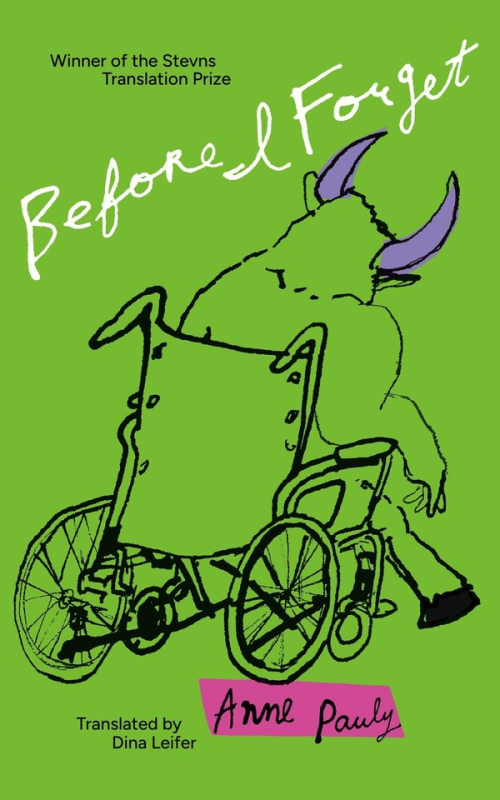
Anne Pauly’s autofiction work Before I Forget features the cover image of a horned, cloven-footed beast in a wheelchair slumped to one side. It’s a child’s drawing—a simple representation of Anne’s father Jean-Pierre as the monster who painted her childhood with violence. She refers to him as a minotaur, but his horns are purple. The splash of color indicates the youthful tendency to seek beauty in an otherwise monstrous person or situation. Anne felt it as her father comforted her when she needed it. She learned even more about that side of him from his childhood love Juliette. As the illness that tethered him to a wheelchair progressed and he became more dependent, more of her father’s humanity seeped through. Anne’s emotional barriers slowly eroded as she witnessed his struggle using a prosthetic leg and operating a wheelchair. Jean-Pierre’s death opens the door to Anne’s understanding of just how complicated people are.
Her father’s death makes Anne take stock. Not only of the unknown bits of his life, but also her own life. Anne starts the book listing her father’s personal effects from the hospital room. Later, logistical to-do list associated with the death of a loved one. From booking the church service to clearing out the house, her taking inventory of everything is how she accounts for the forgotten past and adds new memories (or the new understanding of old ones) so she doesn’t forget. It grounds her. Her memories help hold the family together in a way. When her brother Jean-Francois isn’t interested in keepsakes or sentimentality, Anne is heartbroken. Memories are a catalogue of his and their experiences. She wants to remember her father positively and as she discovers more that improves her view of him, she wants to share. Her brother’s rejection makes her feel disconnected from the family and the world.
Death
The things left behind when someone dies are important. They are what prove a person existed before their light blinks out. Anne finds hope among the debris of her father’s life. Along with his love of poetry and philosophy was the aptly named Juliette. She was his friend, but her parents didn’t think much of him because of his meager background. They seemed to agree it was best not to pursue anything more, but based on how their relationship developed, there was evidence of longing and possibly regret. Anne called Juliette to inform her of Jean-Pierre’s passing and the brief connection and subsequent letter from her was exactly what Anne craved. She’d found someone to validate the purple of her minotaur’s horns.
Juliette’s stock of Jean-Pierre was not just a list of things, it was a collection of memories and experiences. They managed to share a side of life separate from Anne and the rest of their family. Juliette wrote a letter for Jean-Pierre that Anne was to read and somehow transmit to him. It was the most accurate portrayal of grief in the most unique format imaginable. It was also an inventory of Jean-Pierre’s goodness, insecurities, worries, and more. Pauly gave Juliette the heaviest load of any character and she didn’t even make a true appearance within the text. She attended the funeral, but did not make herself known. She only exists for Anne in stories, journal entries from her father, a phone call and a letter—not within an actual scene in the book.
Release
The letter put a fine point on the meaning of loss, the associated emotions, and the difficult but necessary ability to move forward with the rest of the world. Unfortunately, Anne had difficulty transitioning back into her routine. She realized her rage at the idea of getting back to “normal,” as if loss was merely inconvenient. She suffered panic attacks and visited mediums to try to learn how her father was experiencing the afterlife. It was a weak antidote to her despair. It wasn’t until a lyric from a pop song made her think of her father many months later that she finally accepted his death and released the burden that was causing her so much pain.
Humor is also an effective way to deal with traumatic events and Pauly infuses it flawlessly. Narrator Anne tags a particularly cruel interaction with her brother with snark that pokes at the wonders of having a loving family. She also gives color commentary on the responses to people as if they are lifeless automatons puppeted by tiny people. Anne’s style of storytelling is purposefully entertaining for the reader, as if to siphon some of the tension that has built up between her and the reader around the sad or brutal details. Part of it comes from managing two relationships at the same time: her relationship with her father and her relationship with the reader.

Anne regresses to a child in some ways as she rummages through her father’s most personal things, but also she makes jokes for her benefit and the reader’s. Not only does she need something to soothe her wounds, but the secondary trauma or triggers readers may experience also need a salve. This may also be why the book is such an economic 130 pages—salvation. The largest criticism is the need for more Juliette—for example, a conversation over coffee with Anne and Jean-Francois to bring him closer to their father, but then perhaps her words wouldn’t land as powerfully or brighten the purple of their minotaur’s horns.
FICTION
Before I Forget
By Anne Pauly
Two Lines Press
Published October 13, 2026


