


For Robert Earle Paige—fabric artist, textile designer, and arts educator—“Design is an answer to a set of questions.” Yet what are the questions? It depends on who does the asking. For Paige and many of the designers and commercial artists featured in Black Designers in Chicago: Culture and Community in the Twentieth Century, design addresses form and function as well as questions about Black visibility and sensibilities.
Although design has been present in the United States for centuries, it was not until the twentieth century that American design aesthetics began to have a greater global impact. After World War II, with the rise of consumerism and mass production that incorporated new and inexpensive materials, American designers led the way with their innovations. While the Chicago-based design contributions of people such as Ludwig Mies van der Rohe are well established, Black Designers demonstrates that Black Chicagoans were also at the forefront of shaping global design. One such figure featured in the book is Charles Harrison, who led product design at Sears from 1961 to 1993. Harrison’s innovations included taking advantage of moldable plastic technologies to create affordable, attractive products that became staples of middle-class American homes.
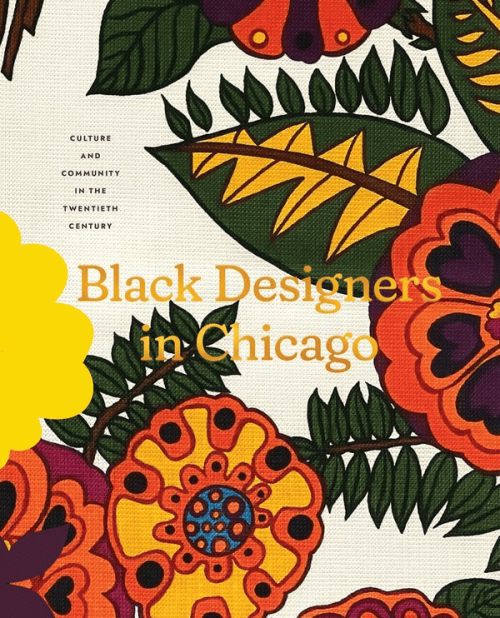
Where Harrison sought to make good industrial design that was democratic without overt appeals to race, other designers and commercial artists in Chicago’s creative Black communities have sought more explicitly to elevate representations of people and cultures from the African diaspora. Johnson Publishing Company (JPC) (1942-2019)—with its pioneering Ebony and Jet magazines—is a name readers may recognize as a formidable entity for cultural production. JPC’s leaders played an important role by employing and mentoring numerous Black commercial artists. In addition to JPC, there are scores more everyday artists, clothing makers, illustrators, and designers of all stripes whose influence has heretofore gone largely unrecognized in surveys of American design history. Black Designers names the people who helped make Chicago a center for design: from Robert Earl Paige, whose 1970s textile design—“028 Ivory” for the Sears 1970s Dakkbar fabric collection—graces the book’s cover, to Folayemi Wilson, who in 2016 co-founded blkHAUS Studios with Chicago native Norman Teague. Chicago as a refuge for WWII-era European Bauhaus artists is well documented. This book shows that the twentieth-century Black arts movement has also been a powerful creative design force with an enduring international impact.
Editors Chris Dingwall, David Hartt, and Daniel Schulman emphasize the role of community as a significant reason for the emergence and flourishing of Chicago’s Black arts scene. From the South Side Community Art Center (SSCAC) to the AfriCOBRA artists collective, which sought to incorporate the politics of the Black Power movement into an activist design movement, the editors demonstrate in the first two-thirds of the book that Chicago has long been fertile ground for the cultivation of designs with the power to speak across classes and cultures.
The latter third of the book is dedicated to a collection of essays ranging from personal reflections about participation in Chicago’s twentieth-century art and design scene (see, for example, “Black Gatsby”) to more polemical scholarly essays such as Jacqueline Goldsby’s “The Artists’ and Models’ Balls.” A Yale University professor, Goldsby introduces new terminology for talking about the ways twentieth-century Black Chicagoans resisted racism and created egalitarian spaces for being agents of their personal and professional lives. The author posits that the annual arts fundraising balls celebrated what Goldsby calls middlebrow(n) aesthetics and worldviews, offering a break from the era’s racial status quo.
The “Black Gatsby” essay, which is Paige’s perspective on his career as told to editors Dingwall and Schulman, was a highlight of the book’s essay section. From his wit—describing himself as trained in the arts of “inferior desecration”—to his remarkable career, I found myself wanting to learn more about the life and contributions of this artist who teases in the oral history that he has more to share, which he is reserving for a future publication of his own.

Black Designers is a beautifully designed book: from the layout, to the cover, to the illustrations that appear on nearly every third or fourth page. The book captures the vitality and joy that emerged from Chicago’s South Side—long a locus for Black Chicagoans—throughout the twentieth century. Readers may be introduced for the first time to designers whose contributions have gone unrecognized in mainstream design history surveys. Yet Black Designers is not a niche book but rather an overdue recognition of the contributions Black artists have made to design more generally.
While Theaster Gates (b. 1973) and Virgil Abloh (1980-2021) are figures many will recognize as important contemporary culture producers with Chicago roots, Black Designers introduces readers to lesser-known artists and creators who have shaped design. As such, this well-researched book is a welcome contribution to design history that situates Black practitioners as empowered people whose rich archival collections and personal stories document a social history that has received scant scholarly attention.
NONFICTION
Black Designers in Chicago
Edited by Chris Dingwall, David Hartt, and Daniel Schulman
University of Chicago Press
Published October 7, 2026


