


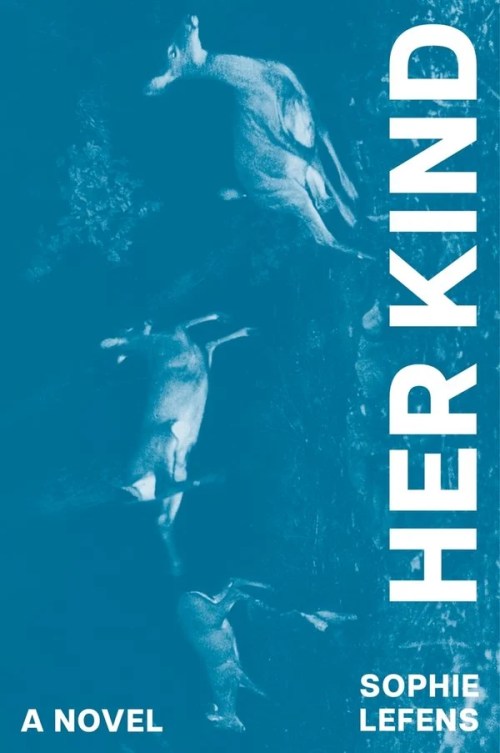
In times of uncertainty and upheaval, the lucky among us have friends or family we can lean on. They help us trust again after loss or trauma. But what if you’re the sole parent to a young child, and you fear you won’t be around to take care of him? Who would you ask to take that on? In Her Kind, Sophie Lefens explores the weight of responsibility that being a single parent really is, especially when it’s not what you bargained for.
Ada’s husband Daniel left her and their baby, Lenny, when he was just eighteen months old, confessing that it was all just too much. Ada’s own mother had abandoned her when she was young, and back then, Ada found refuge with her aunt Leigh in rural, lakeside Michigan. When Daniel leaves, Ada once again shows up at Leigh’s farmhouse with Lenny, leaving her life in Chicago behind.
The book’s epigraph is from Anne Sexton’s “Her Kind,” a poem about the isolation of womanhood, rebelliously becoming a “possessed witch / haunting the black air, braver at night.” Lefens’s quoted stanza is about a woman who “fixed the suppers for the worms and the elves: / whining, rearranging the disaligned.”
And in the book’s opening lines, the narrator says that in books she’s read, “women often flee to the woods to make their home, have their children, find their peace.”
“Maybe in the woods it’s easier to convince yourself that your life is what you meant it to be,” Ada says. And so Ada goes to the woods, establishing an unconventional partnership with Leigh in raising Lenny and trying to heal: daily trips to the lake, tandem biking, watching deer in the yard, playing with barn kittens, and visits from Ada’s old boyfriend Peter, who is always happy to be around and needed. But Ada can no longer imagine a future where she and Lenny are safe, where she can find love and trust that love. She starts to feel trapped and afraid of something horrible happening, “caught inside of a holy, terrifying version of time, dangling from instant to instant.”
She has a recurring vision that someone is violently pulling her away from the earth, and she fears she won’t be around much longer. She invites her three best friends—Joanna the painter, Sage the violinist, and Agnes the seamstress—to come stay with them for a while, with the secret motive of deciding who will take Lenny if she disappears.
Most of the book is quiet, full of descriptive narration of what the women do all day, what they eat, what they wear. The author’s prose is comforting and warm, like the fireplace they sit around every night as the days get colder. Ada believes it’s all too good to be true and that something will go wrong, and it feels that way reading, too, about these daily lives of nature and love and sustenance. What’s the problem?
As Ada struggles to find peace, Leigh’s memory starts to fail, and tension builds between the four friends sharing a home, their perfect refuge starts to fracture. All the while, Ada observes the deer acting stranger and braces for the blow she knows is coming.
Underlying the beauty of the prose and the setting is also the sadness of abandonment. Ada feels for Lenny, wondering how he’ll one day have to process that his father didn’t want to be part of these precious days. She wonders how her own mother could give up the responsibility. Ada’s visions, then, make sense—how can she trust even herself to keep showing up?
She admits that when things are exactly as she hoped they would be, it feels most dangerous. To love is to be vulnerable, exposed to risk. She says, “Real love leaves you quaking, constantly looking over your shoulder, intimately aware of what could be lost.”

And isn’t that the paradox of motherhood? Of womanhood? That Lenny could need her so much, that anyone could, is the root of her fear, and she wants to hide in the dirt and trees, regardless of the incredible mother she is. But Leigh and Ada’s girlfriends show her that the rewards of loving and trusting can be worth the risk. She starts to see that home is where “what was wild and disarranged in you had a chance at finding a form.”
Lefens’s first novel is a nourishing way to recognize motherhood, how it can be “fetishized and demeaned in turn,” internalizing the often-unbearable responsibility of balancing childcare, romantic love, friendships, and purpose in your 30s. Part of Ada’s growth is first admitting the loneliness of her reality. “No one cares about it, you know?” she tells Joanna. “About me being a mom. It’s not admired. Sometimes you just want to be admired.”
Lefens introduces Ada’s moments of growth with the care of experience and with trust in the reader. While the narration can shift abruptly between present and past tense, and Ada’s horror-like visions tempt the reader toward a different kind of reckoning, the book reads like an embrace, perfect for colder months. It is refreshing to have an honest—and exceptionally written—examination of motherhood without hyperbole. Anyone who is a mother or has a mother should read Her Kind.
FICTION
Her Kind
By Sophie Lefens
Mariner Books
Published October 13, 2026


