


Matthew Prigge is an author and librarian at Marquette University in Milwaukee, Wisconsin. He has written several books, including Outlaws, Rebels, & Vixens, which was made into a feature-length documentary about film censorship. His newest book, Dog’s Day, is an examination of the story of John Wojtowicz, the bank robber who inspired Sidney Lumet’s hit film Dog Day Afternoon. The book is an in-depth dive into the lives of John, his accomplices, and his lovers, during a significant time of political unrest and queer protest.
Matthew joined me for a Zoom interview to discuss his relationship to the film, his research methods and resources, and the complicated life of John Wojtowicz. It was a true pleasure to discuss one of my favorite films and this important book.
This interview has been edited for length and clarity.

Ashley Hatzenbihler
This book is about the story that inspired Sidney Lumet’s Dog Day Afternoon, which recently celebrated its 50th anniversary, but it’s also about so much more than that. It’s a portrait of a pocket of the LGBTQ+ community in New York in the 60s and 70s, kind of rooted in this story about a bank robber. What drew you to this story and these people? Did you have a relationship with the movie before this?
Matthew Prigge
Yeah, I think I first saw the movie when I was in high school. I kind of became a movie kid at that time, and I was going back and watching a lot of stuff from the 70s, and I don’t remember exactly when or how I came across Dog Day Afternoon, but it’s probably been one of my 5 or 10 favorite movies since the first time I saw it. I mean, I was just transfixed with it. It was just a perfect movie to me. I actually had the two VCRs set up so you could dub a tape from the rental store. That was my copy for a long time. So my interest absolutely came through the movie, and then at some point I started getting interested in the true story, so I started looking up stuff on the actual robbery. I came across the Life Magazine article, and really, I’ve had the idea to do this book for… God, like 15 years now.
But it was just an idea and I didn’t know the resources out there existed to write a book about it. And if I had known they existed, I wouldn’t have known how to get to them. So it really was that two hours Lumet uses to describe this story that introduced me to this story. Then eventually I found out about some of the other documentaries that were out there about the incident, and I found those really fascinating. It actually wasn’t until I started as a research librarian at Marquette University that the idea of the book took hold, because at that point, I had access to their archival collections and their digital resources, so that was how I was able to consider that I might be able to really find out more of the story than I’d been exposed to so far.
Ashley Hatzenbihler
What specific resources were the most useful for you once you were able to really dive into the story?
Matthew Prigge
Everything that was written about it in the gay press at that time. And certainly I did use, like, the New York Times, New York Post, the Long Island newspapers, all that kind of stuff. They wrote about it a lot, but that was really one small part of the story, and then I got into the newspaper called Gay. It was being published in New York City at that time. And stuff that was in The Advocate. Journalists Randy Wicker and Clifford Jarre were writing about the gay community at this time. So I was reading through their stuff. There’s just two names off the top of my head, there’s a whole lot more. But the debate that this robbery sparked in the gay community and that discussion was really fascinating to me. Because that point of view was a lot different than you saw in the more mainstream press. And that made it clear to me that there was a whole other story to be told here.
Ashley Hatzenbihler
So not only are you building on the story that we see, as you said, in those two hours, which really was just a flash in the pan of what was actually going on in New York, and even just a slice of what was going on in John’s life, but the book also builds a picture of the larger undercurrents of queer movements at the time, and kind of John’s place, or lack thereof, in those movements. And it’s impossible to view those movements in isolation, especially considering the renewed rise of anti-queer rhetoric and policy. So what struck you the most about that aspect of the story as you worked through the book?
Matthew Prigge
John’s relationship to the gay community and his trying to frame this as a political act was a really interesting aspect of this to me, because he was a fascinating character. He’s absolutely the wrong person to be called to account for what he did, if you’re framing it as a political act, because he had just no concept of what the struggle was about, really. But at the same time, I think one of the striking things about this is that debate was going on in the gay community about whether robbing a bank and saying “I’m a gay man, I need this money to make my life right” was a valuable and political act. And there were people who came down on both sides and there’s reasonable arguments on both sides, but the people who actually knew John as a person and had encountered him experienced hesitance to even engage in the debate, because this person is not well and whatever we’re ascribing to this, he did not mean this. This is just a completely selfish act on his part. But at the same time, there was nobody else who was willing to do anything like this.
Say what you will about his motivations, he did take a gun into a bank and tell everybody, “I’m a gay man, I need this to make myself right, I’ve been failed by everybody. This is what I’m doing. This is who I am.” So trying to put all that together, it’s the absolutely wrong person to have been put in this position, but also, maybe the only person who would have ended up in this position. I thought that part about it was really interesting.
Ashley Hatzenbihler
I was struck in your book at how you did an incredible job of weaving together what you were able to learn about John, how he was portrayed in the movie, and then also how he reacted to that portrayal. John was not really someone to root for. He was quite cruel and selfish and destructive, and the book kind of deconstructs this myth that the robbery was only a political act or only to fund his wife’s transition surgery. How quickly into this process did you realize how different John was from how he was portrayed and what was the process like of weaving together all these versions of John?
Matthew Prigge
That’s a good question. There’ve been a few documentaries that have been made involving him. I think the most prominent one was The Dog, which came out after his death. He gets a lot of time on camera in that and they’re following him in the last years of his life, and he’s telling his version of events, and I think it’s a really interesting artifact, because you get to see how he adopted the Dog Day Afternoon story as his own. And also, you can see that he’s a very charming person, and he’s got a lot of charisma, and he certainly manages to seduce the audience while telling his version of events. And the documentary makes it pretty plain too. They talk to other people in his life and his ex-wife, Carmen, who says plainly “He’s not a good person. He ruined my life in a lot of ways.” That idea or that sentiment about the two sides to him, this charismatic side, and then his very controlling side, the need to dominate, and his inability to consider the feelings of anyone else.
And I’m not sure what my opinions of him were when I started out, but they definitely darkened as I got deeper into this, especially hearing Liz Eden’s side of things, and how in the period between the end of their relationship, which is often portrayed as a marriage, and the bank robbery is really, really dark. He made her life just absolute hell. He was threatening to kill her, constantly showing up where she worked with a gun, dragging her out into the street, physical abuse, mental abuse, stalking her friends. It’s hard to square that behavior with any sympathy for him. I don’t know if you really see who he is, but you see part of his personality, and part of what he’s capable of, and how he treats the people who are in his life, who he supposedly loves and who might love him. Once I went through that part of the research and kind of squared all that up, I really saw all the little signs and everything else, about how everything is always about him.
As I was putting this together, I actually kind of was thinking of this as a love story, but involving this person who really liked the concept of love, but just didn’t know how to functionally participate in it. Because he considers himself to be a romantic. He has love for all these people, but he just can’t do anything that isn’t self-serving in some way, and really can’t consider the feelings of anyone else around him. But he still says he loves all these people. He’s got all this love in his heart. He wants to get married constantly. So, to me, that was what I tried to articulate about his character. In a lot of ways he didn’t really know what he was doing, but he did it often enough, and you witnessed the impact it had on other people often enough, that there’s no way to excuse him for this behavior.
There’s a quote from George Heath, whom he married in a prison yard ceremony, and was also his jailhouse lawyer. He said, paraphrasing, as much love as there is between me and John, I would never trust him to do anything right. And I still think that’s probably the best single-sentence description you can have. For someone who is in a relationship with you and feels love for you to say you’re never going to do anything right is really, really telling.
When I read that, I’m like, yeah, he gets it.
Ashley Hatzenbihler
John was in a heteronormative marriage with a woman named Carmen, (Angie in the movie) and in another unofficial but still blessed marriage with Liz Eden, who’s deemed Leon in the movie. And in the movie and in real life, it seems that John refused to use Liz’s preferred name and pronouns, referring to her as his wife, but still using he/him pronouns to refer to Liz, and using Liz’s deadname. And obviously, the language and the emphasis on pronouns was different at the time, and you address that in the book. But you made a choice, that I’m assuming was deliberate, throughout the book to maintain Liz’s name and preferred pronouns, even in direct quotes from John, often correcting the pronouns. What led to that decision, and were you trying to communicate something in doing that?
Matthew Prigge
In my narrative, I wanted to use she/her pronouns, because from what I’ve read, that’s how she lived the last part of her life, so I was going to respect that. I wanted to be very sensitive moving through this to the language that’s going to be used in this. Things are always changing and evolving, so even from the early stages, I did workshop this with an LGBTQ writing group at Marquette. I went through it with that group, and had good conversations with them, got feedback from them. Then once I got with the publisher, Counterpoint, they have published similar works before, dealing with similar language issues. So I had an idea in mind of how I wanted to approach this, but then a lot of it was just listening to other people who were more qualified or who are always thinking about preferred language and preferred nomenclature. So, I had an idea of what I wanted to do, and then it was just me doing a lot of listening and taking the advice of others.
Ashley Hatzenbihler
We’ve talked a lot about John. But we get much less of other people, particularly Sal and Liz, in the movie, so I’m assuming a lot more came about them as you worked through this research. How did your relationship with Liz and Sal evolve, and what was it like by the end of the book? What kind of feelings did you have towards them?

Matthew Prigge
You know, Sal is an interesting character and person in all of this, because he’s the only character in the movie who uses the name of the actual person. And once I got into this a little more, I felt it was very fitting, but I think not in a good way. Because he kind of gets overlooked in this. One of the biggest differences from the film to real life is that the actual Sal was an 18-year-old street kid, a young gay man who grew up in New Jersey. His mother was in and out of jail, he had a few sisters, he had a pretty decent arrest record, mostly for theft and drugs and things like that. Reading stuff from people who actually knew this kid, it’s really a heartbreaking case. He didn’t seem to be mean or vindictive, really. He was easy to manipulate. If there was a way to make money that wasn’t strictly legal, he’d probably go along with it, because that was just kind of his nature.
Reading his motivations for going along with the robbery, there are a few. I think one of them is that he wanted to raise some money because he had two sisters who were in foster care, and he wanted to be able to take care of them. During the robbery itself, like you see in the movie, he’s the one who’s willing to die in the bank. But they don’t mention in the movie that he had been incarcerated, and he’d been sexually assaulted in prison a number of times and he was never gonna go back to prison. He had made up his mind that he would rather die than go back. And that wasn’t rhetoric. I strictly believe that was absolute in his mind.
So learning more about him… I can never argue against casting John Cazale in any role, because he’s brilliant in this, and he’s brilliant in everything, and he’s perfect in that role in the movie, but the real story is a lot sadder, because he’s a dead-end kid. He’s taking this opportunity because maybe he can get 50 grand out of it, maybe he has to die in a bank. It’s kind of all the same to him.
They’re probably both in their 20s in the movie. But looking at it, they have the air of adults, especially Cazale, he feels like the older one in the movie. But knowing he was so young in real life…
One of the fascinating things I came across is that he had a job at a little candy shop in Brooklyn at the time of the robbery, and he actually called somebody who worked at the candy shop to tell him, “I’m not going to be in to work. I’m on schedule tonight, but I’m not going to make it in because I’m holding hostages in a bank.” That kind of sweet mentality is really heartbreaking when you get into it. So Sal was very fascinating.
And the character of Liz. Chris Sarandon is in the movie for eight minutes or so, something like that, but an entire book could be written just about her and her place in the early drag scene in New York City. At the time of the robbery, she was probably one of the most famous trans people in the world. It wasn’t a big group, but aside from Christine Jorgensen maybe there were not a lot of other trans people who got their name in the newspapers as trans people. She was one of the reasons why this works as a book, just her personality. There’s a lot of unlikable people here who you’re asked to kind of follow along, but Liz’s personality, her sense of humor, just her attitude towards things is really wonderful, and I think having that presence in the story is really helpful. And just as a person who deserves a little bit of tribute for her role in all this. Because she was doing these things when they didn’t even have agreed upon language to describe what she was doing.
But she’s also a real tragic figure. A lot of people in here are tragic figures, but getting to know her more really helped with making this a story and making this an engaging read because she’s very much somebody worth knowing.
Ashley Hatzenbihler
There are so many stories that won’t ever be told, and so many people who won’t see their name out there. This book is another way for Liz’s name to continue to be there, and hopefully people will see something in these people that they may not have gotten to see otherwise because media has changed so much since then, and we’re limited to what we already have from then. Which I’m sure is something you think about often as a librarian.
Matthew Prigge
Yeah, the reason this whole thing was possible is because of journalists, I mentioned Randy Wicker, who I believe is still around, Cliff Jarre, Marty Manford, who not only wrote about this, but saved their papers and gave them to libraries. Randy Wicker, in particular, put his entire archive online. He had this website, it’s very much a throwback to when people had personal websites, here’s all my things, here’s pictures of me and my friends. I love it whenever I can still find one of those. And there’s this little link on it that says Randy Wicker’s archive, and it was just thousands of pages of his notes, of letters, of correspondence he had with John and Carmen.
At the time, every journalist saved all their stuff in a file, but not all of these were maintained or saved after the person passed away. Certainly, it’s very rare that any of them are digitized and available online, or even in an archive somewhere, but because these things survived is why I was able to do this. Without that, none of this would have been possible. Even just the preservation of the newspapers themselves, which is hit and miss in some cases, is kind of an achievement.
Even Liz herself maintained a small archive, a collection of some of her legal documents and photographs and letters with John and other people that are still in a little box in New York City at the LGBT Center there.
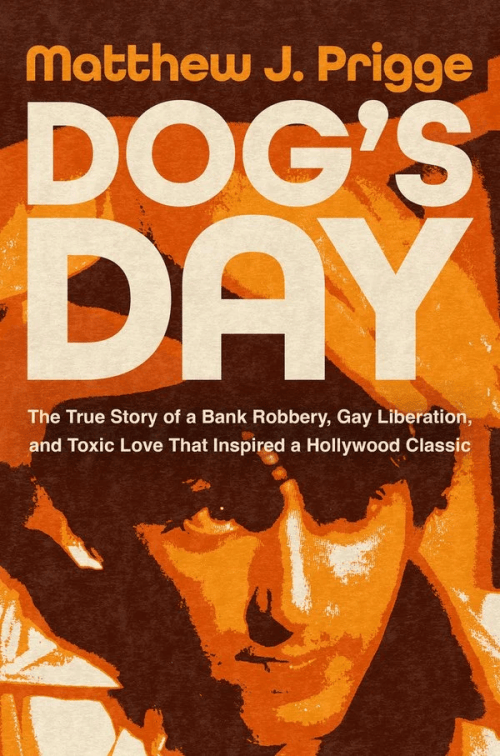
NONFICTION
Dog’s Day
By Matthew J. Prigge
Counterpoint
Published September 29, 2026


