


The 250th anniversary year of the United States Declaration of Independence puts one in a frame of mind to reflect on what we consider American values. For some, those values include hard work, innovation, and owning land. For others, the same qualities can devolve into relentless greed, get-rich-quick schemes, and exploiting people and the earth. American realist and Chicago-born author Frank Norris (1870-1902), whose 1903 novel The Pit: A Story of Chicago has just been reissued, is among those to caution against too much of a presumed good thing.
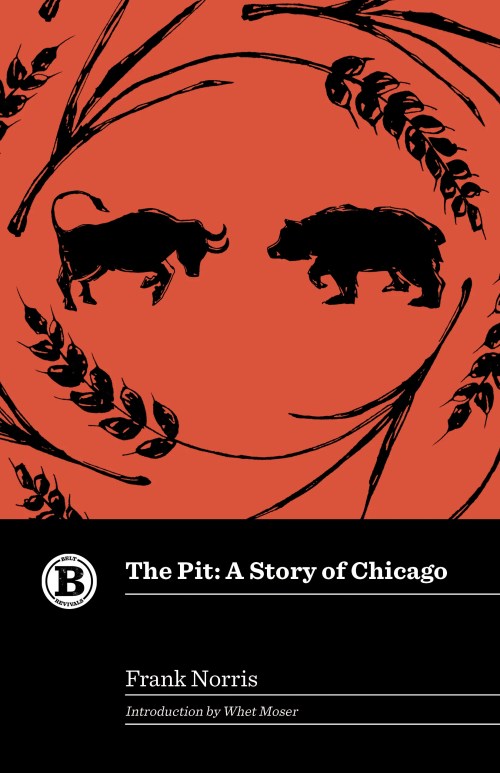
Norris is best known for The Octopus: A Story of California (1901), which critiques the railroad industry’s mistreatment of California ranchers. The Pit was published two years later as part of a planned trilogy he called “The Epic of the Wheat.” These three stand-alone novels were meant to explore—respectively—the production, distribution, and consumption of wheat, though Norris died before writing the final book. When it comes to novels of the era addressing social issues, readers will likely be more familiar with Upton Sinclair’s The Jungle (1906) than The Pit. Belt Publishing’s illustrated reissue of the book, which includes an introduction by New York Times news briefings editor Whet Moser, is likely to generate new interest in Frank Norris.
The Pit follows self-made Chicago real estate mogul, Curtis Jadwin, as he speculates on the grain market. The pit in question represents both a physical space at the Chicago Board of Trade and the metaphorical pit that sucks in men of the time who sought to corner the market and get rich overnight. A mere 5 years prior to the book’s original publication, businessman Joseph Leiter tried to corner the wheat market and lost between $5 and $10 million when his adversary, meatpacking industrialist Philip Armour, stockpiled grain in his Goose Island warehouse.
Chicago’s Board of Trade was established in 1848 and its physical building—demolished in 1929 to make way for something more modern—became a dynamic space for commodities exchange. In the last decades of the 19th century, those who gained the greatest riches also took the greatest risks. In the pit, speculators exchanged gossip and strategized to drive up the price of grain, control its trade, then sell it back to market at outrageous prices. In the 1897-98-multimillion-dollar incident, Leiter lacked Armour’s means for storing grain until it could be sold at an inflated price.
Belt Publishing’s reissue enhances The Pit’s realism with the inclusion of 13 illustrations and photographs from the era. Among these are street scenes, photographs of the original Board of Trade Building, the Auditorium Theatre, and the Archbishop’s house at North Avenue and State, which served as a model for Jadwin’s mansion.
The book’s romantic plotlines may surprise readers. In fact, readers’ first glimpse of Curtis Jadwin is from the perspective of young Laura Cressler as she waits for friends in the Auditorium’s lobby. She is attracted to him even as she contrasts him against her other suitors. In his introduction, Whet Moser asks, “How did I end up in a Jane Austen novel?” Similarities between Austen and Norris are superficial at best; namely, Laura is an orphaned young woman with a finite inheritance who is concerned about her livelihood and that of her sister. While I was surprised to discover The Pit’s inclusion of romance, more surprising was the contrast between Norris’s realist descriptions of commerce and the city and the almost comical melodramatic voice he deploys to explore matters of the heart. Consider this exchange between two people who have circled each other for years without moving beyond friendship:
“It is not too late. Listen—listen to me.”
“Oh, why weren’t you a man, strong enough to know a woman’s weakness? You can only torture me now. Ah, I hate you! I hate you!”
“You love me! I tell you, you love me!”
Moser notes in the introduction that Norris was a vocal proponent of romantic fiction and felt that, unlike realism, it “belongs to the wide world for range.” One does wish however, Norris had found less inspiration in the era’s popular stage melodramas and more in Jane Austen. Austen’s heroines, like Norris’s Laura, are frequently concerned with financial stability. Yet Norris lacks Austen’s brilliant handling of the themes of love and money. Norris’s loverly dialogue sounds silly to modern ears. Moreover, his lovers tend towards self-centeredness. For example, Laura’s younger sister describes the self-sacrifices she plans to make for her future husband in terms laden with self-righteousness. Then again, what could be a more American realist approach to money and love than an emphasis on acquisitiveness and the self?
This reissue of The Pit is a welcome snapshot of an earlier time demonstrating what has changed and what has remained the same in the US and Chicago, a place Norris calls the “Heart of the Nation.”
Here, of all her cities, throbbed the true life—the true power and spirit of America; gigantic, crude with the crudity of youth, disdaining rivalry; sane and healthy and vigorous; brutal in its ambition, arrogant in the newfound knowledge of its giant strength, prodigal of its wealth, infinite in its desires.
Frank Norris’s The Pit: A Chicago Story is an excellent reminder that individualism and engaging in morally dubious behavior for financial gain are as American as apple pie.

FICTION
The Pit: A Story of Chicago
By Frank Norris
Belt Publishing
August 25, 2026


