


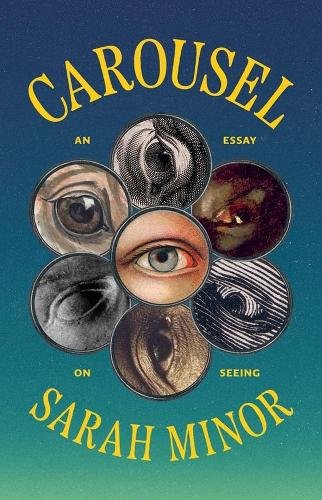
The design of the first motion-picture camera was based on the machine gun. This is the type of revelation that gives reading Sarah Minor’s Carousel: An Essay on Seeing the sensation of touring a museum of illusion. Minor’s eccentric prose and quick leaps in thought may induce a kind of vertigo. While the object in view may reappear almost as before, it’s been altered by a shift in our perception.
It’s not unlike what happens when we experience or witness violence. The threat of it becomes a new shadow across every face and object. As writer Myriam Gurba puts it in the context of sexual violence, “Everything takes on a new hue, the color of rape. You look at the world through rape-tinted glasses.” In Carousel, the glasses are tinted the color of empire. Through these frames, Minor sees a sequence of violence pulsing beneath our pursuit of seeing. She has clearly wrestled with the ethical and craft questions of writing about violence in nonfiction: How to depict it without replicating it, without reducing it to spectacle? Her answer: “To depict violence as sequence, not as pinnacle, disrupts a chronology without direction; makes instead the portrait of the violator.”
The premise of Carousel is a lecture on the history of the panorama. Beginning with the medieval Bayeux Tapestry, a 225-foot-long embroidered narrative of the Norman Conquest of England, Minor picks up the thread of the panorama’s most well-worn debate: whether ancient works like the tapestry are related to the digital vistas of the iPhone, “whether there exists a continuous attempt at seeing tied to an inherent, human need for overview.” She travels through an impressive expanse of art history, alternating between panoramas, whose landscapes are dominated by military conquest, and works that challenge the dominant overview of history. Take René Magritte, whose surrealism punctured the idea of an objective reality amid the world-shattering of world wars, or Ana Mendieta and Kara Walker, whose silhouettes reclaim or intervene in colonized landscapes.
I want to stress that Carousel, as its title suggests, is also fun, even funny. Minor confesses she “began seeking illusions before she could speak,” and her delight in seeing something anew, if only for a moment, is tangible. She is disappointed and relieved when a man “with a head that is five times the height of a human skull” is revealed as a normal-sized man, a trick of the light. In her role as professor, she is aware she is playing a game for her students’ attention, one of screen vs. screen. She notices one student squinting at 104 tabs, another’s microbangs glowing from the phone in her lap. Her choice of third-person perspective creates the observational distance that gives humans trying to connect the quality of aliens awkwardly gesturing at each other as lingua franca.
Minor doesn’t hide behind style or form, either. When she steps into first person in the book’s intermission, “(stab),” she brings us into the world of her grandfather, nicknamed Sky for his days as a pilot. Sky sees what could be a Magritte painting from Minor’s slideshow. He sees a hole in his dog, sees “blue right through her.” Sky has Lewy Body Dementia. At the disease’s ugliest, he threatens his daughter and nurse with knives. In this departure from the lecture, Minor poignantly witnesses the devastation of losing one’s perspective. And this is the book’s central concern—perspective, and the dangers of its collapse.
“The legacy of the panorama is the flattening of potentially different perspectives,” writes Minor. It is an attempt at a godlike perspective. It’s like what AI spits out at us.
Recognized for troubling the relationship between the visual and the literary, Minor is an exciting formal experimenter. While her choice of academic slide lecture in Carousel may sound old-fashioned or, less generously, boring, it counters the viewing and processing of the social media feed, that flattener. It slows the onslaught of images and information that are said to define our contemporary human condition. By translating images into text in a book and placing them in critical context, by embodying the sharing and receiving of these images and carefully crafting their sequence, Minor has spun a lyric, almost anthropologic essay not only about seeing but also the technologies—paintings, books, cameras, drones—we use to see and be seen.
The question I’m left with is not whether we will always pursue overview. Throughout our pursuit of expanded vision, there were many cases of protest. In the eighteenth century, the London mill housing a panorama of the city was burned to the ground. Upon seeing the first hydrogen balloon, a mob of French farmers shot down the balloon with pitchforks, scythes, and rocks. The question I’m wondering, turning over this book in my hands, is am I holding a tool or a weapon?
And which one do we need now?
NONFICTION

Sarah Minor
Yale University Press
Published on July 21, 2026


