


In the eight years that I’ve lived in Chicago, I’ve inhabited four different apartments (five if you count my freshman year dorm room). For a period of time, it felt like every year and a half I was packing my trinkets into bins, rolling suitcases of winter sweaters and summer dresses from one neighborhood to the next. First, I lived in a haunted second-floor apartment on Roscoe Street with an actual hole in the wall that the landlord had covered with a paper plate to stop soot from spilling out. After that, I spent two and a half years in a beautiful three-flat off of Southport with a rooftop you could hear Wrigley Field from, followed by a one-year stint in Roscoe Village where wild neighbors and the thinnest ceilings and floors known to man made for a horrendous few months of sleep. For the last two years, though, I’ve lived in a somewhat run-down but nevertheless sunny top-floor apartment in Ravenswood, adorned with yellowish string lights and colorful paper chains, with neighbors who turned the back porch into a makeshift greenhouse. It is a house, I suppose, but it’s more so a home.
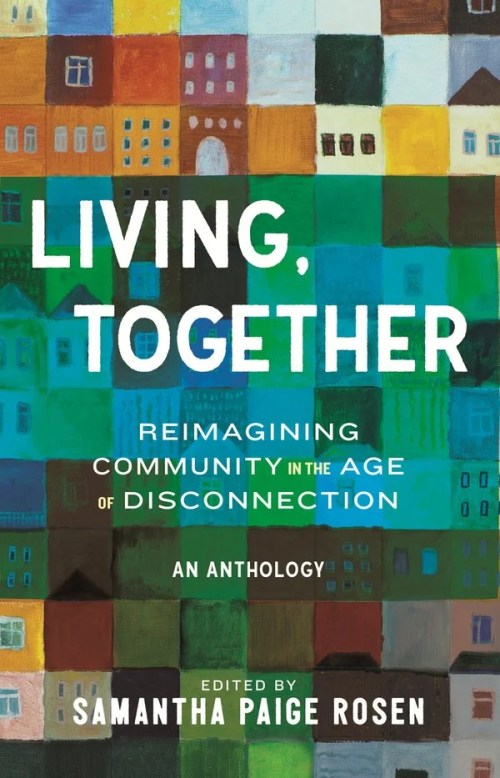
Samantha Paige Rosen’s debut, Living, Together: Reimagining Community in the Age of Disconnection, begs the question: what makes a home? Is it a shared loft apartment in Brooklyn with no closet space but a fire escape you can smoke on? Perhaps it’s a three-bed Cape Cod build in the suburbs with a white picket fence and a nuclear family. Or maybe, the idea of a “home” is just as fluid as the lives of the people who inhabit it.
Living, Together pulls together essays and Q&As from twenty-one writers and organizers of different ages, genders, races, and socio-economic statuses. Split into three sections: “Family Homes,” “Intentional Communities,” and “Beyond Housing,” Rosen seeks to reconfigure preconceived notions regarding sharing space, communal living, and collective care. Each contributor shares their unique experience with some form of cohabitation, whether that be in residences shared with family, lovers, friends, and/or strangers, in intergenerational neighborhoods like Hope Meadows (featured in “Q&A with Hank Gamel and Fran Biederman”), in chosen families, or in organizing groups. In each contribution, though, there is a through line: a “home” is not defined by drywall, crown molding, or property lines. Instead, “home” is rest. It’s stability and comfort, watching your loved ones grow old, and really, truly knowing your neighbors. It’s growing vegetables to use at communal dinners, picking up your friend’s child from school, and building community despite the challenges that come with doing so. It’s safety, the ability to live and love freely, having pride in your culture and honoring the generations who came, sacrificed, and suffered before you. “Home” is in the people you love and care for, and who love and care for you back.
Furthermore, Living, Together also makes the point that the concept of a “home” is innately political. Ultimately, the land on which we cultivate communities and build our homes is land that was previously inhabited and then stolen. We live in a socio-political system that advances by making Black, Brown, and Indigenous individuals continually feel displaced. Modern-day ideas of an “ideal family” should appear as purport capitalist, racist, and classist rhetoric. But as Amanda E. Machado explains in their essay, “The Myth of Stable Ground,” creating a home is resistance. It is the act of making oneself known despite the threat of violence and erasure, and it is the commitment to growing, loving, and living authentically.
As editor of the anthology, Rosen has curated a richly singular and moving collection of stories and conversations. While essays such as, “You and I Were Roommates Once” by Adam Vitcavage, “Returning to Ospaye” by Rodney M. Bordeaux, and that of Amanda Machado’s mentioned above were personal standouts to me, not one contribution feels out of place or subpar. In fact, each story seems to be integral to the anthology’s seamlessness as a whole.
In a single word, Living, Together by Samantha Paige Rosen is hopeful. Each writer’s contribution— though sometimes harrowing, other times beckoning, and often joyous—asks readers to lead with empathy, yes, but also idealism. We can exist and love in any way we can dream up—we just have to expand the walls that confine us.

In the last eight years, I’ve inhabited four different apartments. Through each of these, I’ve carried something with me—my best friend and roommate. Whether it was a sooty Wrigleyville three-flat, a brownstone with big, beautiful built-ins, a noisy short-term lease, or a quaint, colorful top-floor two-bed, she’s stayed with me. In living together, we’ve built ourselves a home in each other.
Nonfiction
Living, Together
Edited by Samantha Paige Rosen
Beacon Press
Published July 14, 2026


