


I connected with Yu-Mei online last year as we both are members of Grubstreet, where she teaches writing workshops. We spoke about our upcoming novels, the writing, and the publication process. Yu-mei is a Singaporean author, living in Boston where she first worked as a bookseller at Papercuts Bookshop. Her short fiction has received a Pushcart Prize special mention and been shortlisted for the Commonwealth Prize.
I met Yu-Mei for the first time at AWP26 in Baltimore. After our greetings, she modestly pulled out an advance copy of her debut novel. I glanced at the stunning yellow and orange cover with the peeking eyes. I knew I had to read the book.
In Names Have Been Changed, Yu-Mei Balasingamchow explores 38-year-old Ophir’s story in the form of a podcast. This thrilling narrative takes us through London, Tokyo, and America with the story of an immigrant who is on the run from a crime she never set out to commit. Ophir’s fearless voice and her courage to find her next exciting adventure takes us far from home, and yet brings us back to the people we have grown up loving.
Yu-Mei and I met on Zoom to discuss her beautiful prose, the research process, character arc, and the time it took her to write the book. We also spoke in detail about the unusual structure of the novel.
This interview has been edited for length and clarity.

Chital Mehta
You begin this novel with a podcast episode. Tell me how this came about. How did you come up with that idea, and how did you execute this?
Yu-Mei Balasingamchow
Names Have Been Changed is told in the form of podcast episodes in the voice of the main character, Ophir, who will not tell you her real name. The character came to me first, before the concept. It was a voice in my head, a woman who’s been on the run for ten years, and I was trying to figure out who she was. Very soon I realized she’s kind of an accidental fugitive. She actually had quite a good life in Singapore before she left. She’s the youngest in a big family, she has lots of friends. She likes to go out and be the center of attention, and then she gets mixed up in a crime. Things go south rapidly.
One day, she flees the country, and suddenly she’s cut off from everyone she knows and everything she loves—what does she do now? That question really absorbed me. I was also wondering, what is prompting her to speak now? She has found out her father has died, and she has no way of connecting with her family. And it’s 2020: the world suddenly goes into lockdown. She’s even more isolated. All this internal pressure is building, and she needs to let it out. She lands on the idea of making a podcast. People can hear her, but nobody knows where she is, so she’s still safe, and she can bare her soul, which she needs to do.
It gave me a systematic way of thinking about how she would tell her story. Once a week she comes home from work, she turns on the mic, and she talks until she feels like stopping. She doesn’t want it to be edited, because she says, “I just need to speak my mind and live with it.” And then about two thirds of the way into the book, other things start to happen as a result of people paying attention to this podcast.
Chital Mehta
Take me through the process of the character arc behind Ophir. What was your process in getting to know her?
Yu-Mei Balasingamchow
Ophir’s voice is very intense and urgent. In the course of writing the first draft, and subsequently when I was revising, I was trying to capture the intensity that kept pushing the sentences forward. Ophir has a lot to say! And she’s driven by deep-seated feelings that I think many of us can identify with: wanting to be with our loved ones, yearning for what we’ve inadvertently lost, fearing we’ll lose the little autonomy we have. It also became important that Ophir’s telling of the story would not only activate old memories but also trigger something that would change her future.
We assume reminiscing about the past is pleasurable, but for Ophir it’s very visceral and unsettling. Some of these memories are painful, or she realizes she could’ve done things differently, and maybe then she wouldn’t be quite so alone. The podcast is the first time she’s finally reflecting on why she did what she did. She’s very vulnerable. The retelling becomes a rather rigorous, unflinching experience. She puts herself under a microscope and doesn’t look away.
Chital Mehta
Your book has references to culture and food throughout. How did you balance using cultural references? Were you ever worried about how it would come across to your readers?
Yu-Mei Balasingamchow
Food is a universal touchstone for people, especially people who live away from where they were born. Ophir is not actually crazy about food. That’s partly because she’s living such a pared down existence that her primary concerns are: how much money do I have? Am I earning enough? Am I going to have enough food?
But even if Ophir doesn’t go searching for it, there are moments when it presents itself and triggers a memory. For example, when she is a caregiver in the home of a Malay family. Ophir’s grandmother was Malay, so unwittingly, when she eats some of their food or looks at some of the things in their house, she’s unconsciously thinking about home. It’s having an effect on her. When she’s working at a Chinese restaurant in London, she runs into her old friend from school who orders the same dish all the time to provoke Ophir. The dish is Singapore fried noodles with what Ophir calls the ridiculous turmeric and vegetable scraps and shrunken prawns. She can’t help but be disgusted with the order.
Chital Mehta
Names Have Been Changed takes place in various settings across countries. Take me through your research process.
Yu-Mei Balasingamchow

I actually did not do a ton of research, because in the past, with other novels that I tried to write, I got so absorbed in the research that it derailed the writing. Ophir’s voice was so urgent that I didn’t want to lose this energy. I decided to use places that I’ve visited like Tokyo, London, and Colorado. Then I thought about where she could hide and came up with completely fictional settings. The hostess bar in Tokyo. The Chinese restaurant in London where she works for some time—it’s a loving homage to all the Chinese restaurants I’ve been to around the world.
I did more research when Ophir encounters a character who is a political exile. There are exiles from Singapore who left in the 1970s and 1980s, some more recently, because they were unfairly harassed and targeted for disagreeing with the government. They’ve lived abroad for decades, unable to return. I did enough historical research to do justice to the character of the exile, to make her feel like she could have existed from that time.
Chital Mehta
How many drafts did it take to complete the novel?
Yu-Mei Balasingamchow
I don’t remember the number but it took three and a half years, which by my standards is really fast. I’m usually a much slower writer. I took a year and a half to write the full first draft. I have two previously uncompleted novels where I had basically lost the fire, so I was desperate not to lose it again. Ophir’s emotional urgency was also driving me. After I had a full first draft, I spent another two years doing revisions while querying agents.
The basic skeleton of the novel hasn’t changed since the first draft. She starts with the crime that triggered it all, then she takes you on her journey to various places. The main characters she meets have not changed, nor have the broad themes: what does home mean? How do you access an idea of home if you can’t go there? Some of the characters she meets, who are also Singaporean, they’ve left home for different reasons, but like Ophir they’re constantly on the move. All these characters are trying to make sense of where they are now and of their relationship with their home country. Home is a fraught place for them, but they can’t stop thinking about it.
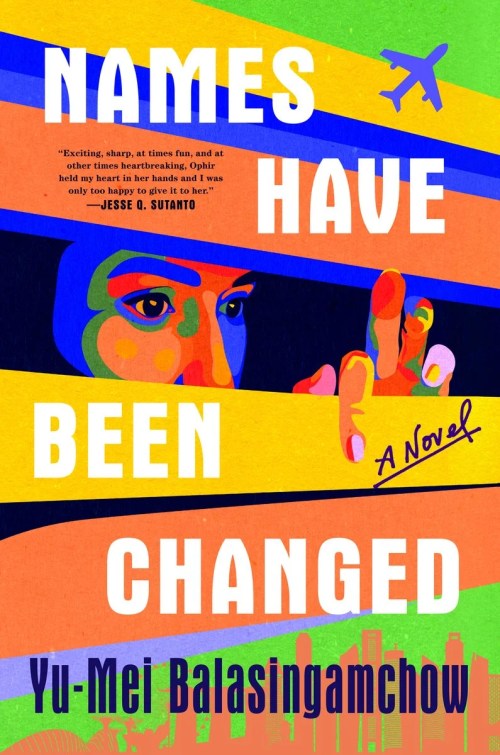
FICTION
by Yu-Mei Balasingamchow
Tiny Reparations Books
Published on June 23, 2026


